SOSTAC and RACE planning guide
Info: 6878 words (28 pages) Study Guides
Published: 23 Mar 2026
Need help with a undergraduate or MBA marketing assignment? We can help! Our UK-qualified marketing experts are ready to assist. Visit our marketing assignment help page now for more info.
In the dynamic field of marketing, structured planning is not just a bureaucratic exercise. It is a critical success factor.
A well-structured marketing or campaign plan links marketing efforts to broader business goals. It also provides a clear roadmap for execution and measurement (Guerrero, 2024).
In practice, using a proven framework helps ensure no key element is overlooked. It also helps make sure all activities serve an integrated strategy.
Frameworks like SOSTAC and RACE have gained widespread recognition for their clarity and effectiveness. They are even recommended by the Chartered Institute of Marketing (CIM) for both professional practice and student assignments (Chaffey, 2022). Indeed, SOSTAC was voted among the top three marketing models by industry leaders for its logical structure and real-world results (Professional Academy, 2025).
For management students, mastering these frameworks can provide a solid foundation for developing marketing plans that are both comprehensive and persuasive. It encourages disciplined, step-by-step thinking, from initial analysis through to ongoing control. This keeps campaigns grounded in insight and aligned with objectives.
In short, structured planning matters because it brings clarity, accountability, and strategic focus to marketing efforts. That is invaluable in both academic contexts and business practice.
Planning frameworks: SOSTAC and RACE
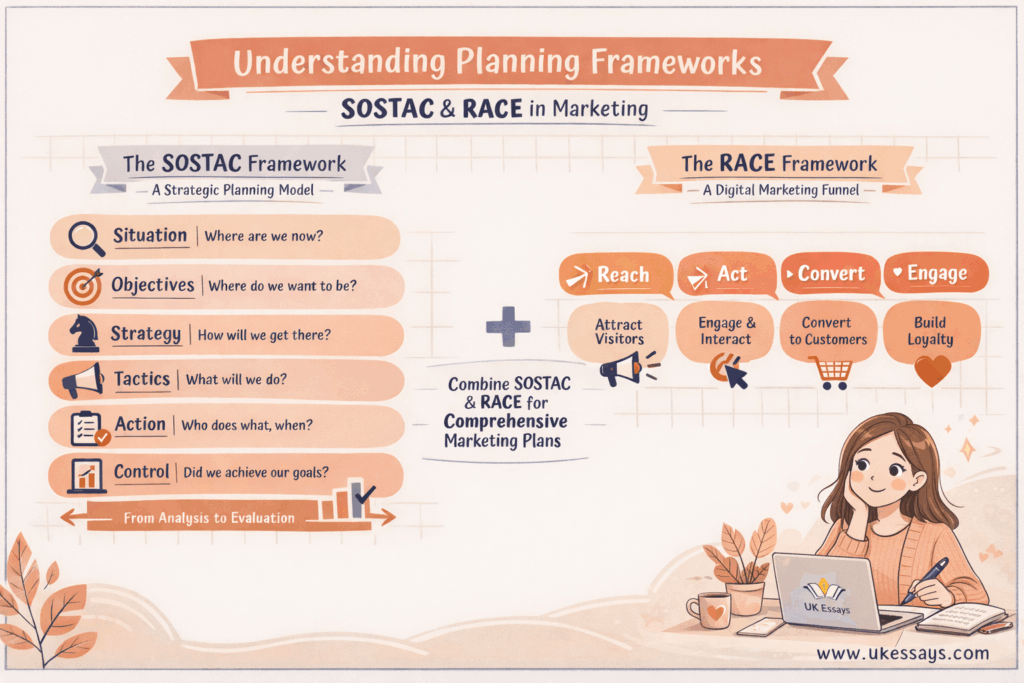
To bring order and consistency to the planning process, marketers often rely on established frameworks. Two of the most popular are SOSTAC® and RACE.
Each serves a distinct purpose. SOSTAC provides an overall planning structure, while RACE focuses on the digital marketing funnel and customer journey.
Used together, they can help managers and students create robust marketing plans. These plans can cover both high-level strategy and on-the-ground execution.
SOSTAC: Situation, Objectives, Strategy, Tactics, Action, Control
The SOSTAC framework, developed by PR Smith in the 1990s, is a classic model for marketing planning (Smith, 2011). The acronym stands for Situation, Objectives, Strategy, Tactics, Action, and Control.
These are the six stages of the planning cycle. SOSTAC prompts planners to address key questions in a systematic way. Where are we now? Where do we want to be? How will we get there? What specific steps will we take? Who does what, and when? Finally, did we get there? (Chaffey, 2023).
The Situation stage involves assessing the current environment and company position. Next, Objectives define where the plan is heading. Ideally, these are SMART goals, discussed below.
The Strategy outlines the overall approach for achieving the objectives. This includes decisions on target markets and positioning. Then, Tactics cover the specific marketing mix and campaigns needed to implement the strategy.
Action refers to the execution plan. This includes the timeline, responsibilities, and processes needed to put the tactics into practice. Finally, Control establishes how results will be measured and evaluated against the objectives (Professional Academy, 2025).
SOSTAC’s strength lies in its clarity and completeness, it ensures that a plan covers analysis through to evaluation in a logical sequence.
It is also a flexible framework. That can be applied to almost any marketing plan, whether for a full business strategy or a focused campaign.
Notably, CIM and other professional bodies recognise SOSTAC as a top-tier planning methodology because of this crystal-clear logic (Chaffey, 2022). By following SOSTAC, students can structure assignments in a way that examiners find easy to follow. It helps them cover all necessary components, from situational research to measuring success.
RACE: Reach, Act, Convert, Engage
While SOSTAC gives the overall planning structure, the RACE framework focuses on the digital marketing funnel and customer lifecycle (Chaffey, 2023). RACE stands for Reach, Act, Convert, and Engage.
It outlines the key stages a customer goes through, from initial awareness to post-purchase loyalty. It also aligns marketing activities and KPIs to each stage.
Reach and Act
In the Reach stage, the aim is to build brand awareness and visibility. Marketers use channels like search engines, social media, and advertising to reach potential customers and drive traffic (Chaffey, 2023).
Next is Act, short for Interact. Here, the focus is on engaging the audience and prompting an action. For example, this might mean encouraging a site visitor to sign up for a newsletter, download a resource, or otherwise show interest.
This stage often involves compelling content, interactive tools, or strong calls to action. These move prospects closer to conversion.
Convert and Engage
The Convert stage is where prospects become customers. This stage is all about driving the actual purchase or conversion. That could be an online sale, but it might also be an offline conversion, as RACE is often applied to multi-channel contexts.
Finally, Engage focuses on post-purchase engagement. The goal is to build a long-term relationship that increases customer satisfaction, loyalty, and advocacy.
Tactics here might include personalised follow-up emails, loyalty programmes, social community building, and excellent customer service. The aim is to turn one-time buyers into repeat customers and brand advocates.
Why RACE is valuable
Importantly, RACE is a metrics-driven framework. It encourages setting specific performance indicators at each stage. These might include website visits for Reach, lead form conversions for Act, sales revenue for Convert, and repeat purchase rate or customer satisfaction scores for Engage (Chaffey, 2023).
The RACE model is particularly valuable in digital marketing planning because it ensures that all parts of the customer journey are addressed. It also creates a continuous loop of engagement beyond the sale.
It helps marketers avoid focusing only on customer acquisition. Instead, it places equal emphasis on retention and lifetime value.
For management students, RACE offers a customer-centric way to structure the tactical sections of a marketing plan, especially where online channels or integrated campaigns are involved. In summary, where SOSTAC gives the broad planning steps, RACE zooms in on campaign execution and lifecycle management. That makes the two frameworks highly complementary.
Step-by-step planning guide using SOSTAC and RACE
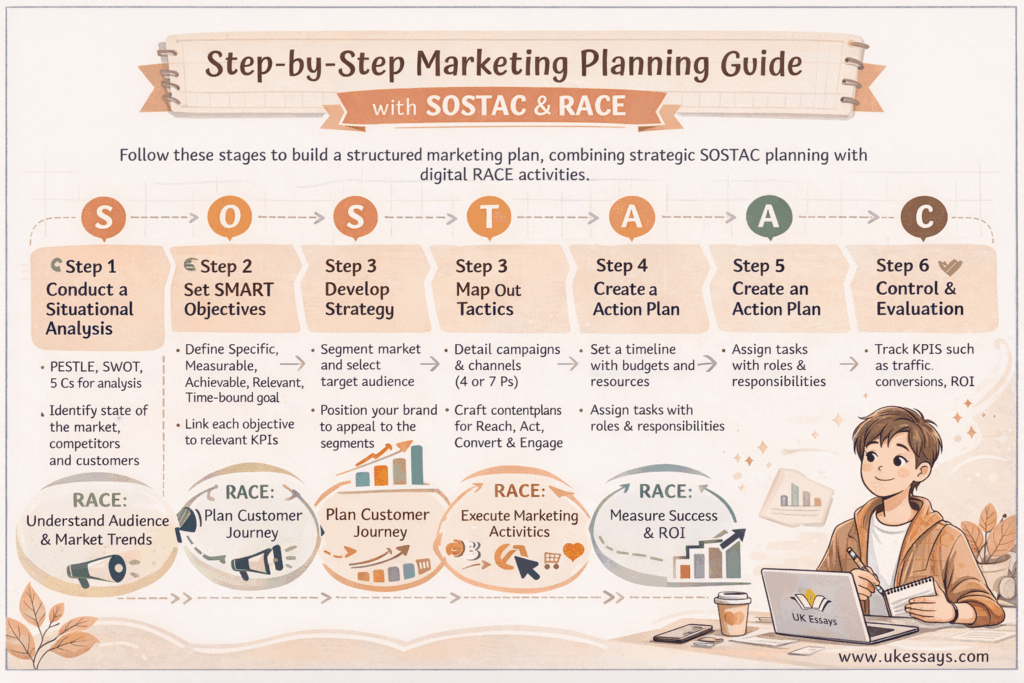
With an understanding of SOSTAC and RACE, we can now walk through a step-by-step guide to building a structured marketing plan. The following steps follow the SOSTAC order, from Situation to Control, and show how RACE can be incorporated within those stages.
This approach ensures that strategic thinking is tightly integrated with tactical execution. In other words, big-picture goals and strategy stay connected to channel plans and customer journey activities.
Each step below includes best practices and considerations for students writing assignments, as well as marketers developing real campaigns.
Conduct a situational analysis
Start by analysing the current situation. In other words, establish where things stand now.
A solid situational analysis sets the foundation for the rest of the plan. It provides data-driven insights into the internal and external environment (Kotler and Armstrong, 2018).
There are several frameworks that can help structure this analysis. At the macro-environment level, a PESTLE analysis reviews external factors. These include Political, Economic, Social, Technological, Legal, and Environmental trends that may affect the organisation’s marketing (Kotler and Armstrong, 2018).
This helps identify big-picture opportunities or threats, such as regulatory changes, economic shifts, new technologies, or consumer behaviour trends.
At the micro-environment level, tools like the 5Cs or the 5 Forces can assess more immediate factors. These include Company, Customers, Competitors, Collaborators, and the wider context or industry conditions.
The situational analysis often culminates in a SWOT matrix. This summarises the organisation’s internal strengths and weaknesses, alongside external opportunities and threats (Chaffey, 2022).
Using insight to shape strategy
This SWOT synthesis is extremely useful for informing strategy. It highlights where the company can leverage strengths or must overcome weaknesses. It also flags external openings to exploit or dangers to mitigate.
For example, if the analysis shows a competitor pulling ahead in social media engagement, that may be a threat that requires a response. If there is a growing segment of eco-conscious consumers, that may be an opportunity to target with green messaging.
In academic assignments, it is important to show evidence of situational insight. Include relevant data such as market share figures, customer research, or competitor case studies to support your points.
By thoroughly understanding where we are now, you set the stage for realistic objectives and a strategy grounded in reality.
Avoiding common pitfalls
A common pitfall is spending too much time on analysis without purpose. It is crucial to keep the situation analysis focused on information that will later inform decisions (Chaffey, 2023).
Rather than reviewing every possible factor, concentrate on the key drivers in your market. Also focus on how your brand compares to competitors on those dimensions.
Some experts recommend using a TOWS matrix, a variant of SWOT, to connect findings directly to strategic implications. It does this by pairing internal factors with external factors to generate strategic options (Chaffey, 2023).
Whether or not you use TOWS, the main goal is to move smoothly from analysis to action. The insights gained here should clearly lead into the objectives and strategy that follow.
As a final point, remember that situational analysis is not a one-time task. It is wise to keep monitoring the environment as the plan unfolds, so you can adapt if conditions change.
Set SMART objectives with clear KPIs
After understanding the situation, the next step is to define your objectives. Where do you want to go?
Objectives state the outcomes the marketing plan aims to achieve. They must be well defined, because they guide the strategy and provide the yardstick for success.
The widely accepted best practice is to use SMART objectives. That means they are Specific, Measurable, Achievable, Relevant, and Time-bound (Doran, 1981).
In practical terms, each objective should be concrete and numeric where possible. It should also be tied to a timeline and aligned with higher-level business goals.
For example, a SMART objective might be: “Increase online sales revenue by 15% in the UK market within the next 12 months”. This is specific, measurable, and time-bound. It is also presumably achievable and relevant, based on the situational analysis.
By contrast, a vague objective like “Improve brand awareness” would not pass the SMART test without more detail. How much improvement is needed? By when? Measured by what metric?
In a marketing plan, you may set multiple objectives across different areas. These might include sales targets, market share growth, customer acquisition numbers, or engagement goals.
Dave Chaffey suggests considering a range of objective categories such as the 5 S’s. These are Sell, Serve, Sizzle, Speak, and Save (Chaffey, 2023).
Using these categories helps create balanced objectives. It ensures you cover both financial outcomes and customer relationship goals.
Linking objectives to KPIs
Equally important is linking each objective to Key Performance Indicators (KPIs) and measurement methods. In other words, define how you will know if the objective has been achieved.
For example, if the objective is to increase website traffic by 20%, the KPI might be monthly unique visitors measured through Google Analytics.
It is good practice to outline the metrics and tools for monitoring alongside the objective statements (Chaffey, 2023). This close link between objectives and control is a hallmark of professional planning.
It also helps you assess whether the target is realistic and how progress will be tracked. When writing assignments, explicitly stating KPIs and intended data sources can demonstrate a thorough and controlled approach.
For example, you might state that customer satisfaction will be measured through Net Promoter Score surveys each quarter. That shows accountability and a willingness to adjust tactics based on real data.
Finally, make sure objectives are prioritised and aligned with the situational analysis. They should address the key issues or opportunities identified earlier.
For example, if your SWOT revealed a weakness in customer retention, one objective might be to improve repeat purchase rates by a specific amount.
Set a limited number of clear objectives rather than too many. This keeps the plan focused.
In summary, SMART objectives with concrete KPIs set a destination for the strategy and create accountability. They provide a direct link between the plan’s ambitions and its evaluation.
Develop the strategy (segmentation, targeting and positioning)
With objectives in place, attention turns to strategy. How do we get there?
In the SOSTAC framework, strategy is the high-level roadmap that guides which tactics and actions are chosen. It is about making core decisions on who you will target, what you will offer, and how you will approach the market to achieve your objectives (Kotler and Armstrong, 2018).
A central part of strategy is segmentation, targeting, and positioning (STP). First, marketers segment the market into distinct groups with similar needs or characteristics.
Next, those segments are evaluated and one or more are targeted. These should be the groups that best align with the product or service and offer the strongest opportunities.
Once a target segment is selected, you craft a positioning strategy. This defines how you want your brand to be perceived by that audience relative to competitors (Kotler and Armstrong, 2018).
For example, after segmentation you might target tech-savvy young professionals. You might then position your product as the most innovative and convenient solution in the category.
Shaping the overall strategic approach
Strategy also involves deciding on the overall campaign approach. Will you compete on price, or differentiate on quality and service? Will you focus on personalised marketing, or aim for broad mass marketing?
These choices should flow logically from your earlier analysis and objectives. If the objective is aggressive growth, you might pursue a strategy of capturing market share in a niche before expanding outward. If the objective is improved profitability, the strategy may emphasise customer retention and lifetime value.
When integrating RACE, the strategy stage is also where you decide which parts of the customer journey to prioritise. You also consider how resources should be allocated across Reach, Act, Convert, and Engage (Chaffey, 2020).
For instance, a strategic decision may be that you need to grow brand awareness among a new demographic while also improving e-commerce conversion rates. These priorities will guide the tactics chosen in each RACE stage.
This is also the point where you consider channel strategy. How will online and offline channels work together? Will you adopt a digital-first strategy? How will traditional marketing support digital touchpoints in a seamless multichannel experience?
For example, your strategy might outline that digital content marketing will drive initial awareness and engagement. Email nurture campaigns and targeted promotions might then be used to convert leads into sales. Finally, a loyalty programme and social community management could be used to engage customers after purchase.
All these broad decisions form the strategic blueprint.
Justifying strategic choices
A strong strategy section in an assignment should clearly justify these choices. In academic work, it is important to explain why certain segments were chosen and why your positioning is likely to succeed, based on the situation analysis.
This often means referring back to consumer insights or competitive dynamics identified earlier.
For example, you might say that Segment X was chosen because it is underserved by competitors and aligns with your product’s strengths. You might also argue that a cost-effective positioning exploits a market gap in a category dominated by premium-priced rivals.
By linking back to your analysis, you demonstrate strategic coherence. In sum, the strategy step is about making the big planning decisions that shape the rest of the plan. It defines the target audience, clarifies the unique value offered, and sets the overall game plan for achieving the objectives.
Map out tactics (marketing mix and channel plans)
Once the strategy is defined, it is time to design the specific tactics that will implement it. This is where the plan becomes more granular and practical.
Tactics are the precise marketing activities, tools, and initiatives used to execute the strategy and meet the objectives.
In many ways, this corresponds to the classic marketing mix. This is often summarised as the 4 Ps: Product, Price, Place, and Promotion. In services, it may be extended to the 7 Ps by adding People, Process, and Physical evidence (Kotler and Armstrong, 2018).
In the tactics section, you outline what you will actually do in each area.
Under Product, for example, will any features be adjusted or emphasised to appeal to the target segment? Under Price, will you use promotional pricing, volume discounts, or a premium pricing strategy?
Place concerns distribution and channels. How will you make sure the product is available to the target audience, whether through direct online sales, retailers, or an app?
Promotion is often the largest part of the tactics section. This covers communication and advertising plans, which may include digital campaigns, content creation, social media, search engine marketing, PR events, or influencer partnerships.
Applying RACE to tactical planning
It is often helpful to present an integrated communications plan. This should show which channels and messages will move customers through the RACE stages (Chaffey, 2020).
For example, a Reach tactic might be an Instagram advertising campaign aimed at young adults. An Act tactic might be a series of engaging blog posts or webinars that encourage prospects to spend more time with the brand.
For Convert, you might use an email remarketing campaign offering a limited-time discount to users who abandoned an online shopping cart. For Engage, you might schedule personalised follow-up emails, loyalty discounts, or community-building activities on a forum or social platform.
When mapping tactics, each one should clearly tie back to the strategy and objectives. One way to ensure this is to create a table or matrix showing the relationship (Chaffey, 2023).
For example, you could list each objective and then identify the tactics that support it, along with the responsible person and KPIs. This helps confirm that every objective has enough tactical support and that no major tactic exists without a strategic rationale.
In academic work, markers will look for a coherent line from objectives to strategy to tactics. Avoid the mistake of throwing in every marketing idea you can think of.
Tactics should be chosen and justified. It is better to propose a few well-chosen tactics in the right places than to present an unfocused list of activities.
Budget, content and tactical coverage
It is also in the tactics section that budgets and resources begin to matter. You might outline how the marketing budget will be allocated across channels or campaigns.
For example, part of the budget may go to digital ads, part to content marketing, part to events, and part to social media management. The exact split will depend on the plan.
Make sure the allocation reflects the priorities stated in your strategy. If digital Reach is a priority, it should receive a meaningful share of the budget.
Also consider the content mix and calendar. For instance, you may specify a monthly blog, weekly email newsletter, daily social posts, or quarterly white papers, depending on what fits the plan.
An actionable content calendar can be a useful appendix item. This level of detail shows that you have thought through implementation over time.
Finally, when integrating RACE, make sure your tactics cover all stages of the customer journey. The framework can act as a checklist. Do you have tactics to generate Reach? How will you prompt Action? What is the plan to Convert interested leads? How will you continue to Engage customers after conversion?
For each stage, assign specific tactics and metrics. This not only adds structure, but also demonstrates a customer-centric approach.
In summary, the tactics section translates the strategic vision into concrete actions. It should outline the marketing mix decisions, campaign plans, channel strategies, and content to be deployed, all woven into an integrated programme designed to achieve the plan’s objectives.
Create an action plan (implementation and budget)
Having defined the tactics, the next step is to formulate an action plan. This is essentially the project management side of the marketing plan.
It answers three practical questions. Who will do what? When will they do it? What resources are required?
While the tactics section explains what will be done, the action plan explains how those tactics will be executed in practice.
A useful tool here is a timeline or Gantt chart. This can schedule the marketing activities across the planning period.
For example, you might map out a 12-month calendar showing when each campaign will run, when key content will be published, and which milestones matter most (Kotler and Armstrong, 2018).
This helps ensure that activities are logically sequenced. It can also reveal timing conflicts or gaps, such as making sure Reach campaigns come before Convert promotions.
In addition to timing, assign responsibilities. Each major task or campaign should have an owner or team accountable for it.
In a corporate plan, this would mean specific roles or departments. For example, a social media manager may run the Instagram campaign, while the sales team may handle lead follow-up.
In a student assignment, you can simulate this by suggesting which roles or outsourced agencies would take on key tasks. Clarifying responsibility promotes accountability and reduces confusion.
It is also worth noting any required training or capability building. For example, if the plan depends on new marketing automation software, the action plan should note that staff need training on that tool by a certain date.
Budget and resource allocation
Another part of the action plan is budget and resource allocation. While the tactics section may outline a budget split, this stage firms up the numbers and costs over time.
For instance, you might specify the total budget for each campaign or for each month. If possible, include a simple budget table breaking down advertising spend, content production costs, event costs, or agency fees.
This shows that the plan is financially grounded. In assignments, you may not have real cost data, but even rough estimates or percentages can still show sound budgeting awareness.
Also consider human resources. Is additional staff or outside help needed for any part of the plan?
For example, if one tactic is to run a PR event, the plan might note the use of an events agency during that month. If content creation is central, it may involve hiring freelance writers.
In short, the action plan ensures that the moving parts of the tactics are coordinated and properly resourced.
Process, contingency and control
An often overlooked element at this stage is process and contingency. Outline any important processes that will govern implementation.
For example, if multiple teams are involved, mention how they will coordinate. This might include weekly campaign meetings or collaboration software.
Also consider risks and fallback options. If one marketing channel underperforms, can budget be shifted elsewhere?
Including a brief note on risk management shows foresight. For example, if initial Reach through Facebook ads under-delivers, the plan might shift more budget into search engine marketing in Q2.
In summary, the Action stage of SOSTAC is about turning the plan into reality in an organised way. A good action plan gives confidence that the proposed tactics can be executed effectively.
It shows planning of timelines, assignment of responsibilities, alignment of resources, and awareness of execution challenges. For students, a clear implementation schedule and budget can strengthen a marketing plan by showing practical managerial thinking rather than theory alone.
Control and evaluation (monitoring metrics and ROI)
The final element of SOSTAC is Control. This involves setting up how performance will be tracked and how results will be evaluated.
This stage answers the question, Did we get there? It refers directly back to the objectives.
It is closely tied to the objectives and KPIs defined earlier. In many ways, it brings the whole plan full circle.
At this stage, you outline the specific metrics, analytics tools, and reporting processes that will be used to measure progress and success (Chaffey, 2022).
For example, if one objective is to increase web traffic by 20%, control means regularly monitoring website analytics to track traffic trends.
Useful tools might include Google Analytics, social media analytics dashboards, CRM reports, sales tracking systems, and customer feedback surveys.
A strong control plan will specify what will be measured, how often it will be measured, and who will monitor it. Measures might include weekly website visits, conversion rate, cost per acquisition, social engagement rate, return on ad spend, or customer satisfaction scores.
In a professional setting, it is common to create a marketing dashboard. This may be a simple table or software dashboard showing all key KPIs in one place for regular review (Chaffey, 2023).
Students can mirror this by describing a hypothetical dashboard or including a sample tracking table in the plan.
Using data to improve performance
It is crucial that control is not treated as an afterthought. For each objective, there should be at least one corresponding metric used to evaluate it (Smith, 2011).
For example, if the objective is brand awareness, suitable metrics may include brand recall survey scores or social media reach. If the objective is customer retention, repeat purchase rate or churn rate may be more appropriate.
Beyond listing metrics, it is important to explain how the data will be used. A strong plan should say how often the team will review results and what they will do with the insights.
For example, the marketing and sales teams may meet monthly to review KPI performance. If website conversion rate falls below target for two consecutive months, the team might investigate the cause through usability testing and then adjust landing pages or calls to action.
This shows a cycle of continuous improvement. Control data is not just collected. It is used to refine strategy and tactics in an agile way.
ROI, reporting and closing the loop
Another part of evaluation is calculating ROI, or return on investment, where possible. For campaigns with clear financial outcomes, even a simple ROI calculation can show effectiveness in business terms.
This is also a useful point to acknowledge qualitative as well as quantitative outcomes. Not all results are immediate or easy to measure. For example, changes in brand perception may be assessed through surveys or social listening.
Still, modern marketing increasingly relies on data-driven decision-making, and RACE reinforces this by encouraging data at each stage (Chaffey, 2023). For digital channels in particular, almost everything can be tracked, from email open rates to ad click-through rates to lifetime customer value.
Students should take advantage of that by proposing relevant analytics. It is also helpful to mention specific tools or platforms where relevant.
For example, Google Analytics might be configured with goal funnels to track conversion rates at each step of the customer journey in line with RACE metrics.
Finally, mention any control process linked to stakeholder reporting. In business, this could mean monthly reports to the marketing director or dashboard summaries for the executive team.
In an academic context, it is enough to show that outcomes would be reported methodically and used for learning. The control phase closes the loop by tying performance back to objectives and demonstrating accountability.
In the language of SOSTAC, it answers “Did we get there?” More importantly, it explains why or why not, which can then inform the next planning cycle.
By detailing a strong evaluation plan, you show a professional mindset. It demonstrates a focus not just on execution, but also on measurement, learning, and continuous improvement.
Application in assignments: writing a structured marketing plan
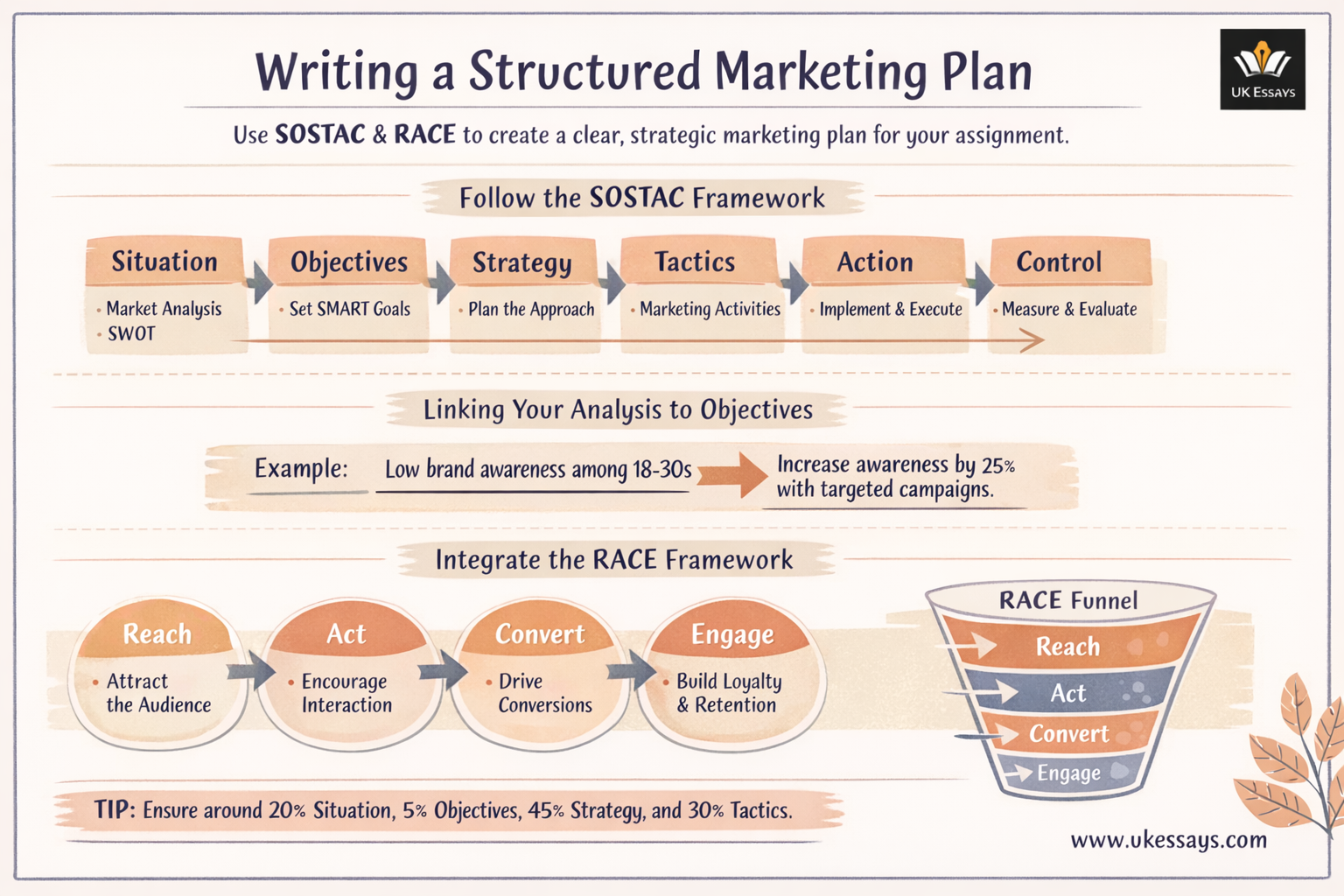
When it comes to academic assignments, such as CIM qualifications or university marketing courses, using SOSTAC and RACE can greatly improve the quality and clarity of a marketing plan.
Examiners and tutors expect to see a coherent narrative that covers analysis through to evaluation. These frameworks provide an excellent structure for doing exactly that (Chaffey, 2023).
Start the assignment with a brief introduction explaining that you will use SOSTAC to structure the plan. This signals to the marker that your approach is methodical.
Then work through the SOSTAC sections in order: Situation, Objectives, Strategy, Tactics, Action, and Control. These can serve as the main headings.
This makes sure you address all the key components. As you move through them, integrate insights and justify decisions at each stage.
For example, in the Situation section, include data on market trends, a short SWOT, and perhaps a graphic or table summarising your analysis. Show that you have considered competitors and customers in depth.
This might include a paragraph on customer personas or behaviour, alongside a paragraph on competitor benchmarking. Citing credible sources for these insights will strengthen the work and is expected in academic writing.
Showing linkage and justification
One important tip is to show the linkage between each part of the plan. This demonstrates strategic thinking.
For instance, when moving from Situation to Objectives, explicitly state how the objectives respond to issues or opportunities identified in the analysis.
If your analysis revealed low brand awareness among millennials, an objective might be to increase awareness by a specific percentage in the 18 to 30 age group. You should make clear that this is a direct response to the issue identified.
Likewise, each tactic should tie back to a strategic point or objective. This kind of cross-referencing helps the plan hold together logically and can earn marks for integration.
Students often lose marks by writing sections in isolation. They may produce a strong SWOT, then follow it with unrelated objectives, or list tactics that seem random. Using the frameworks as a connective thread helps avoid this problem (Chaffey, 2023).
Using RACE and managing word count
When including the RACE framework in an assignment, it often fits well within the Tactics or Action sections. For example, you can organise the tactics discussion around Reach, Act, Convert, and Engage.
This not only shows deeper knowledge, but also ensures that the customer journey is covered thoroughly.
You may even include a simplified RACE funnel diagram, if allowed, to show how customers move from one stage to the next through your tactics.
Make sure you also justify the choice of channels and content at each stage. For example, if your target audience heavily uses mobile apps for discovery, it would make sense to use mobile display ads and Instagram Stories in the Reach stage.
These justifications show that your choices are evidence based rather than generic.
Another practical issue in assignments is word count and balance. There is often a temptation to spend too many words on the situation analysis because research comes first.
However, it is important to leave enough space for strategy and recommendations. Dave Chaffey, drawing on experience with student assignments, suggests roughly 20% of the content on Situation, 5% on Objectives, 45% on Strategy, and 30% on Tactics, with Action and Control covered more briefly (Chaffey, 2023).
In other words, most of the write-up should focus on the forward-looking parts. That is where you show how the marketing challenge will be addressed.
Overly long background sections can crowd out the space needed to present and explain the actual plan. So, be concise in the situation analysis.
Include enough context and insight, then move into objectives and strategy. If you have a large amount of research material, consider placing detailed analyses such as a full SWOT or PESTLE in the appendix so the main body stays focused.
Strengthening the final assignment
Lastly, always include a brief Control section, even if the brief does not emphasise it. This adds a professional touch.
Mention relevant metrics and note that analytics or dashboards will be used to track progress. This can help the work stand out, as some students neglect evaluation altogether.
It is also useful to weave competitor and customer insights throughout the plan. You might compare your strategic choices with competitor behaviour or explain how the plan addresses customer needs revealed in the research.
When justifying channel choices, link them to both audience media habits and the requirements of the objectives.
For example, a decision to invest in SEO and content marketing may be justified by evidence that the target customers research solutions through Google. It may also directly support the objective of increasing organic web traffic.
This level of justification is what lifts a plan above the average. It shows critical thinking and a clear understanding of why the plan is built the way it is.
By following SOSTAC and using RACE within it, you create a clear, logical structure. That structure naturally supports the kind of thorough explanation expected in both academic and professional settings.
Tips for integrating SOSTAC and RACE
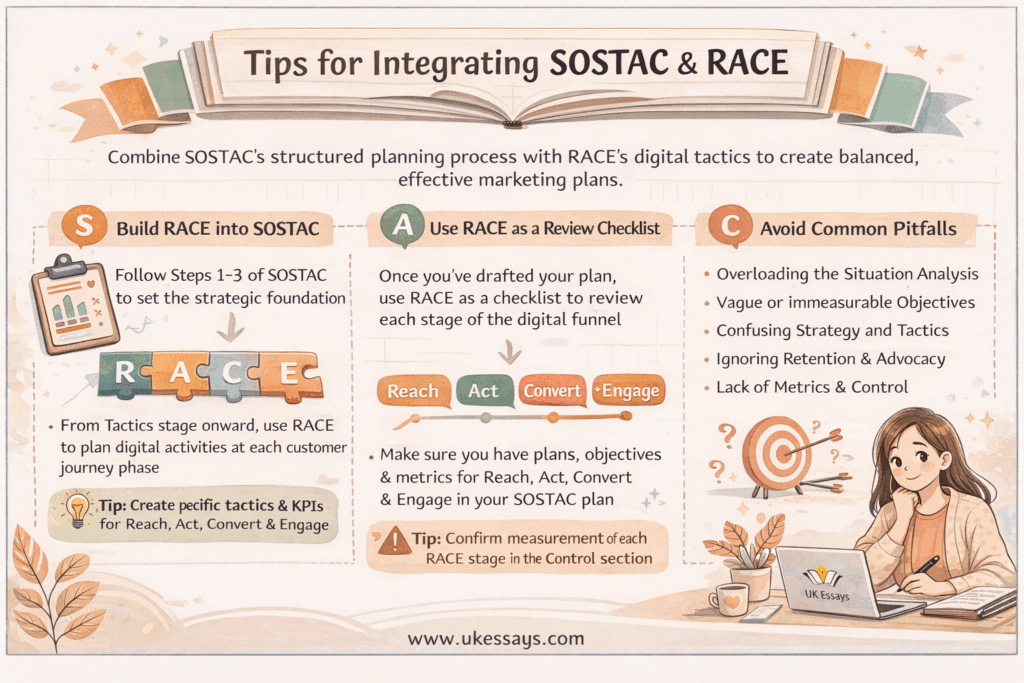
Both SOSTAC and RACE are valuable on their own. However, integrating them can create a more powerful planning approach.
The key is to use each framework for what it does best. Use SOSTAC to structure the overall planning process. Then use RACE to ensure full coverage of digital tactics and customer journey stages.
Using RACE within the SOSTAC structure
One practical approach is to build the plan through the SOSTAC stages up to Strategy first. Then, when developing the Tactics and Action sections, apply the RACE model (Chaffey, 2020).
In effect, SOSTAC provides the what and why. RACE provides the how across the customer lifecycle.
For example, once the strategy is in place, you can map out tactics for Reach, Act, Convert, and Engage. This helps ensure that each customer journey stage is addressed within the action plan.
Under Tactics, you might create sub-sections or a table for each RACE element. Each can list the campaigns, channels, and KPIs relevant to that stage.
This approach helps prevent an over-focus on acquisition or conversion alone. Instead, it ensures there are plans to attract new prospects, engage and educate them, convert them, and then build loyalty after purchase.
Using RACE as a review checklist
Another useful approach is to use RACE as a checklist when reviewing a SOSTAC-based plan. Once you have a draft, go through each RACE stage and ask whether the plan addresses that part of the journey.
Are there strategies or tactics for that stage? Are there objectives and metrics tied to it?
For example, under Control, check that you have metrics for each RACE stage. These might include awareness metrics for Reach, engagement metrics for Act, sales and conversion metrics for Convert, and retention or advocacy metrics for Engage (Chaffey, 2023).
This keeps the measurement section balanced across the funnel rather than focusing only on end results.
If you find a gap, such as weak planning for Engage, you can strengthen it by adding tactics like a loyalty email campaign or social community activity. In this sense, RACE adds a second layer of thoroughness to the plan.
Why the two frameworks work well together
It is also worth noting that SOSTAC is a general planning framework. That is part of its appeal, but it does not explicitly focus on digital or channel-specific activity (Chaffey, 2020).
RACE fills that gap by highlighting digital marketing activity and the progression of audience engagement. It also introduces a stronger customer-centric perspective into the SOSTAC structure.
For example, when developing strategy, you might explain that the plan aims to improve the customer journey by strengthening the Reach and Act stages so that more prospects enter the conversion pipeline.
That shows an awareness that strategy is not only about segmentation and targeting. It is also about guiding customers smoothly from awareness to loyalty.
Integration can also improve consistency of goals and metrics at every level. Suppose one objective is to convert 1,000 new customers through the website this quarter.
Using RACE, you would naturally think about the numbers needed at earlier stages. How many people must be reached to generate that many conversions? How many need to act by signing up or adding to cart? What level of post-purchase engagement do you want from those new customers?
Laying this out helps align tactics and metrics throughout the funnel. It also shows a more sophisticated understanding of planning.
In summary, SOSTAC works well as the backbone, while RACE adds the execution detail around the customer lifecycle. Together, they create an integrated plan that is strategically sound and practically useful.
Common pitfalls to avoid
Even with strong frameworks, there are several recurring pitfalls in marketing planning. Being aware of them can help students and practitioners produce a more effective and credible plan.
Overloading the situation analysis is a common mistake. It is easy to spend page after page on background material without producing actionable insight (Chaffey, 2023).
An overly exhaustive PESTLE or SWOT can consume words and attention, yet still leave the reader asking, “So what?” Keep the analysis concise, relevant, and tied to strategic implications.
Unclear or immeasurable objectives are another frequent problem. Objectives such as “become a market leader” or “improve customer experience” sound impressive, but without a timeframe or measurement they are difficult to evaluate later.
All objectives should be SMART and linked to at least one KPI (Doran, 1981). They should also clearly relate to the issues identified in the earlier analysis.
Confusing strategy and tactics is another weakness seen in many plans. For example, saying “use social media marketing” as a strategy is incorrect. That is a tactic.
The strategy should express the broader approach and rationale. The tactics should explain the practical methods used to carry it out (Chaffey, 2020).
Lack of integration between plan elements can also weaken a marketing plan. This happens when each section feels isolated, with no clear thread linking one to the next.
A SWOT may be strong, but if the objectives do not respond to it, or the tactics do not support the strategy, the overall plan feels disjointed. Cross-referencing sections and showing alignment can help avoid this problem (Chaffey, 2023).
Pitfalls in customer journey and control
Ignoring the later stages of the customer journey is another major pitfall. Many plans focus heavily on acquisition and conversion, but say very little about interaction, retention, or advocacy.
This can lead to campaigns that win customers but do not build loyalty or maximise customer lifetime value. Plans should therefore include post-sale engagement, such as follow-up communication, customer support, community building, or advocacy programmes.
Insufficient focus on metrics and control is the final mistake to avoid. Some plans end with a launch, but give little thought to how success will be measured or what will be learned.
Even in academic work, the Control section should be specific. Rather than saying performance will be tracked and adjusted as needed, state which indicators will be measured, how often they will be reviewed, and how the findings will be used.
That level of detail demonstrates accountability and a commitment to continuous improvement.
Conclusion
In conclusion, using SOSTAC and RACE together provides a comprehensive and structured approach to marketing planning. This can benefit management students and practitioners alike.
A structured plan makes the complex task of campaign planning more manageable. It also ensures that every aspect, from the macro-environment down to daily content execution, supports the overall objectives and vision.
By carrying out a focused situational analysis, setting SMART objectives linked to KPIs, crafting a clear strategy, detailing tactics across the marketing mix, and then building action and control plans, marketers can greatly improve their chances of success.
The addition of the RACE framework strengthens this process further by ensuring that the whole customer journey is addressed, not just the point of acquisition.
This disciplined approach also reflects the kind of planning that examiners from bodies like CIM look for in assignments. It mirrors real-world best practice and encourages stronger strategic thinking.
As these frameworks are applied, it is important to keep the common pitfalls in mind. Each section of the plan should feel logically connected and clearly justified.
Do that, and the result will be a marketing plan that is well structured, professional, persuasive, and more likely to drive real results.
In a fast-paced marketing environment, a robust planning methodology is a genuine competitive advantage. It provides confidence that decisions are informed and gives the agility needed to adapt and succeed.
Further reading
For readers who want to deepen their understanding, the Ansoff Matrix is a useful next model to explore. It complements SOSTAC and RACE by helping marketers think about growth options such as market penetration, market development, product development, and diversification.
Another valuable framework is Porter’s Five Forces. This extends the situational analysis by offering a more detailed way to assess competitive pressure, buyer power, supplier power, substitute threats, and barriers to entry within a market.
Need help with a undergraduate or MBA marketing assignment? We can help! Our UK-qualified marketing experts are ready to assist. Visit our marketing assignment help page now for more info.
For those you like to listen to explanations as well as read them, this is an excellent presentation by Dr Dave Chaffey.
References
- Chaffey, D. (2020) How do I integrate the SOSTAC® and RACE frameworks?. DaveChaffey.com, 31 March 2020. Available at: https://www.davechaffey.com/digital-marketing-strategy/how-do-i-integrate-sostac-and-race-frameworks/ (Accessed: 10 September 2025).
- Chaffey, D. (2022) SOSTAC® marketing plan model. DaveChaffey.com, 11 October 2022. Available at: https://www.davechaffey.com/digital-marketing-glossary/sostac-marketing-plan-model/ (Accessed: 9 September 2025).
- Chaffey, D. (2023) SOSTAC® marketing planning model guide and the RACE Growth System. Smart Insights, 20 October 2023. Available at: https://www.smartinsights.com/digital-marketing-strategy/sostac-model/ (Accessed: 9 September 2025).
- Doran, G. T. (1981) ‘There’s a S.M.A.R.T. way to write management’s goals and objectives’, Management Review, 70(11), pp. 35–36.
- Guerrero, C. (2024) A marketing plan must line up with strategic business priorities. Gartner, 8 November 2024. Available at: https://www.gartner.com/en/articles/a-marketing-plan-to-align-with-business-priorities (Accessed: 9 September 2025).
- Kotler, P. and Armstrong, G. (2018) Principles of Marketing. 17th edn. Harlow: Pearson Education.
- Professional Academy (2025) Transform Your Strategy: PR Smith’s SOSTAC® Plans & AI Masterclass. Professional Academy Blog, [online] January 2025. Available at: https://www.professionalacademy.com/blogs/PR-smith-sostac-masterclass/ (Accessed: 9 September 2025).
- Smith, P. R. (2011) The SOSTAC® Guide to writing the perfect plan. United Kingdom: PR Smith.

Cite This Work
To export a reference to this article please select a referencing stye below: