When a research paper becomes unmanageable: warning signs and next steps
Info: 2518 words (10 pages) Blog
Published: 12 Mar 2026
Don’t struggle alone. If you’re feeling overwhelmed, running out of time, and have no support in sight, act! Our research paper writing service was created for situations exactly like yours.
It’s a familiar nightmare: you sit staring at a mountain of notes and half-written paragraphs, wondering how your research paper got so out of hand. One day you had a neat plan, but now the scope has ballooned, the question keeps changing, and even your supervisor’s advice feels contradictory.
If this scenario sounds familiar, take heart – you are not alone. Research papers can spiral quickly when under pressure, and many students experience this kind of breakdown.
The good news is that there are clear warning signs when a project is veering off course, and there are practical steps to get back on track. This post will help you recognise those signs and guide you towards effective solutions.
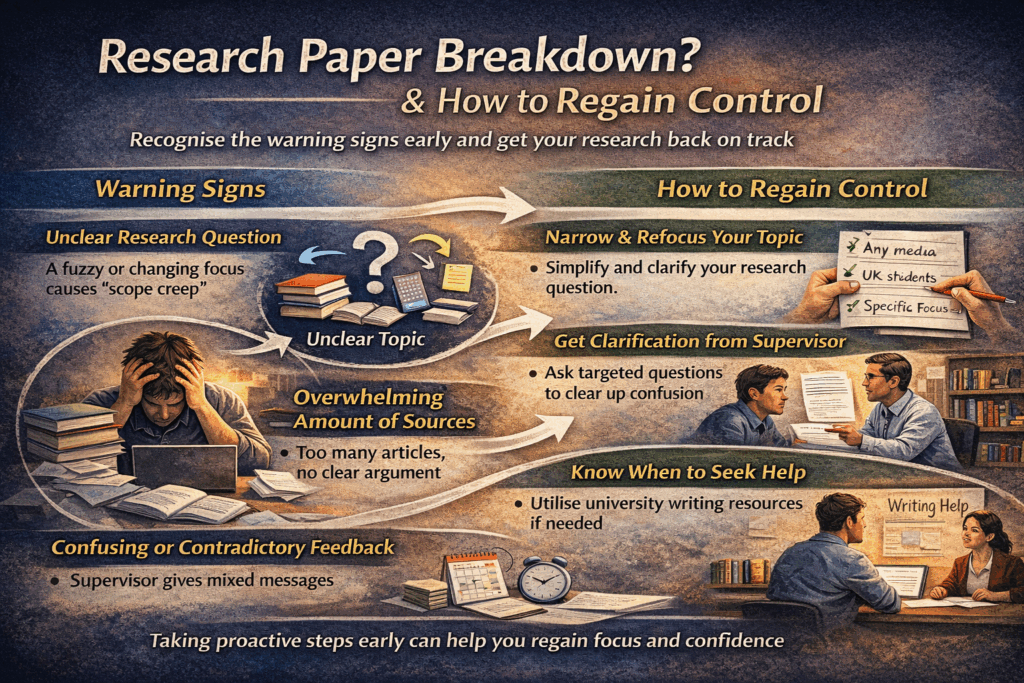
Unclear or shifting research question:
A research paper can quickly spiral if your central question keeps changing or was never clear in the first place. When the focus is fuzzy, you may keep adding literature or data in hopes that something will stick. Consequently, your project experiences “scope creep” – it grows beyond its initial boundaries without a clear direction.
Derek Jansen and David Phair note that an overly broad topic leads to an unclear direction and attempts “to take on too much” gradcoach.com. If you find you can’t pin down exactly what you’re asking or answering, that’s a red flag.
Too many sources, no clear argument:
Are you drowning in a sea of articles and books, yet struggling to form a coherent argument? An excessive pile of literature with no narrative thread is another warning sign. It often stems from the first issue (an unfocused question). You might have collected everything remotely related to your topic because you aren’t sure what to filter out.
One PhD student described “reading dozens of papers only to realize half of them don’t even relate to my topic,” which perfectly captures how easy it is to lose focus. Ultimately, it’s a sign that your research scope needs tighter borders and your argument needs a sharper focus.
Supervisor feedback that contradicts or confuses:
When every meeting with your supervisor leaves you more confused than reassured, something is amiss. Perhaps one week they say “expand Chapter 2,” but the next week they advise “condense that section.” It’s frustrating and can paralyze your progress. Sometimes this happens because your work itself is changing direction, and feedback evolves with it.
As Cally Guerin explains, supervisors’ feedback often “develops over time” alongside the writing (Guerin, 2018). Still, consistently conflicting feedback is a warning sign that either the project’s direction is unclear or communication with your supervisor needs improvement.
If instructions feel like a moving target, take note – you may be in the midst of a breakdown in the process.
What this means and why it matters
If these warning signs sound familiar, your research process may be veering off course — and the impact is serious. Academically, an unfocused project can derail your timeline and the quality of your work.
For example, an unclear research question leads to collecting irrelevant data and scope creep, which means wasted time and effort. Conflicting guidance can leave you second-guessing every decision, so progress grinds to a halt. In short, these issues derail your research, often requiring major revisions or even restarts if left unchecked.
Equally important is the emotional toll. When a paper becomes unmanageable, students often feel overwhelmed, anxious, and stuck. It’s normal to experience self-doubt or a sense of failure in this situation — indeed, fear of failure and stress are widespread among students under intense pressure.
In one survey of 800 undergraduates, 87% cited pressure to succeed as a top reason for seeking outside help with assignments, and 63% worried their own skills weren’t “A-worthy” (College News, 2023).
Such findings reflect how writing anxiety can set in when your project isn’t going well. You might start procrastinating or avoiding the work because it induces panic. Emotionally, you may oscillate between “I have to fix this all by myself” and “I can’t do this at all.” Recognising these feelings is important: they’re signals that your current approach isn’t working, not proof that you’re incapable. In fact, feeling overwhelmed is a cue to take action and regain control of your research process.
How to regain your control
Facing an unmanageable research paper can be daunting, but there are concrete steps you can take to get back on track. The journey from chaos back to clarity involves focusing your scope, improving communication, and, when necessary, seeking support. Below are key strategies to consider:
Narrow your scope and refocus your question
The first step is to rein in that runaway scope. Revisit your research question (or thesis statement) and make it as specific as possible. Ask yourself: What exactly am I trying to answer? If your question has multiple parts or could spawn multiple papers, simplify it. You might need to cut out subtopics or save them for future projects.
A useful tip is to define the who, what, where, and when of your study explicitly (Jansen and Phair, 2025). For example, instead of tackling “How does social media affect mental health?”, narrow it down to “How does daily Instagram use influence anxiety levels among UK university students during exam periods?”
By pinning down specifics like population, location, and timeframe, you draw clear boundaries around your research. Experts emphasise that a tightly focused topic not only prevents overload but also leads to a deeper, more meaningful analysis (Jansen and Phair, 2025).
In practice, narrowing your scope might feel like you’re “doing less,” but it actually empowers you to make a strong, coherent argument on a manageable aspect of the problem. Remember, quality beats quantity – it’s better to thoroughly address a smaller question than to skim the surface of a huge one.
Once you have sharpened your research question, let that clarity guide the rest of your work. Trim your literature down to sources that directly inform your specific question. It can be hard to set aside interesting but unrelated sources, but doing so will immediately reduce overwhelm. If you have 50 sources but only 15 are truly relevant, focus on those core 15 first.
Organise your notes around key themes or arguments related to the refined question. This will help you see a logical structure for your paper emerging.
Essentially, you are drawing a line around your project: everything inside the line is on-topic, and everything outside can be acknowledged briefly or left out entirely. By controlling scope this way, you’ll find it easier to develop a strong argument without getting pulled in a hundred directions.
Seek targeted feedback and clarification
Next, tackle the supervision issue proactively. If your supervisor’s feedback has been confusing or contradictory, it’s time to seek clarity. Supervisors are there to help, but they may not realise you’re struggling unless you tell them. Don’t be afraid to ask specific questions.
Instead of a general “What do you think about my draft?”, pinpoint the areas you’re unsure about. For instance: “I got feedback last month to expand Section A, but now the latest comment suggests trimming it. Could you clarify what aspect I should focus on?” By directing your supervisor’s attention to the specific conflict, you make it easier for them to explain or resolve it.
Sometimes, you’ll find that priorities changed as your work evolved – which is normal. As mentioned earlier, feedback can develop as the project develops (Guerin, 2018). Still, you deserve to understand why a particular change is being recommended.
Politely press for rationale: “I want to make sure I understand your vision. Last meeting you emphasized expanding the theory section, but this time the methods chapter seems to be your focus. Is my understanding of your comments correct?” This kind of dialogue can clear up misunderstandings and help both you and your supervisor get on the same page.
It’s also wise to document and summarise the feedback after each meeting. After discussing issues in person, you might email your supervisor a brief summary: “Just to confirm, my next steps are to streamline Section A to focus on X, and to gather more data on Y. Does that sound right?” This gives them a chance to affirm or correct your understanding in writing.
It also creates an informal “paper trail” of agreed direction, which can be extremely helpful if confusion arises later.
Additionally, consider seeking feedback from multiple sources if possible. If your department offers writing tutors or peer review groups, an outside perspective might shed light on the issues you’re facing. Sometimes another academic (or a savvy peer) can help interpret your supervisor’s critiques or suggest how to address them without compromising your vision.
The key is not to sit silently with contradictory feedback. Engage with it actively: ask for examples of what your supervisor wants, or even request a short follow-up meeting dedicated solely to resolving the conflicting guidance. Showing initiative in seeking clarity demonstrates your commitment to improving the work, and most supervisors will respond positively to that.
Ultimately, clearer communication can transform disheartening feedback into a constructive roadmap for your next draft.
Know when to seek academic support
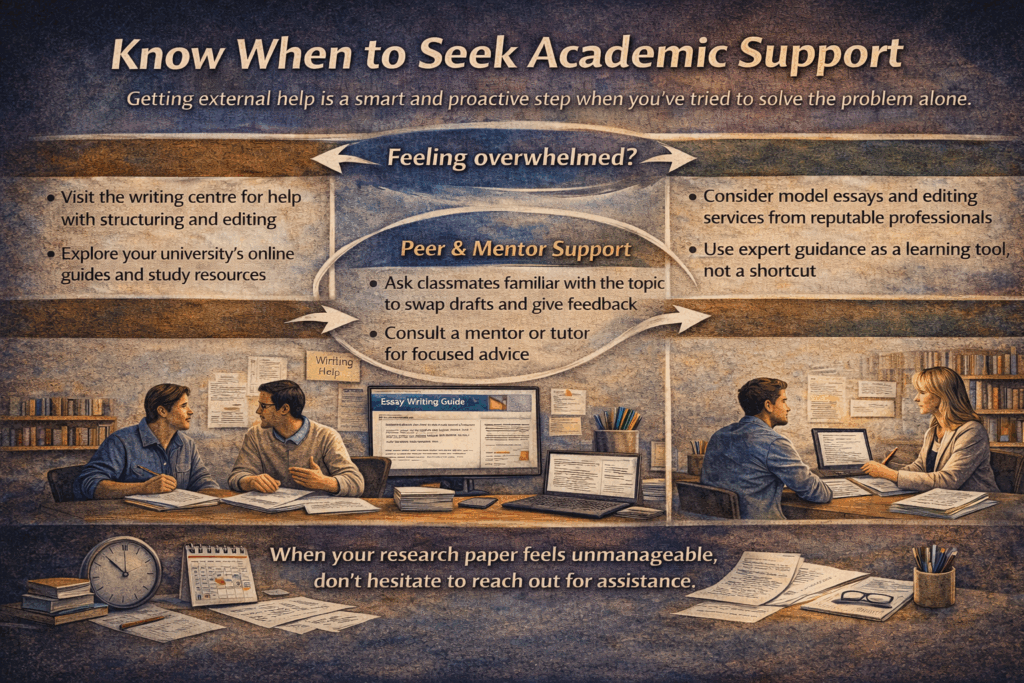
Finally, recognise that you don’t have to fix every problem alone. While independence is a virtue in research, there’s a difference between perseverance and pointless solo struggle. If you’ve tried the above steps – narrowing your scope and clarifying feedback – and you’re still feeling lost, it might be time to seek additional support.
This is not an admission of failure, but rather a smart, proactive move.
Many students delay asking for help, often until it’s almost too late. In fact, one report described a student who said they’d rather fail a class than ask for help, echoing a common reluctance among college learners (Sedlak and O’Hara, 2024). However, when a research paper feels unmanageable, reaching out early can save your project (and your sanity).
This help might come in various forms. You could approach a university writing centre or a mentor for guidance on structuring your argument. You might ask a classmate who’s familiar with your topic to swap drafts and give feedback. Sometimes just talking through the problem with someone can illuminate a solution you hadn’t considered. The point is, seeking help should be seen as a practical problem-solving step, not a last resort.
There are also a wealth of online resources which are available. This site alone has an immense amount of resources offered completely free of charge.
For example there is a ‘Ultimate Essay Writing Guide’ along with guidance on ‘Developing Your Ideas’.
Beyond informal help, remember that professional academic support is also available. Services like UK Essays’ academic support exist for situations exactly like this – when you need an expert pair of eyes to guide you.
Academic writing services can provide model essays, editing, or advice tailored to your needs.
Importantly, using such support is a normal and professional solution; it doesn’t mean you’re “cheating” or incapable. Think of it as getting a tutor for a tough course. In professional life, people consult experts or use support all the time – academia should be no different.
If time pressure is crushing you (and a survey showed 85% of students struggle with academic overload (College News, 2023)), outside help can relieve the burden by helping you organise and focus your material effectively.
Likewise, if fear of failure or perfectionism is paralyzing you – if you’re staring at a blank screen because you’re terrified your words won’t be good enough – a professional writer’s input can kick-start your progress by providing a clear example or structure to follow.
When considering academic support services, always use them ethically. The idea is to learn from the assistance, not to hand over responsibility. For example, you might use a model essay to see how to structure your literature review, or get an editing service to polish your draft so you can see how to improve your own writing.
Legitimate services will emphasise that their help should be used as a guide (UK Essays, 2025).
By integrating external support into your process wisely, you can overcome roadblocks that might otherwise persist. And you’re not alone — many students use these services; one survey found 55% of students who had used a writing service did so regularly as part of their study strategy (College News, 2023). So, there is no need to suffer in silence or let your paper fall apart due to pride or fear.
Recognising when to seek help is a mark of insight, not weakness. Ultimately, the goal is to get your research back to a manageable, productive state.
Finally, breathe and refocus – you’ve got this
A research paper can become unmanageable faster than you might expect, but the warning signs are usually clear in hindsight. If you catch them early – a drifting research question, an avalanche of sources with no focus, or feedback that leaves you perplexed – you can take action before the situation becomes a full-blown crisis.
By refocusing your question, communicating actively with your supervisor, and availing yourself of support resources, you can turn the ship around.
Every researcher encounters setbacks; what defines your success is how you respond. Instead of seeing an unmanageable paper as a personal failure, treat it as a challenge that can be solved with the right strategies.
Academic writing is tough, but you are not alone in the struggle, and you’re certainly not the first to feel this way. With empathy for yourself and a willingness to seek solutions, you can overcome the breakdown and get your research back on track.
Remember, asking for help – whether from a mentor, a peer, or a professional service like UK Essays – is not only normal, but often the smartest next step when you’ve hit a wall.
Take a deep breath, implement these steps, and bit by bit, you will regain control of your research journey.
Don’t struggle alone. If you’re feeling overwhelmed, running out of time, and have no support in sight, act! Our research paper writing service was created for situations exactly like yours.
References
- College News (2023) ‘How and Why Do College Students Cheat on Assignments?’, College News. [Online]. Available at: https://www.collegenews.com/article/how-and-why-do-college-students-cheat-on-assignments/ (Accessed 15 December 2025).
- Guerin, C. (2018) ‘Why do supervisors contradict themselves? Development of feedback’, DoctoralWriting blog, 11 September 2018. [Online]. Available at: https://doctoralwriting.wordpress.com/2018/09/11/why-do-supervisors-contradict-themselves-development-of-feedback/ (Accessed 15 December 2025).
- Jansen, D. and Phair, D. (2025) ‘Writing a Quality Research Proposal: Eight Common – But Costly – Mistakes to Avoid’, Grad Coach, March 2025. [Online]. Available at: https://gradcoach.com/research-proposal-rejection-mistakes/ (Accessed 15 December 2025).
- Sedlak, W. and O’Hara, R. (2024) ‘Help is available—but many college students don’t ask for it’, Lumina Foundation – News & Views, 17 June 2024. [Online]. Available at: https://www.luminafoundation.org/news-and-views/help-is-available-but-many-college-students-dont-ask-for-it-read-on-for-solutions/ (Accessed 15 December 2025).
- UK Essays (2025) Academic Writing Services. [Online]. Available at: https://ae.ukessays.com/services/ (Accessed 15 December 2025).

Cite This Work
To export a reference to this article please select a referencing stye below: