Scenario planning in business: a comprehensive guide
Info: 5560 words (22 pages) Study Guides
Published: 22 Mar 2026
Stuck on your scenario planning? Don’t just reflect – act! Get an MBA-qualified writer to help you today. See our business assignment help page for info.
Scenario planning is a strategic planning method used to manage uncertainty by exploring multiple plausible future scenarios rather than predicting a single outcome.
Unlike traditional forecasting, which focuses on one most likely trend, scenario planning envisions a range of alternative futures. These include both positive and negative possibilities. It then considers how an organisation might respond in each case.
It is essentially a way of telling a story with many possible endings. Planners make clear assumptions about key drivers, then imagine how different futures could unfold. By developing several coherent, plausible narratives about what might happen, business leaders can better prepare for unexpected changes and avoid the pitfalls of linear thinking.
In short, scenario planning helps companies anticipate and prepare for a variety of potential environments, rather than being caught off guard by a future that deviates from expectations (Ali, 2025).
Importantly, scenarios are not forecasts or exact predictions. They are hypothetical constructs designed to stretch an organisation’s thinking.
Each scenario explores a distinct combination of factors that might shape the future. This allows decision-makers to consider “what if” questions in a structured way. For example, one scenario may imagine a surge in demand for a product, while another envisions a market downturn. Each narrative examines how the business could respond in those circumstances.
Through this process, scenario planning provides a framework for flexible long-term planning. It helps firms become proactive rather than reactive when facing uncertainty (Tapp, 2025). It is a tool for strategic foresight that can illuminate emerging opportunities and risks before they fully materialise.
Why scenario planning is important
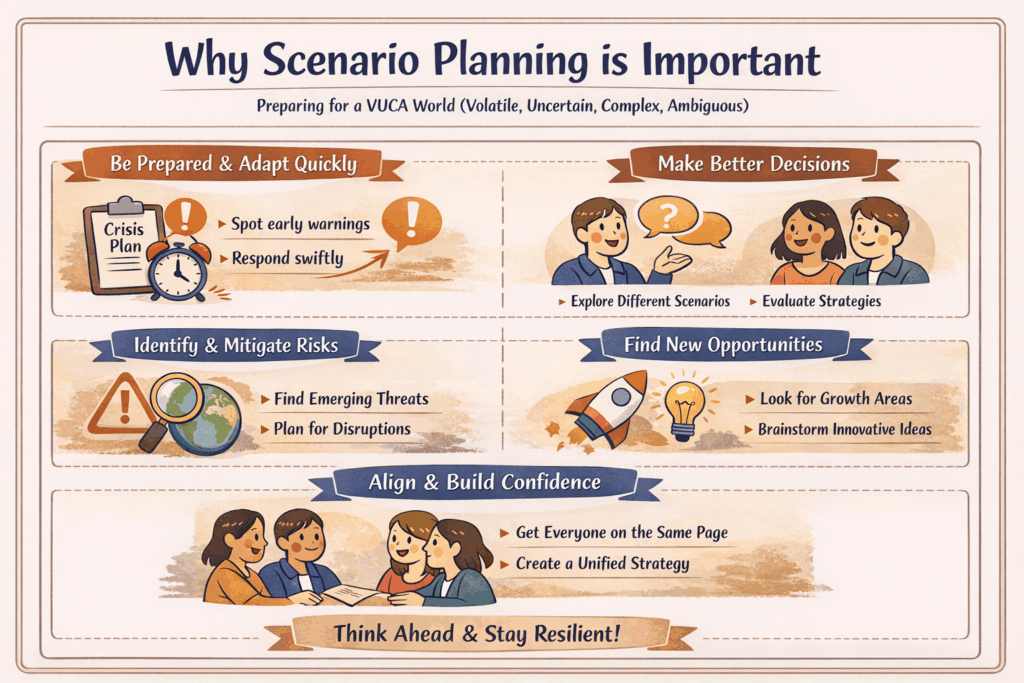
In today’s volatile and complex business environment, often described as VUCA (volatile, uncertain, complex, ambiguous), scenario planning has become an essential practice. It forces organisations to think ahead and consider a range of possible developments. In doing so, it helps build resilience.
Several key benefits make scenario planning especially valuable:
Enhanced preparedness and agility:
By visualising diverse future situations, managers can recognise early warning signs and respond faster. If a crisis or surprise event occurs, a company with scenario plans already has a playbook, so leaders are not scrambling to improvise under pressure (Ali, 2025). This ability to react quickly and decisively can provide a competitive advantage.
Better strategic decisions:
Scenario planning encourages deeper discussion and analysis among teams. It enables executives and stakeholders to confer, debate, and strategise together about potential futures, leading to more robust and well-thought-out strategies (Tapp, 2025). Because the process highlights how each scenario would affect plans, budgets, or operations, it supports more effective decision-making under uncertainty. Organisations can test how a strategy performs across different scenarios and refine it to be more resilient.
Risk identification and mitigation:
A core benefit of scenario work is mapping out potential threats. It expands a company’s risk radar beyond the usual, expected problems. Teams engaged in scenario planning can identify emerging risks, such as new competitors, regulatory shifts, supply chain disruptions, or technological changes, that might otherwise go unnoticed. They can then brainstorm proactive measures to mitigate those risks. This broader awareness helps avoid the trap of planning only for business-as-usual.
Uncovering opportunities:
Scenario exercises are not only about worst-case events. They also consider optimistic futures. By asking, “what if things go better than expected?”, organisations may spot growth opportunities or innovative ideas. Creative scenario discussions can reveal new markets, products, or business models to explore, as well as ways to capitalise on favourable trends (Tapp, 2025). In practice, companies often find that scenario planning sparks insights about how to improve efficiency or diversify because thinking about different futures encourages out-of-the-box ideas.
Greater organisational alignment and confidence:
Engaging multiple departments in scenario planning fosters communication and a shared understanding of strategic issues. It breaks teams out of siloed thinking and an echo chamber of assumptions. The collaborative nature of building scenarios means everyone, from the board to line managers, can align on the major uncertainties and priorities. As a result, if challenging times come, the organisation is more unified and confident in its course of action. People know there is a plan in place for the unknown, which reduces panic and builds a culture of preparedness.
In summary, scenario planning enables pre-emptive decision-making, comprehensive risk management, and strategic agility. It pushes leaders to consider both pitfalls and windfalls ahead. This helps ensure that businesses are not caught flat-footed by change, but can navigate and even thrive across a range of future states.
Origins and evolution of scenario planning
The practice of scenario planning has its roots in military and geopolitical strategy. It first developed in the mid-20th century, when planners sought ways to imagine the unthinkable.
In the 1950s, Herman Kahn of the RAND Corporation, a military think-tank, pioneered modern scenario techniques. His work helped the U.S. government contemplate alternatives beyond “annihilation or surrender” in the event of nuclear war (GLISA, 2025). This early approach introduced the idea of constructing detailed hypothetical situations to support strategic decision-making under extreme uncertainty. It laid the foundation for scenario planning as a discipline.
The concept was soon adapted to the business world, most famously by Royal Dutch/Shell in the 1970s. Shell’s planning group, led by Pierre Wack and colleagues, used scenario planning to make sense of major changes in the global oil industry. By stepping away from simple trend forecasting, Shell became far more resilient during the 1973 oil embargo than many competitors (Kleiner, 2003).
In fact, Shell’s scenario team had foreseen the possibility of a sudden oil supply shock and had warned top management. When the OPEC crisis hit and oil prices quadrupled, Shell was better prepared. It had already considered this scenario and taken “mundane but crucial” preparatory actions, which helped the company not only survive but leapfrog rivals in the aftermath (Kleiner, 2003).
Through the 1970s and 1980s, Shell continued using scenarios to anticipate major events such as the 1979 price spike and the 1986 oil glut. Over time, this approach became integral to its strategic thinking.
Shell’s success brought scenario planning into the mainstream of corporate strategy. By the 1980s, many other companies and consultancies were adopting scenario methods to cope with uncertainty in markets, technology, and politics.
Wider adoption of scenario planning
The approach also spread beyond business. Governments began using scenario planning for policy development and national strategy. A notable example is South Africa in the early 1990s, where the Mont Fleur scenarios helped different political groups explore possible paths after apartheid. This contributed to a peaceful transition to a multiracial democracy (Kleiner, 2003).
Similarly, scenario techniques have been applied in fields such as environmental planning. NASA and climate researchers, for example, use scenarios to consider the impacts of climate change and devise adaptation strategies (GLISA, 2025).
Over the decades, scenario planning has evolved into multiple schools of thought and applications. It remains an open and adaptable approach, used in disciplines ranging from corporate management to public policy and academia. Researchers Cordova-Pozo and Rouwette (2023) note that scenario planning now encompasses a diversity of methods, yet all share the common goal of addressing uncertainty in strategic decision-making.
Today, organisations large and small, across industries from energy and finance to technology and healthcare, use scenario planning to future-proof their strategies. Its enduring popularity reflects its value. In an era of rapid change, the ability to envision and prepare for alternate futures is an invaluable strategic asset.
Scenario planning vs. forecasting and other approaches
It is important to clarify how scenario planning differs from other forward-looking management tools such as forecasting, contingency planning, and business continuity planning. While these approaches are related, they serve different purposes.
Traditional forecasting
Forecasting typically involves predicting a single “most likely” future based on current trends and historical data. For example, a financial forecast might project next year’s sales by assuming a certain growth rate.
This is generally a linear, one-outcome approach. Scenario planning, by contrast, explores multiple divergent outcomes. It considers not only the expected case, but also less likely scenarios that could have major impact.
In practice, both can work together. A company might use forecasting to establish a base case, then use scenario planning to stress-test that base case against alternative assumptions (Ali, 2025). The key distinction is simple: forecasting narrows in on one future, while scenario planning opens up consideration of many possible futures.
Contingency planning
Contingency plans are specific predefined actions for particular identified risks: if X happens, we will do Y. For instance, a business might have a contingency plan for a data centre outage or the sudden loss of a key client.
Scenario planning is broader and more exploratory. Rather than planning for one discrete event, it constructs a whole context of multiple interrelated conditions. A contingency plan is usually one-to-one. A scenario, by contrast, is a holistic narrative that may include many factors and lead to a range of challenges and opportunities.
Scenario planning often yields insights that later inform contingency plans. After developing scenarios, a company may create contingency measures for risks that appear across several of them.
Business continuity planning
Business continuity planning (BCP) focuses on how to keep the business running during and after a crisis or disaster, such as a natural disaster, system failure, or operational disruption. BCP is about immediate response and maintaining critical functions, often over a short-term recovery period.
Scenario planning usually plays a longer game. It examines how external events could evolve over time and affect the business’s strategic position, including upside possibilities (Ali, 2025).
In essence, continuity planning asks, “How do we operate through a disruption?” Scenario planning asks, “What different worlds might we operate in, and how would we succeed in each?” The two can complement each other. Leadership teams that engage in scenario thinking often strengthen continuity preparedness because the exercise highlights vulnerabilities continuity plans should address.
In summary, scenario planning stands out for its breadth of imagination and strategic orientation. It does not replace forecasting or risk management techniques. Instead, it enriches them by ensuring that planning is not confined to the most obvious path.
Forecasts and budgets often assume business will continue in a predictable way. Scenario planning challenges that assumption and prepares the organisation for non-linear change. By doing so, it helps avoid the trap of plans based on a single view of the future and equips organisations to handle surprise events or major shifts.
Types of scenario planning approaches
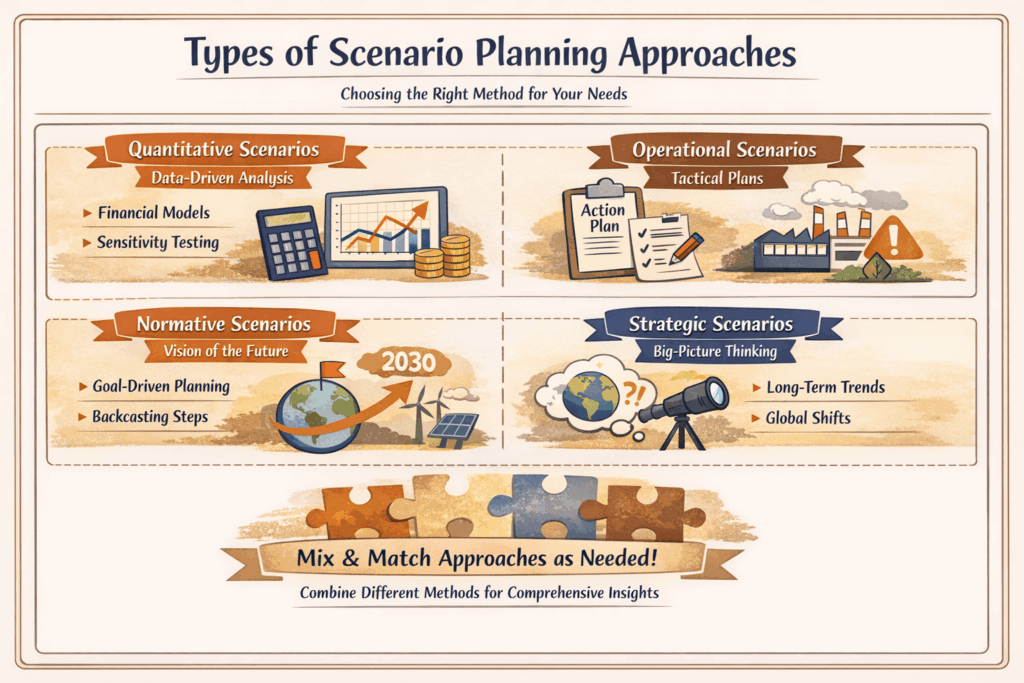
Over time, practitioners have developed several approaches to scenario planning, each suited to different purposes. Understanding these variants can help organisations choose the style that best fits their needs.
Common types include:
Quantitative scenarios:
These are driven by numerical models and data. They often involve creating financial or operational models to project outcomes under different assumptions. For example, a finance team might build best-case and worst-case versions of a cash flow model by changing key variables such as revenue growth or costs. Quantitative scenarios are useful for sensitivity analysis and stress-testing plans with hard numbers (Ali, 2025). They are common in budgeting and forecasting exercises.
Operational scenarios:
These apply scenario planning to immediate, tactical issues and internal processes. They typically explore the direct impact of specific events on a company’s operations in the short term. For instance, a manufacturing firm might develop a scenario for a sudden supplier failure and consider what immediate steps operations and supply chain teams should take. These scenarios often produce short-term action plans and are frequently used in crisis management and emergency response.
Normative scenarios:
These are goal-driven scenarios that describe a desired future or end-state and explore how it might be achieved. In this approach, planners start with a vision of the future they want, or one that is considered acceptable, then work backward to identify the changes needed to get there. For example, a company might imagine a future in which it is carbon-neutral by 2030 and then outline the steps required to reach that outcome. Normative scenarios are less about predicting external events and more about planning strategic initiatives to realise a specific outcome (Ali, 2025).
Strategic management scenarios:
These are the classic big-picture scenarios associated with corporate strategy and futurists. They are typically high-level narratives about the business environment, markets, or society, rather than the internal details of one company. They might explore questions such as, “What if a new technology revolutionises our industry?” or “What if geopolitics shifts dramatically and changes our market conditions?” Shell’s famous oil market scenarios are a prime example. These scenarios can shape long-term strategy, R&D priorities, and major investment decisions.
It is worth noting that these categories are not mutually exclusive. In practice, a comprehensive scenario planning project may combine several of them.
For instance, a strategic scenario narrative might be supported by quantitative financial projections. A normative “preferred future” scenario might also be developed alongside more exploratory scenarios for comparison.
The key point is that scenario planning is a flexible approach. Organisations can tailor it to their needs, whether they want a quick financial what-if analysis or a deep strategic foresight exercise. The fundamentals remain the same: define assumptions, explore how those assumptions play out in different futures, and identify implications for decisions today.
The scenario planning process and frameworks
While there is no one-size-fits-all method, scenario planning generally follows a structured process. Below is a step-by-step framework that synthesises best practices from various methodologies (Wright et al., 2019; Schwartz, 1991).
Adhering to a structured approach helps ensure that scenarios are rigorous, relevant, and useful for decision-making.
Step 1: Define the focal issue and scope
Every scenario planning exercise should begin by clearly defining the question or decision at hand. What is the central issue you are exploring?
It could be broad, such as “What will our industry look like in 10 years?” It could also be more specific, such as “How will new environmental regulations in the next 5 years affect our business model?”
Teams should also agree on the time horizon. Are you looking 5, 10, or 20 years out? You also need to define the scope: global or regional, whole industry or a single market.
This step is critical because a well-defined focal issue keeps the process focused and relevant. For example, a retail company might ask, “What will consumer shopping behaviour be like in 2030, and how could that affect our stores and e-commerce strategy?” That question then anchors all later analysis.
It is also important at this stage to secure stakeholder buy-in and assemble the right team. Scenario planning is inherently collaborative and cross-functional. Involve people from strategy, finance, operations, R&D, and other relevant areas. External experts may also be useful.
As one guide notes, the process should include all relevant stakeholders so that those who will need to act on the scenarios have a hand in creating them (GLISA, 2025). This improves the quality of insights and builds ownership of the outcomes.
Step 2: Identify key drivers and uncertainties
With the focal issue defined, the next step is research and analysis. The aim is to understand what factors could shape future outcomes.
This often involves horizon scanning or PESTLE analysis, looking at Political, Economic, Social, Technological, Legal, and Environmental forces. The team should brainstorm a wide range of drivers of change, such as demographic trends, emerging technologies, regulatory shifts, economic growth, consumer preferences, and competitor moves.
Past data, expert interviews, and published research can inform this stage. Creativity and breadth are important here. The goal is to cast a wide net and capture anything that could matter.
After compiling a list of drivers, teams need to identify the critical uncertainties. These are the factors that combine high potential impact with high uncertainty. In other words, they would significantly affect the focal issue, but their future direction is unclear.
Some factors may be important but relatively predictable, such as slow-moving demographic ageing trends. These can often be treated as constants across scenarios. The truly pivotal uncertainties, such as the path of a disruptive technology or the possibility of major regulatory reform, become the core building blocks of the scenarios.
Step 3: Develop scenario logics (frameworks for scenarios)
Once the key uncertainties are chosen, planners create the framework or logic that will underpin the scenarios. A popular method here is the 2×2 scenario matrix.
This involves taking two of the most critical uncertainties and placing them on two axes. Each axis has two contrasting outcomes, such as high versus low, or one possible state versus another. That produces four quadrants, each representing a distinct combination of the two uncertainties.
For example, imagine a technology company identifies two major uncertainties: the pace of technological innovation and the regulatory environment. Crossing those uncertainties could generate four scenarios, each describing a different future business environment.
The 2×2 matrix is widely used because it offers a simple but disciplined framework. It helps ensure that scenarios are meaningfully distinct and internally consistent.
However, it is not the only approach. Some exercises produce three scenarios, such as best case, worst case, and baseline. Others may develop a larger set to cover more combinations. The key is to keep the number manageable, usually around three to five, so the range is broad enough to be useful but not so large that it becomes confusing.
Each scenario should also have a distinct logic. It often helps to give each one a descriptive title that captures its essence. This makes the scenarios more memorable and easier to communicate.
Step 4: Flesh out scenario narratives
With the framework in place, the team develops each scenario into a rich narrative. This is where qualitative insight becomes especially important.
For each scenario, describe how the future unfolds under those conditions and what it means for the organisation. A strong narrative covers both the external environment and the implications for the focal issue defined in Step 1.
If one scenario came to pass, what challenges and opportunities would arise? How would consumer demand, competition, supply chains, or regulation change? What strategic dilemmas might the organisation face?
Effective scenario narratives are coherent, plausible, and engaging. They are not fantasies. Each one should be grounded in the drivers identified earlier, even if those drivers are combined in novel ways.
Teams should also check for internal consistency. A scenario that assumes strong economic growth but collapsing consumer spending, for example, may be logically inconsistent unless there is a clear explanation.
Many teams find storytelling techniques helpful. Some write scenarios like short stories or future news articles. The aim is to create a vivid picture of a possible world so decision-makers can mentally step into it and imagine operating within it.
At this stage, teams often identify early indicators for each scenario as well. These are signs that the world may be moving in a particular direction, such as policy changes, market shifts, or technological breakthroughs.
Step 5: Identify strategic implications and options
Once the scenarios are developed, the next step is to analyse what they imply for the organisation and to formulate responses. This is sometimes called “wind tunnelling” because it involves testing strategies under different future conditions.
The team should ask questions such as: How would our current strategy perform under Scenario A? What about Scenario B? Where are the vulnerabilities? Which business units would thrive, and which would struggle?
This analysis often reveals that a strategy which seems strong under one future could fail badly under another. That insight can lead to new contingency plans, investments, or strategic options that are more robust across multiple futures.
For each scenario, teams can brainstorm actions the organisation could take to exploit opportunities or reduce risks. Some of those actions may be scenario-specific. Others may be “no regret” moves that make sense across nearly all futures.
These no-regret strategies are particularly valuable. If a move appears beneficial in most or all scenarios, it is often a strong candidate for early action.
Another useful output is a set of trigger points or signposts. These link early indicators to pre-agreed responses. If a company sees certain developments taking shape, it can move more quickly because the broad response has already been considered.
Step 6: Integrate, monitor and update
Scenario planning should not be treated as a one-off academic exercise. Its real value comes when it is integrated into ongoing management.
After developing scenarios and response options, organisations should embed them into strategic planning, risk management, and decision-making processes. This may involve presenting the scenarios to the wider leadership team or board and using them to refine the official strategy or risk register.
Scenario planning should also be treated as a continuous process. The environment keeps changing, so scenarios need to be reviewed and refreshed regularly. Many organisations update them annually, every two years, or whenever a major change occurs.
If a scenario becomes clearly outdated or implausible, it should be revised or replaced (Ali, 2025). Likewise, new uncertainties can be incorporated as they emerge.
Monitoring the indicators associated with each scenario is an ongoing task. Some organisations assign this to a strategy or intelligence team, which tracks external developments and reports on whether elements of a particular scenario seem to be materialising.
The ultimate aim is to cultivate a scenarios mindset within leadership. When that happens, even an unexpected future tends to resemble something the organisation has already considered, at least in part.
Applications of scenario planning in practice
Scenario planning is a versatile tool and can be applied in almost any domain where future uncertainty exists. A few real-world examples illustrate how it works in practice.
Energy industry (Oil & Gas)
The classic example remains Royal Dutch Shell. In the late 1960s and early 1970s, Shell was relatively weak in its industry. Yet by the end of that turbulent decade, it had emerged as one of the industry leaders, thanks in part to scenario planning (Kleiner, 2003).
Shell’s scenario team had presented top management with a future in which OPEC dramatically cuts supply and triggers an oil shock. They also explored scenarios involving long-term lower oil demand. These exercises prompted Shell to take prudent steps, such as cost-cutting, diversifying supply sources, and investing in alternative energy research, before crises hit.
When the 1973 oil crisis and later the 1980s market collapse arrived, Shell was more prepared than competitors that had planned mainly for business-as-usual. It still uses long-range energy scenarios today.
Public sector and policy planning
Governments and non-profits also use scenario planning to support policy choices and societal strategy. A famous example is the Mont Fleur scenarios in South Africa during the early 1990s.
A diverse group, including economists, activists, and politicians, developed scenarios for the country’s future as apartheid was ending. These narratives explored several political and economic paths. The exercise helped important stakeholders build a shared view of the consequences of different choices and contributed to a smoother transition.
Scenario planning is also widely used in environmental and climate adaptation work. Agencies and cities develop scenarios for different climate futures, then use them to plan infrastructure and policy responses.
Financial services and macroeconomic planning
Financial institutions often use scenario analysis as part of risk management and strategic planning. A bank, for example, may develop recession, steady-growth, and high-inflation scenarios, then assess how its loan portfolio or capital position would perform in each case.
Corporate finance teams use similar approaches when planning budgets and investments. Many firms also relied heavily on pandemic scenarios during COVID-19, comparing outcomes such as a short disruption versus a prolonged downturn.
In some cases, this preparedness has made the difference between survival and bankruptcy. Companies that had already thought through severe downside scenarios were often able to act faster when those scenarios began to unfold.
Manufacturing and supply chain management
Manufacturers increasingly use scenario planning to improve supply chain resilience. They simulate scenarios such as the shutdown of a key supplier, a sudden tariff increase, or the loss of access to a major production region.
These exercises can reveal weak points, such as over-reliance on one supplier or one geography. Companies can then respond by diversifying suppliers, holding more inventory, or investing in greater flexibility.
Recent disruptions in semiconductors and global logistics have made this especially relevant. Firms that plan for extremes are often in a much stronger position when disruption actually hits.
Technology and innovation strategy
Technology companies operate in fast-moving environments where disruption can quickly reshape the landscape. Scenario planning helps them imagine how emerging technologies and consumer behaviour might evolve.
A software firm, for example, might compare a future where open-source tools dominate with one where proprietary platforms remain in control. That kind of analysis can guide product strategy, partnerships, and R&D investment.
Scenario planning can also help tech firms prepare for changes in regulation or public sentiment. Considering different futures in advance allows them to adapt more quickly when the market shifts.
Small and medium businesses
Scenario planning is not only for large organisations. SMEs can benefit too, especially by improving agility.
A small retail chain, for instance, might imagine a future where online shopping accelerates sharply and physical footfall drops by half within five years. In response, it might strengthen its online store, invest in delivery partnerships, and improve digital customer retention.
At the same time, it may also consider a scenario in which physical stores continue to matter because customers want a better in-person experience. By planning for both possibilities, the business becomes more flexible and less vulnerable to surprise.
These examples show that scenario planning is broadly applicable, from global corporations to local businesses and public institutions. In each case, the principle is the same: explore the what-ifs now so that tomorrow feels less uncharted.
Challenges and pitfalls in scenario planning
Despite its strengths, scenario planning is not without challenges. Several common pitfalls can reduce its effectiveness if they are not managed carefully.
Conceptual and organisational resistance:
Some leaders are sceptical of scenario planning because it feels too speculative or not sufficiently data-driven. There can also be cultural resistance to discussing low-probability or long-term futures. This can lead to scenarios being ignored altogether.
Cognitive biases and groupthink:
Scenario planning can be distorted by confirmation bias, anchoring, and groupthink. Teams may unconsciously create scenarios that support their existing strategy or worldview. Sometimes all the scenarios end up looking too similar because people stay too close to the status quo.
Overwhelming complexity:
Without discipline, scenario planning can become chaotic. Teams may generate too many variables and too many scenarios, leading to confusion rather than insight. Excessive data collection can also become a distraction. Scenarios should be judged by their usefulness, not their precision.
Lack of integration into decision-making:
One of the biggest failures occurs when scenarios are developed but then left on a shelf. Insightful reports are produced, but nothing actually changes in strategy, resource allocation, or risk management. If that happens, much of the effort is wasted.
False sense of security or misinterpretation:
Scenario planning can also create overconfidence if people assume reality will neatly match one of the prepared scenarios. The future may differ from all of them, or combine elements from several. Scenarios are meant to broaden thinking, not replace it.
Resource and time intensity:
A strong scenario planning exercise can take time and may require skilled facilitation. Some organisations struggle to justify that investment, especially if they do not have internal expertise.
Despite these challenges, many can be mitigated with careful design and leadership support. Even imperfect scenario planning can still add value if it reveals a major risk or opportunity that would otherwise have been missed.
Best practices for effective scenario planning
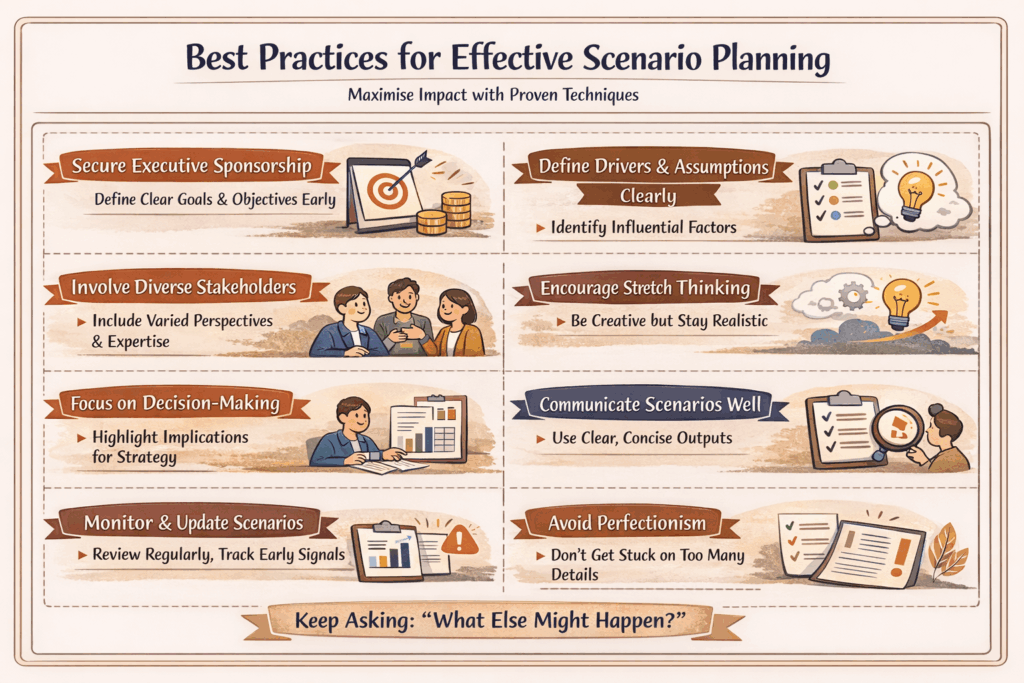
To maximise the value of scenario planning and avoid common pitfalls, organisations should follow a number of well-established best practices.
Secure executive sponsorship and define objectives early:
Leadership buy-in matters. So does clarity about the purpose of the exercise. Is the goal to inform a new strategy, test an existing one, or explore a specific uncertainty? Clear objectives keep the work focused and improve the odds that the results will be used.
Involve diverse stakeholders:
Scenario teams should not be homogenous. People from different functions, levels, and backgrounds can challenge assumptions and produce more balanced scenarios (Tapp, 2025). External experts may also add perspective where needed.
Define drivers and assumptions clearly:
Strong scenarios are built on clear assumptions and plausible logic. Teams should identify the most influential drivers, decide which are uncertain, and ensure each scenario remains internally consistent. It also helps to keep the number of scenarios manageable, usually three or four.
Encourage creativity without drifting into fantasy:
Scenario planning should stretch thinking, but it should still stay grounded. Workshops should encourage fresh ideas, yet those ideas must eventually be tested for plausibility and relevance.
Focus on decision-making utility:
Scenario planning should lead to action. The process should highlight what each scenario means for strategy, investment, risk management, and operations. If the result is just a set of interesting stories, the value will fade quickly.
Document and communicate scenarios well:
Scenario outputs should be easy to understand and share. Short summaries, one-page narratives, visuals, or comparison tables can make the scenarios more accessible across the organisation.
Establish monitoring and update mechanisms:
Good scenario planning is a living process. Organisations should track early indicators, review scenarios regularly, and update them when needed. Integrating them into annual strategy reviews or budgeting cycles is often a good way to keep them relevant.
Avoid perfectionism and fixation:
Teams should not try to produce too many scenarios or make them excessively detailed. Nor should they become emotionally attached to one preferred scenario. The point is not to predict correctly, but to think more broadly and prepare more intelligently.
By following these practices, organisations can turn scenario planning from an intellectual exercise into a practical strategic tool. When done well, it becomes part of the organisation’s DNA and encourages people to keep asking, “What else might happen, and are we ready for it?”
Conclusion
Scenario planning has proven itself to be a powerful approach for navigating uncertainty in business. From its origins in Cold War strategy work to its modern use in corporate boardrooms and government planning, its core insight remains the same: the future is unlikely to be a straight-line extension of the present, so wise leaders prepare for multiple possibilities.
In a world where sudden shocks, technological leaps, and major political shifts can disrupt the business landscape, scenario planning offers a way to be less surprised and more prepared. It helps organisations build strategies that are flexible, robust, and creative. In effect, it allows them to rehearse the future before it arrives.
For undergraduate and postgraduate students of business, scenario planning offers a valuable lens on strategic thinking that goes beyond number-crunching. For professionals and executives, it can strengthen both strategic foresight and risk management.
As discussed, the method requires careful execution. It needs clear objectives, broad perspectives, logical construction, and active use of the outputs. However, the rewards are significant. Firms that use scenario planning regularly often spot trends earlier, adapt faster, and recover more quickly from setbacks because they have already mentally travelled those paths.
Next steps
In closing, scenario planning should be seen as an ongoing journey rather than a one-off project. The world will continue changing in unexpected ways. The organisations that thrive will be those that not only plan for what they expect, but also prepare for what they do not. Scenario planning is the art and science of doing exactly that, enabling businesses to move into an uncertain future with eyes open and strategies ready.
Further reading
If you want to deepen your understanding of scenario planning, PESTLE analysis is a useful next step. It helps identify the political, economic, social, technological, legal, and environmental forces that often feed directly into scenario work. In practice, it is one of the clearest ways to map the external drivers that shape future uncertainty.
You may also find SWOT analysis helpful as a follow-on tool. Once scenarios have been developed, SWOT can help organisations test their internal strengths and weaknesses against the external opportunities and threats each scenario presents. This makes it a good bridge between scenario thinking and decision-making.
Stuck on your scenario planning? Don’t just reflect – act! Get an MBA-qualified writer to help you today. See our business assignment help page for info.
For those you enjoyed listening to explanations, Oberholzer Gee gives an excellent presentation in the video below.
References
- Ali, R. (2025) What Is Scenario Planning? Strategy, Steps, and Practical Examples. Oracle NetSuite Resource Articles, 8 September 2025. (Senior Product Marketing Manager, Oracle NetSuite).
- Cordova-Pozo, K. and Rouwette, E.A.J.A. (2023) ‘Types of scenario planning and their effectiveness: A review of reviews’, Futures, 149, 103153. DOI: 10.1016/j.futures.2023.103153.
- Great Lakes Integrated Sciences and Assessments (GLISA) (2025) Scenario Planning. University of Michigan. Available at: https://glisa.umich.edu/engagement/scenario-planning/ (Accessed: 30 September 2025).
- Kleiner, A. (2003) ‘The man who saw the future’, Strategy+Business, Spring 2003(30). Available at: https://www.strategy-business.com/article/8220 (Accessed: 30 September 2025).
- Tapp, F. (2025) Scenario planning: Tactics, frameworks, and examples. QuickBooks (Intuit) Blog, 9 May 2025. Available at: https://quickbooks.intuit.com/ca/resources/midsize-business/scenario-based-planning/ (Accessed: 30 September 2025).
- Wright, G., Cairns, G. and Bradfield, R. (2019) Scenario Planning for Future Futures. Palgrave Macmillan. (Note: Example reference for scenario planning methodology).
- Schwartz, P. (1991) The Art of the Long View: Planning for the Future in an Uncertain World. Doubleday. (Pioneering book on scenario planning by a former head of Shell’s scenario team).

Cite This Work
To export a reference to this article please select a referencing stye below: