Kotter’s 8-step change model
Info: 2452 words (10 pages) Study Guides
Published: 10 Dec 2025
Need support with an assignment on Kotter’s change model? Our UK-qualified writers can help you produce polished, high-quality work that stands out. Visit our management assignment help page to learn more.
John P. Kotter developed his eight-step change model to help organisations successfully implement major transformations in a systematic way.
Kotter (1995) studied over 100 companies undergoing change and identified common mistakes that cause change efforts to fail. He distilled these lessons into eight critical stages that leaders must address.
The model was first introduced in Kotter’s Harvard Business Review article “Leading Change: Why Transformation Efforts Fail” (1995). It was later expanded in his book Leading Change (1996).
It has since become one of the most widely recognised frameworks for change management, valued for its clear, step-by-step guidance (Appelbaum et al., 2012).
In essence, the model provides a roadmap for executives and change agents to follow. It helps them avoid pitfalls and build momentum so that new strategies take hold.
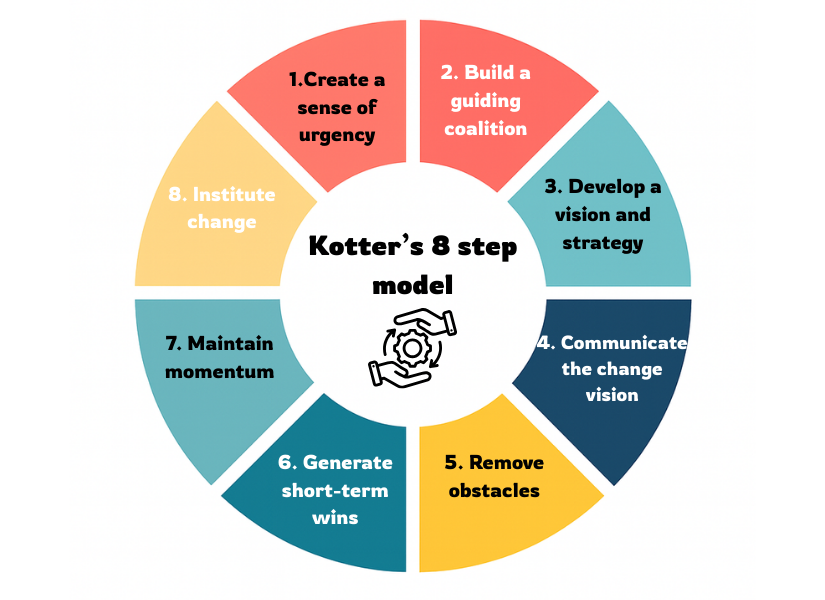
Kotter’s eight steps are as follows:
- Establish a sense of urgency: Highlight the need for change by revealing key threats or opportunities that make the status quo untenable.
- Form a powerful guiding coalition: Assemble a powerful and credible team to lead the change effort.
- Develop a vision and strategy: Craft a clear vision for the future and a strategy to achieve it.
- Communicate the change vision: Communicate the vision relentlessly and broadly, engaging hearts and minds across the organisation.
- Empower broad-based action: Remove obstacles and change any systems or structures that undermine the vision.
- Generate short-term wins: Plan for quick, visible “wins” and recognize the people who achieve them.
- Consolidate gains and produce more change: Build on early wins to drive bigger changes. Avoid complacency or declaring victory too soon.
- Anchor new approaches in the culture: Institutionalise new practices into the culture so the change sticks, for example by updating training and succession plans.
Each of these steps is discussed in detail below, along with guidance on how to carry them out effectively and common challenges to anticipate.
Step 1: Establishing a sense of urgency
Successful change begins with urgency. Leaders must convince stakeholders that change is not just desirable but absolutely necessary. This often involves presenting hard evidence (for example, declining financial results or emerging competitive threats) to show that the status quo is more dangerous than venturing into the unknown.
Kotter (1995) notes that more than half of change efforts fail at this first step. Often this is because managers underestimate how hard it is to push people out of their comfort zones. Therefore, it is crucial to spark an honest dialogue about threats and opportunities facing the organisation.
For example, a CEO might share troubling market data or even stage a looming crisis to grab everyone’s attention. The goal is to raise the sense of urgency to an exceptionally high level. Kotter (1995) suggests that roughly 75% of management and employees must genuinely believe that “business as usual” is untenable. Achieving this widespread conviction creates the motivation needed to mobilise initial change efforts.
Step 2: Forming a powerful guiding coalition
No leader can implement large-scale change single-handedly. The next step is therefore to build a guiding coalition – a committed alliance of key people who will lead and support the change.
This coalition should comprise influential individuals from different levels and departments, not just the top executives. Members of this coalition must have the trust of their peers. They also need the authority, expertise and energy required to drive the initiative.
The coalition’s role is to provide leadership beyond what a single person can offer. They coordinate the effort, model the desired behaviours, and maintain momentum.
Kotter (1995) argues that a strong coalition is essential. If a “critical mass” of supporters is not achieved early on, the change process can stall.
In practical terms, forming such a team might involve identifying change champions across the business. Those individuals can then be brought together to work as a team with a shared commitment.
The coalition’s power comes not only from formal titles, but also from informal influence. It should include respected voices whose backing will convince others to get on board.
Step 3: Developing a vision and strategy
For change to be purposeful and coherent, there must be a clear vision of what the organisation is trying to become.
The third step is to craft a compelling vision that describes the future state after the change. This vision provides direction. It paints a picture of how the future will differ from the past and why that future will be better.
Alongside the vision, leaders formulate a high-level strategy outlining how to realise it. A succinct and inspiring vision is critical because it aligns and motivates people. It gives everyone a shared sense of the intended destination, so they can coordinate their actions (Kotter, 1996).
Without an overarching vision, change initiatives can dissolve into a confusing array of incompatible projects. At worst, this can lead the organisation in the wrong direction or nowhere at all (Kotter, 1995). Therefore, developing the vision and strategy often requires the guiding coalition to distil complex ideas into core themes.
The vision should be ambitious yet realistic. Meanwhile, the strategy needs to be credible enough that people understand how the vision can actually be achieved. When done well, this step yields a “north star” for the transformation. This unifying purpose can then be communicated and reinforced at every opportunity.
Step 4: Communicating the change vision
Even a brilliant vision is useless if only a few people know about it. Step 4 is to communicate the change vision extensively and persuasively throughout the organisation.
This goes far beyond sending one email or holding a single town-hall meeting. It requires relentless repetition and the use of varied communication channels to ensure the message sinks in.
Kotter (1995) observed that many organisations under-communicate their vision “by a factor of ten or more.” In successful transformations, leaders weave the vision into daily conversations, presentations, and decisions at all levels. They use every available forum – from newsletters and management meetings to informal chats – to reinforce the vision.
Crucially, leaders must also “walk the talk” by aligning their own behaviour with the new vision. Nothing undermines a change message more quickly than leaders acting in ways that contradict it.
Effective communication of the vision is two-way as well. Leaders listen and encourage dialogue, addressing concerns and gathering feedback. The aim is to win not just minds but hearts. Employees need to understand and believe in the change so that they will be willing to make short-term sacrifices.
When people see a clear, consistent vision and hear it constantly emphasised, it galvanises them. They understand what the goal is and why it matters.
Step 5: Empowering broad-based action
With the vision communicated, employees should be empowered to turn that vision into reality. In practice, this means removing barriers that hinder people from acting on the change.
Obstacles can come in many forms – for example, outdated structures, burdensome procedures, or managers who resist the change. Leaders must actively identify and dismantle these impediments.
Management should adjust organisational structures and align systems (such as performance appraisals and reward schemes) with the new vision. Providing the necessary resources also enables employees to contribute fully.
An important part of empowerment is fostering a culture that encourages innovation and prudent risk-taking in support of the change. If staff fear punishment for trying new approaches, they will revert to old habits. Therefore, managers should model openness to new ideas and explicitly reward behaviour that advances the change.
Kotter (1996) points out that empowerment can involve tough decisions – such as moving aside managers who block progress.
Step 5 is fundamentally about clearing the path so that the broader organisation can make the vision happen. When people feel unshackled and supported, they can act much more nimbly. They are far more likely to implement new ways of working.
Step 6: Generating short-term wins
Change of any significant scale can take a long time – often years. To keep momentum and motivation high over such a duration, Kotter emphasises the need to create short-term wins. These are visible, unambiguous successes that can be achieved within a relatively short timeframe (for example, within the first year).
By planning for some quick, meaningful victories, leaders provide proof that the effort is paying off. This evidence helps silence critics and convert skeptics. Early wins also have a powerful psychological effect. They reward the team’s hard work and encourage everyone to persist.
It is important that these wins are not left to chance. Instead, change leaders should deliberately identify opportunities where even a modest investment can yield tangible improvements in performance or quality.
For example, a company might pilot a new process on a small scale. It can then publicly celebrate the resulting efficiency gains. Each win should be visibly communicated and the contributors recognised. This practice builds credibility for the change and makes people proud to be part of it.
Kotter (1995) distinguishes creating short-term wins from simply hoping for them. Proactive planning and pressure for results are needed. Without early wins, people may lose faith or energy, and some may even join the opposition.
Thus, step 6 serves as a crucial midpoint that fuels the later stages of the transformation. It shows that progress is not only possible but already happening.
Step 7: Consolidating gains and producing more change
After initial wins, there is a natural temptation to relax or declare victory.
Step 7 warns against this complacency and urges leaders to press harder with the insights and credibility gained so far. Early successes should be used as stepping stones to tackle additional, deeper challenges. This might mean expanding the scope of change initiatives or addressing tougher process problems. It could also involve fixing structures that still don’t align with the vision.
At this stage, Kotter advises that it’s vital to keep urgency up and not let momentum falter. Declaring the mission accomplished too soon can be fatal. It often causes the organisation to slip back into old habits (Kotter, 1995). Instead, leadership should treat the initial wins as proof of concept and empowerment to drive more change.
For example, suppose a new software system is successfully rolled out in one division as a short-term win. The team can then leverage that credibility to push for revamping outdated systems across the company.
Additionally, step 7 often involves bringing in new change agents and promoting employees who can champion the vision. Leaders also reinvigorate the process with fresh projects and initiatives.
The key is to continuously build on the momentum: each win should lead to more action and more improvement. By consolidating gains in this way, the change effort avoids stagnation. It achieves progressively larger transformations instead of plateauing.
Step 8: Anchoring new approaches in the culture
The final step of Kotter’s model focuses on ensuring that the changes will endure.
To truly “anchor” new approaches in the organisational culture means making them part of the company’s DNA. In essence, the changes become part of the shared values and norms that guide behaviour when no one is watching.
In practice, this often takes place only after the tangible benefits of the change are evident. People need to see how the new ways have improved outcomes so that they connect new behaviours with success. Therefore, leaders should consciously highlight and celebrate examples of the change yielding results. They should link these successes to the organisation’s overall performance. Over time, this helps shift assumptions about “how we do things here.”
Kotter (1996) also stresses the importance of leadership succession in anchoring change. The next generation of management must personify and promote the new approaches. This may involve succession planning and leadership development aligned with the change values.
For instance, the organisation should reward managers who exemplify the new culture and remove those who persistently defy it. Policies and processes (from hiring criteria to training programmes) should likewise be updated to reflect the new norms.
It is important to recognise that culture change comes last, not first. Attempts to change culture prematurely usually fail. Instead, culture evolves as a result of consistent new behaviour and success over time.
By step 8, the organisation should have integrated the changes into its identity. The transformation no longer depends on a few individuals, but is sustained by shared practices. When the change has become “the way we do things”, it is anchored in the culture – and thus it is likely to endure.
Conclusion
Kotter’s 8-step change model remains a cornerstone of change management practice and theory, decades after its inception.
The model’s strength lies in its intuitive sequence. It addresses the psychological and organisational hurdles in the order they typically need to be overcome.
In Kotter’s model, change begins with mobilising urgency and leadership commitment, then moves through executing the change, and finally ends with cementing new practices in the culture. The framework is prescriptive, which provides clarity to leaders navigating complex change.
However, it is not without criticism. Some scholars have argued that Kotter’s approach is overly linear or rigid. They note that real change can be messier and may require iterative or overlapping steps (Appelbaum et al., 2012; Pollack and Pollack, 2015).
Moreover, the model emphasises top-down leadership. This may neglect grassroots innovation or the emotional complexities that individuals experience during transitions.
Despite these caveats, Kotter’s steps provide an invaluable checklist of “must-do” components for most large change initiatives. These steps remind practitioners to lay a solid foundation by establishing urgency and building a coalition. They emphasise crafting and communicating a clear vision, and empowering people while celebrating progress. Importantly, Kotter urges leaders to never let up until the new ways are firmly embedded.
In today’s fast-paced environment, Kotter (2012) has suggested that organisations must become more agile. He proposes developing dual operating structures to drive change faster. Yet the essence of the original 8-step model continues to hold true: organisations still need strong leadership and a holistic, disciplined approach to change.
If leaders follow these steps closely, and adapt them thoughtfully to their context, organisations can significantly improve their chances of achieving lasting transformation.
Need support with an assignment on Kotter’s change model? Our UK-qualified writers can help you produce polished, high-quality work that stands out. Visit our management assignment help page to learn more.
References
- Appelbaum, S. H., Habashy, S., Malo, J. L., & Shafiq, H. (2012). Back to the future: Revisiting Kotter’s 1996 change model. Journal of Management Development, 31(8), 764–782.
- Kotter, J. P. (1995). Leading change: Why transformation efforts fail. Harvard Business Review, 73(2), 59–67.
- Kotter, J. P. (1996). Leading Change. Boston: Harvard Business School Press.
- Kotter, J. P. (2012). Accelerate!. Harvard Business Review, 90(11), 45–58.
- Pollack, J., & Pollack, R. (2015). Using Kotter’s eight stage process to manage an organisational change program: Presentation and practice. Systemic Practice and Action Research, 28(1), 51–66.

Cite This Work
To export a reference to this article please select a referencing stye below: