International student’s guide to starting a PhD in the UK
Info: 7618 words (30 pages) Study Guides
Published: 05 Apr 2026

Starting a PhD in the UK? If you need support with your proposal or thesis, our PhD-qualified experts are here to help. Explore our PhD thesis help services.
Embarking on a PhD in the UK is an exciting journey, but moving to a new country for research also comes with practical and cultural challenges. This comprehensive guide will help international PhD students navigate everything from visas and bank accounts to British academic culture. We focus on easing your transition so you can settle in quickly and focus on your research.
Visa applications and immigration
Understand the Student Visa requirements:
Most international PhD students will need a Student Visa (formerly Tier 4). Ensure you have an unconditional offer and a Confirmation of Acceptance for Studies (CAS) from your university before applying (British Council 2025). You can typically apply up to six months before your course start date. Decisions usually take around 3 weeks.
The application involves paying a fee (around £524) and an Immigration Health Surcharge (IHS) for NHS healthcare (British Council 2025). As of 2025, the IHS is £776 per year of your visa, so budget accordingly (British Council 2025).
Be prepared to demonstrate your English proficiency and financial resources for living costs and fees. For example, UK visa guidelines expect students to show funds of about £1,483 per month for London and £1,136 per month for other areas (UK Home Office 2023). This reflects the higher cost of living in the capital.
If you’re from a country requiring a tuberculosis test or an Academic Technology Approval Scheme (ATAS) certificate for certain research fields, arrange these well in advance.
Gather important documents:
Before travelling, compile a folder of essential documents. Carry your current passport, visa decision letter (or eVisa details), CAS information, and university offer letter in your hand luggage for immigration clearance.
It’s also wise to bring original or certified copies of your degree certificates and transcripts. Universities often require your previous qualifications during registration. Having these on hand will save you trouble.
Additionally, bring at least one photo ID besides your passport (e.g. driver’s licence) and several passport-sized photographs. These can be useful for student ID cards or other formalities.
Plan for the IHS and healthcare:
When you pay the IHS during your visa application, it grants you access to the UK’s National Health Service. This means that once you arrive, you’ll generally be entitled to free healthcare like any resident (UKCISA 2022). Keep the IHS payment confirmation. Note that if your visa is extended, or if you bring dependants, additional IHS fees apply.
The IHS might seem costly, but it covers most medical needs without further payment. However, consider budgeting extra for dental and optical care, as NHS dentistry is not fully free and opticians charge for eye tests and glasses.
Prepare for entry clearance:
At the UK border, you may be asked about your study plans. Keep the address of where you’ll be staying on your first night, your university’s name, and your CAS number accessible. Answer questions confidently and truthfully about your PhD programme.
Student Visas now use eVisas (digital status) instead of physical residence permits (British Council 2025). You might just show the entry clearance vignette in your passport, if provided, or a digital confirmation.
After crossing the border, you no longer need to collect a Biometric Residence Permit (BRP). The system is digital. Therefore, make sure you’ve created your UK Visas and Immigration account to manage your eVisa status before or shortly after arrival (British Council 2025).
Pre-departure planning and essentials
Make a checklist before departure:
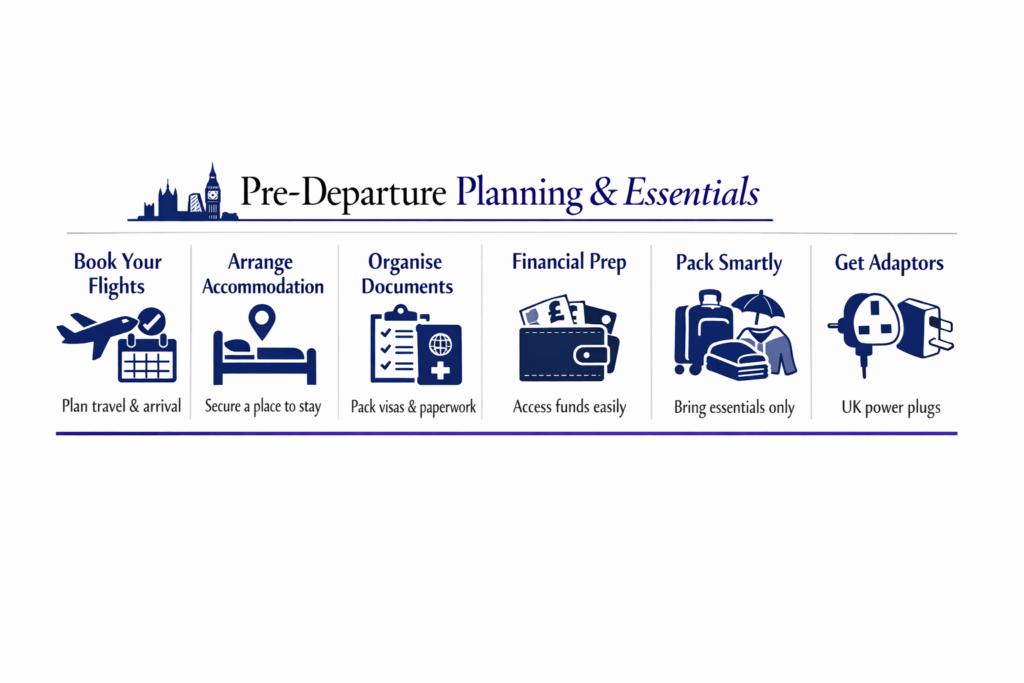
Good preparation can smooth your landing in the UK. Create a checklist of tasks and items for the weeks before you leave. Key items include:
Travel and flight arrangements:
Book your flights early and aim to arrive at least a week or two before your PhD start date. This gives you time to settle in. Check if your university offers an airport pick-up service for international students. Otherwise, plan your route from the airport by researching trains, coaches or taxi options, and make sure you have British currency or a credit card ready to pay for transport.
If you have not secured long-term housing yet, book temporary accommodation for your first few nights. Many students opt for a short hotel or hostel stay, or university guest accommodation, while searching for permanent housing (Teesside University 2023). Having a place pre-booked means you won’t be stranded with luggage in a new city. Use this initial period to recover from travel and to view rental properties in person if needed. Remember, arriving early also increases your chances of getting your preferred university housing if you’re on a waiting list.
Temporary accommodation:
If you haven’t secured long-term housing yet, book temporary accommodation for your first few nights. Many students opt for a short hotel or hostel stay, or university guest accommodation, while searching for permanent housing (Teesside University 2023). Having a place pre-booked means you won’t be stranded with luggage in a new city. Use this initial period to recover from travel and to view rental properties in person if needed. Remember, arriving early also increases your chances of getting your preferred university housing if you’re on a waiting list.
Important paperwork:
Aside from visa and academic documents, pack your financial documents (scholarship award letters or funding proof if you have any, proof of savings you showed for the visa) and health records. It’s useful to bring copies of vaccination records or prescriptions. For example, if you take regular medication, bring a supply and a doctor’s note or prescription (in English) in case you need to arrange refills with a UK doctor. Likewise, have digital scans of all key documents stored securely online as a backup.
Financial planning:
Plan how you will handle money for the first few weeks. Opening a UK bank account can take some time (see the banking section), so ensure you have access to enough funds to cover initial expenses like accommodation deposits, food, and local travel. You might bring a combination of cash (a modest amount for immediate needs, like £150-£300) and a credit/debit card that works internationally. Do not carry large sums of cash for safety and because there are limits on bringing cash (UCL 2023). Instead, consider using travel cards or online banking apps. Some modern digital banks (Monzo, Revolut) allow you to set up an account via app even before you have a proof of UK address (UCL 2023). These can be very handy to have money accessible upon arrival.
Packing wisely:
The UK’s weather is temperate but variable. Bring some warm clothing and a waterproof coat or umbrella, as rain is common year-round. For PhD students, there’s no formal “uniform,” but packing a mix of casual wear and a few smarter outfits (for conferences or formal events) is wise. Don’t overpack things that you can easily buy in the UK (like basic bedding or kitchen items if you’ll move into furnished student accommodation) – save luggage space for personal and important items. If you will live in university halls, check what is provided; often you may need to buy kitchen utensils or bedding, but you can get these after arrival. Some universities even offer “arrival packs” with bedding/kitchen essentials for international students to purchase, so check if that service exists. Lastly, remember UK electrical outlets are unique (three-pin plugs and 230V supply), so bring a couple of plug adaptors for your laptop and phone chargers.
Finding accommodation and understanding living costs
University accommodation vs private renting:
Decide early whether you want to live in on-campus or university-managed accommodation or rent privately. Many universities guarantee accommodation to international postgraduates if you apply by a deadline. University halls or postgraduate residences offer convenience – the utility bills and internet are usually included, and you’ll have an instant community of fellow students. This can ease you into social life.
However, spaces can be limited for PhD students and may be a bit pricier than sharing a private flat. If you prefer independence or family-friendly housing, the private sector might suit you. Research the rental market in your university’s city before arrival. Contact your university’s accommodation office for guidance – they often keep lists of trusted landlords or student housing agencies.
If opting for private housing, be prepared to pay a deposit (typically equivalent to 4–5 weeks’ rent) and at least a month’s rent upfront. You’ll need a budget for furniture if the flat is unfurnished (many student lets are furnished, but always confirm). Inspect properties in person if possible.
It’s common to book short-term lodging and then view apartments or rooms once you’re in the UK, so you can assess neighborhoods and conditions. Be cautious of scams – never pay money to a landlord or agent before viewing a place or having a confirmed tenancy offer. Use reputable websites or university housing forums. Cities often have Facebook groups or student union boards where seniors advertise spare rooms.
Costs and budgeting:
The cost of living can vary widely depending on where you live. Major cities like London are considerably more expensive than other parts of the UK. For example, rent in London can easily be double the cost of a similar-sized room in a smaller city. The UK Home Office expects a single student in London to need around £12,000 for 9 months, which is roughly £1,334 per month. Outside London, the estimate is around £9,200 for 9 months, or £1,023 per month (UK Home Office 2023). This is a useful benchmark when planning your budget.
If you are moving to London, make sure you account for higher accommodation and transport costs. In other parts of the UK, accommodation is often cheaper and may be within walking distance of campus, which can help reduce transport spending. As one PhD student noted, “the cost of living in Belfast is relatively cheaper compared with many other parts of the UK” (Famakinde 2024). In fact, Northern Ireland currently has the lowest student living costs in the UK (Famakinde 2024).
Planning your monthly budget
Wherever you are based, it helps to draft a sample monthly budget. Include rent, utilities if these are not already covered, food, transport, your phone bill, and some personal spending. It is also important to factor in one-off costs at the start of your PhD, such as winter clothing, a bicycle, or basic housewares.
Ways to save money
To reduce costs, make the most of student discounts. Once you have your student ID card, which is usually issued during enrolment, you can buy a TOTUM/NUS card for discounts in shops and restaurants. You may also be eligible for a 16–25 Railcard, or a 26–30 Railcard if you are a mature student, which gives you one-third off train fares. This can be especially useful if you plan to explore the UK or commute by train. Many cities also offer discounted student bus passes.
Cooking at home and shopping at budget supermarkets such as Aldi or Lidl can make a big difference compared with eating out regularly. PhD stipends, where available, are usually modest, so being careful with money helps. At the same time, many UK campuses offer inexpensive places to eat, as well as free social events with refreshments, especially during induction weeks. This means socialising does not always have to be expensive.
Temporary accommodation tips:
If you arrive without permanent housing, use your first week to secure a place. As mentioned, have a short-term stay booked. During those initial days, explore areas near the university. Walking around can give you a feel for which neighborhoods are safe and convenient. In those walks, “Google Maps will be of immense help in navigating your way without hassle” as one international student in Belfast pointed out (Famakinde 2024). It helps to mark important locations (campus, grocery stores, bus stops) and see how close prospective accommodations are. Many UK cities are quite walkable, and knowing the layout will also ease your transition when you move into your longer-term home.

Setting up a UK bank account and managing finances
Opening a bank account:
Setting up a UK bank account should be one of your first practical tasks after arrival. It enables you to pay rent, receive any stipend or salary, and avoid foreign transaction fees. Most banks require you to prove your identity and UK address (UCL 2023). Typically, you will need your passport and evidence of your immigration status, such as your visa stamp or share code for an eVisa. You will also need a document confirming your UK address and student status.
After you complete university enrolment, you can request a “bank letter” or student status certificate from your university. This letter is addressed to the bank. It confirms your student status and the local address you have registered with the university. It is an essential document for bank applications (University College London 2023). Make sure you update your term-time address in the university system as soon as you have a permanent place to live. This ensures the letter reflects the correct address.
Research which bank might suit you, as many major banks, including HSBC, Barclays, and Lloyds, offer basic accounts for students. A basic bank account is usually fee-free and provides essential features (UKCISA 2025). Some banks have specific accounts for international students. A few digital banks, such as Monzo or Starling, can be opened through an app. These often accept alternative address verification and can be quicker to set up. Note that some banks may not accept your foreign phone number or email initially. Getting a UK mobile number early can make the process easier and help with receiving verification codes.
Initial money access:
Because opening an account can take one to two weeks, it is important to plan how you will cover expenses meanwhile. There may be identity checks and a wait for your debit card. Many international students use a prepaid travel currency card or services like Wise to hold some funds in GBP. As UCL advises, it is not wise to carry large sums of cash because of safety concerns and customs regulations (UCL 2023).
If you brought a credit card from home, make sure it will work abroad and that you understand any fees. Using your home bank card at UK ATMs is fine occasionally. ATMs at banks are generally free to use and are often called “cashpoints”. However, your home bank may still charge a withdrawal fee. Having a small amount of British cash for immediate needs is usually the best approach. This could include a taxi or a meal on your first day, alongside a plan for cashless spending. Contactless payments by phone or card are very common in the UK.
Budgeting and monitoring:
Once your bank account is open, you may find it helpful to use budgeting apps or your bank’s mobile app to track your spending. Many UK banking apps categorise expenses. This can help you see where your money is going, for example, how much you spend on coffee or books in a month. As a student, it is also worth watching for student perks. Some banks offer incentives such as free railcards or Amazon vouchers for new student accounts.
However, do not be drawn in by gifts alone. Make sure the bank has a local branch if you might need in-person help. Also check that it does not charge high fees. It is also wise to avoid overdrafts where possible. UK student accounts for undergraduates sometimes include overdraft facilities. However, as an international postgraduate student, you may not be offered a large overdraft. It is best to treat credit carefully, especially as your visa will likely restrict work hours. Usually, this means no more than 20 hours per week during term. This may limit your income if you rely on a stipend or part-time job.
Finally, be mindful of transferring money internationally. Bank transfers from overseas can incur fees. Services such as TransferWise, now Wise, or Western Union student services may offer better exchange rates. Plan ahead for tuition payment deadlines by knowing when your fees are due. Also make sure your funds arrive in time. Universities often have international payment platforms to simplify this process. If a sponsor or scholarship is paying your fees, stay on top of any paperwork needed to ensure payment is made on time.
Registering for healthcare (NHS) and well-being
Register with a GP as soon as possible:
The National Health Service (NHS) will be your healthcare system in the UK. Since you’ve paid the IHS, you are entitled to NHS services on the same basis as a UK resident. To make use of this, register with a local General Practitioner (GP) – a doctor’s clinic – soon after you settle into your address. NHS guidance emphasises that students should register with a GP near the university rather than waiting until they get sick (NHS 2021).
By registering early, you ensure you can access free medical appointments and emergency care without delay. Most universities either have a health centre on campus or can recommend nearby GP practices familiar with student health needs. During welcome week, some campuses even host registration drives where you can fill out the GP registration forms on the spot.
Typically, you will need to provide your address and show your student ID or passport at the GP surgery. Once registered, you’ll receive an NHS number by post. Keep that number safe, as it will be used for appointments and referrals.
NHS services and what to expect:
After registering, you can use local NHS services. Consultations with your GP are free. If you need specialist care, your GP will refer you to an NHS hospital or clinic. Prescriptions (medications) in England have a standard charge (currently around £9-10 per item), but in Scotland, Wales, and Northern Ireland, prescriptions are free for residents including students. It’s useful to know this regional difference if you’re studying outside England.
Dental and optical care are not fully covered by the NHS for students, but you can apply for partial cost coverage via the HC1 form (a low income scheme) if money is tight. Many students choose to register with an NHS dentist for routine check-ups (there is a cost, but it’s subsidised). Do this early as well because dentists can have waiting lists.
Also consider getting necessary vaccinations. Universities and the NHS recommend that students have the MenACWY vaccine (against certain strains of meningitis) and two doses of the MMR vaccine (measles, mumps, rubella) (NHS 2021). If you didn’t get these back home, the GP can provide them for free.
Mental health and well-being:
Pursuing a PhD can be intense, and being far from home adds to the emotional challenge. UK universities place a growing emphasis on student well-being. Don’t hesitate to utilise counselling services or mental health support on campus if you feel stressed, anxious, or homesick. Talking to someone early on can be really helpful. The culture in the UK is quite open about mental health – seeking help is seen as a proactive and normal step, not something to be ashamed of.
Universities often have a Student Wellbeing office with trained advisors. Additionally, keep an eye out for workshops or resources on maintaining work-life balance (some grad schools run sessions on stress management, etc.). Simple habits will safeguard your health: maintain a reasonable sleep schedule, and try to eat nutritiously even when you’re busy.
As one NHS student guide bluntly puts it, university life isn’t known for early nights or strict diets, but regular sleep and healthy food will boost your energy and resilience (NHS 2021). Balance those late-night study sessions with adequate rest and some exercise. Many institutions have affordable sports facilities or clubs – joining the campus gym or a weekly football game can help you stay fit and meet people.
Emergency information:
Familiarise yourself with what to do in an emergency. The number 999 is for urgent life-threatening emergencies (ambulance, fire, police). If it’s a medical issue that’s not life-threatening but you need advice quickly (for example, you have a fever at night and are not sure what to do), you can dial 111 – the NHS non-emergency medical helpline. They can advise whether you should visit a pharmacy, see a doctor the next day, or go to an urgent care centre. Save these numbers in your phone.
Also, note the location of the nearest hospital with an Accident & Emergency (A&E) department and the nearest walk-in clinic. Hopefully you won’t need them, but it’s good to know. If you have a chronic condition, register with relevant services or inform your GP so they can connect you to specialist care as needed (for example, if you’re diabetic, you’ll want to set up with an NHS diabetes clinic for ongoing support).
Adapting to UK academic culture
Expectation of independence:
UK PhD programmes are typically research-focused from day one, with fewer taught classes than some other countries. This means you are expected to drive your project forward proactively. Supervision style might be more hands-off than you’re used to. Supervisors will guide you in regular meetings (perhaps weekly or fortnightly, depending on the field and individual arrangement), but you won’t be micromanaged. It’s important to take initiative – set your own mini-deadlines for literature reviews, experiment milestones or chapter drafts. Don’t wait for your supervisor to tell you exactly what to do next at every step. That said, supervisors are there to help, so keep them updated and ask for feedback or advice when you need it. British academics often understate criticism in order to be polite – for example, if a supervisor says a piece of writing is “not bad,” it might mean it’s good but has room for improvement. Learn to probe gently for clearer feedback if needed (e.g., “I’m glad it’s not bad; what aspects do you think I should improve further?”).
Addressing and communicating with academics:
In the UK, the academic hierarchy exists but is often informally expressed. It’s usually fine to address your supervisor by their first name unless they prefer otherwise. Many professors will introduce themselves as “John” rather than “Professor Smith.” If unsure, listen to how they refer to themselves or how others address them. Email communication can also be a bit more formal at first – start with “Dear Dr [Surname]” if writing to a new contact, but your daily emails with your supervisor or peers may quickly become casual with “Hi [Name]”. British academic culture values politeness (plenty of “please” and “thank you” in requests), and indirect speech is common. For example, instead of saying “You are wrong about X,” a colleague might say, “I’m not entirely convinced about X” or “Perhaps we should re-examine X.” This is not meant to confuse – it’s just a softer communication style. With time, you will recognise these nuances and even adopt them.
Academic norms and resources:
Get to grips with the resources available for research students. Most universities have a Doctoral College or Graduate School that provides training beyond your specific project – workshops on research ethics, academic writing, data analysis, or presentation skills. Attend these, especially early on, as they not only equip you with skills but also let you meet fellow PhD students from other disciplines. Moreover, learn the terminology of a UK PhD: for instance, the “viva voce” (often just called “viva”) is the oral examination at the end of your PhD where you defend your thesis before examiners. It’s a crucial part of the process in the UK system – unlike some countries that have public defences, the UK viva is usually a closed-door meeting with two examiners. Knowing about it from the start can help you prepare gradually (for example, by presenting at seminars or doing mock interrogations of your work with colleagues to build confidence).
In many UK universities, PhD students also have an annual or mid-term progress review or “upgrade” (if you are initially registered for an MPhil/PhD and then “upgrade” to full PhD candidacy). Take these reviews seriously; they’re meant to ensure you’re on track and identify support you might need. They may involve submitting a report or having an interview panel. Culturally, these checkpoints are not meant to be intimidating (most students pass them fine) but are an opportunity for fresh eyes on your work. If your university assigns you a secondary supervisor or mentor, use them as an additional support source, especially if you have any concerns about your main supervision.
Overcoming language and accent barriers:
Even if you’re fluent in English, you may still go through a period of adjustment when it comes to UK accents and academic language. The UK is home to a wide range of accents, and a Glaswegian (Glasgow) accent, a Geordie (Newcastle) accent, or a Welsh lilt may sound very different from the standard English you have heard in textbooks or films. Do not be discouraged if you find yourself asking people to repeat themselves at first. In fact, research has shown that unfamiliar native accents are one of the biggest hurdles in listening comprehension for international students (Vasquez Diaz & Iqbal 2024). In one study, 72% of students from non-English-speaking countries said regional British accents were a major barrier to understanding lectures initially (Vasquez Diaz & Iqbal 2024).
The encouraging part is that this usually improves with exposure. More than 70% of students become comfortable with local accents within one to six months (Vasquez Diaz & Iqbal 2024). If someone is speaking too quickly or their accent is difficult to follow, it is perfectly acceptable to say, “Sorry, could you repeat that more slowly?” Most people will be understanding and happy to help. Universities may also offer in-sessional English support classes or accent-focused resources. For example, some institutions run sessions on listening skills for different accents or provide conversation groups.
Building confidence through language support
If English is not your first language, it is worth making use of any English language support classes available. These may cover academic writing conventions, presentation skills, or more general language development. One student from China reflected that attending sessional English courses on local culture, academic English and presentation skills “helped [her] get well prepared for life, research and the dissertation process… and improved [her] skills in using English” (Wang 2024). As her language skills improved, her confidence also grew (Wang 2024).
You can expect something similar. As you become more comfortable using English, you are likely to participate more actively in seminars and enjoy a richer social life.
Adjusting to British academic language
For self-study, try reading academic papers in your field regularly so you can become more familiar with discipline-specific terminology. If possible, join a journal club or writing circle. This can strengthen both your comprehension and your writing style.
It is also worth remembering that British academic writing may favour a slightly different style from what you are used to, such as more caution or understatement in claims. Paying attention to how experienced researchers write, and seeking feedback on your own drafts, will help you adapt to these expectations more confidently.
Social integration and building your community
Connect with fellow students:
Moving to a new country can be isolating at first, but UK universities have vibrant communities to welcome you. During your first weeks, make the most of orientation events. Many campuses organise special welcome sessions for international students and postgraduate students. These might include campus tours, social mixers, or information fairs. Attending these events is a great way to meet people who are in the same boat as you. Don’t be shy – everyone is new and looking to make friends.
You may also be introduced to a “buddy” or mentor, as some universities pair new international students with a current student. If your university or students’ union offers this, signing up can give you an immediate friendly contact who knows the area.
Join student societies:
A huge benefit of university life is the abundance of clubs and societies. There will be academic societies, such as a science society or literature circle, as well as sports clubs, hobby groups, and cultural or national societies. For international students, joining your country’s student society, if one exists, can be comforting because it connects you with compatriots who have already navigated the move.
For example, at Queen’s University Belfast, the Nigerian Society provides a close-knit community for Nigerian students to support each other (Famakinde 2024). Damilare Famakinde, a Nigerian PhD student, noted that having a larger group of Nigerians on campus made it easy to feel at home and build friendships, and being part of the Nigerian Society helped him interact with others from his culture (Famakinde 2024). Such groups often celebrate festivals such as Diwali or Chinese New Year, cook traditional meals together, and provide a sense of belonging. They are usually very welcoming to new members.
Simultaneously, interact with local and other international students too – don’t limit yourself to one circle. Joining interest-based societies, such as a photography club, a volunteering group, or a sport, will mix you with British students and others from around the world who share that interest. It gives you conversation starters beyond “Which country are you from?” and helps you integrate.
If you’re not sure where to start, the Freshers’ Fair, or postgraduate equivalent, at the start of term showcases all the clubs. Go along and sign up for a few that intrigue you. Even as a PhD student, you can and should take part in such extracurriculars for a fuller experience.
Use online platforms and local networks:
Outside the university, there are community groups and meetups that can expand your social network. Websites and apps like Meetup have groups for everything – hiking enthusiasts, tech meetups, language exchange gatherings, and book clubs in your city. Joining a couple of Meetup groups can help you meet people outside the university bubble, including local residents, which enriches your cultural experience.
Facebook and WhatsApp groups are also popular among international student communities. You’ll often find Facebook groups named things like “Indians in Manchester” or “International Students in Glasgow”, where members post questions, organise get-togethers, or sell second-hand items. These can be useful for getting peer advice, for instance on where to find ingredients for your home cuisine or tips about local services. Just exercise the usual caution with online groups and meet in public places first if you’re meeting someone new via social media.
Embrace the culture (while sharing yours):
The UK has a rich culture, and each region has its quirks. Embrace opportunities to experience it, whether that means attending a local music festival, watching or playing a bit of football or cricket, or celebrating Bonfire Night or Christmas markets. British colleagues or flatmates will appreciate your interest, and you can invite them to experience your culture’s festivities in return.
Universities often hold multicultural events where you can showcase your country, such as food fairs or international student showcases. Getting involved in these not only fights off homesickness by celebrating your own culture, but also educates others and fosters mutual respect.
At the same time, understand that social customs might differ. For example, British people often socialise at pubs, which are like casual bars. You can go to a pub and enjoy the atmosphere even if you don’t drink alcohol, as it is common to just have a soft drink. Pub quizzes, where teams compete in trivia, are a fun weekly ritual in many areas and a great way to mingle with locals.
Don’t worry if you miss some references in conversations, such as niche British TV shows or slang. People will usually explain if you ask. By being open and curious, you’ll gradually decode the humour and idioms. Remember, feeling a bit of culture shock initially is normal. You might find communication styles more or less formal than you expect, or the food or weather strange. Give yourself time to adjust, maintain an open mind, and keep a sense of humour about the little misunderstandings that may occur.
Handling homesickness and finding support:
There will likely be times when you miss home or feel out of place. Combat this by creating a support system. Identify a few friends or colleagues you can talk to honestly, as chances are they feel similarly at times. Schedule regular calls with family or friends back home, but also try to establish a sense of home in the UK.
Little things like cooking your comfort food, practising your faith at a local place of worship, or decorating your room with familiar items can help. The UK is diverse, and most cities have mosques, temples, gurdwaras, churches, and other places of worship. If you come with a spouse or family, link up with any “International Families” networks, as some student unions have activities for families or partners.
Universities often have an International Student Support office. They are not just there for paperwork. You can approach them if you struggle with adjusting, and they may connect you to resources or even organise day trips to explore places, which can help you bond with others.
Taking care of practical matters in your first weeks
University registration and admin:
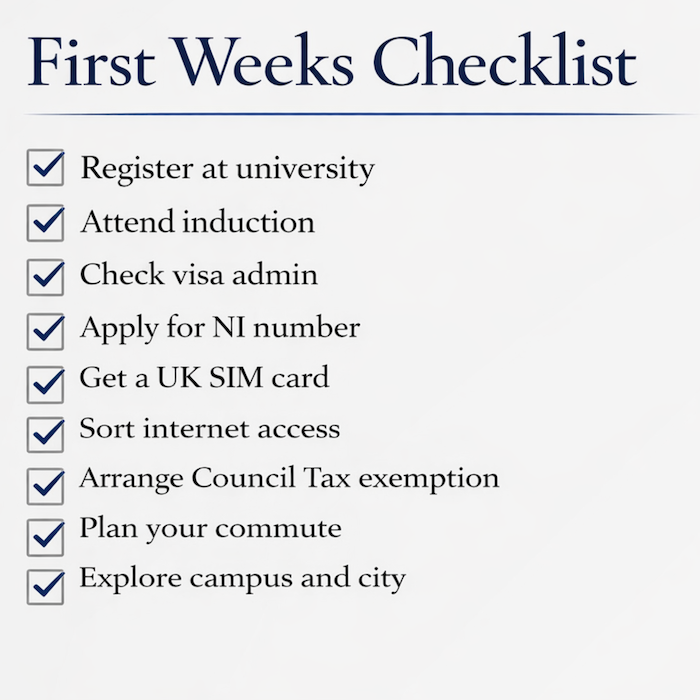
Soon after arrival, you’ll go through the official university registration. This usually involves presenting your passport/visa in person, collecting your student ID card, and registering for the university IT systems. Attend any induction sessions for your department or doctoral college. These meetings will clarify important details: safety inductions, how to access laboratories or libraries 24/7, research integrity training, etc. You may also need to enrol with the police within 7 days if it’s a condition on your visa (check your visa vignette; note that as of recent years, the police registration requirement has been abolished for most nationalities, but verify current rules). If it does apply to you, your university will assist by giving instructions on how to register with the local police (it usually involves an online form and a visit to a police station with your documents).
National Insurance (NI) number:
If you intend to work part-time or as a teaching/research assistant, you’ll need a National Insurance number for tax purposes. Students on a Student Visa are allowed to work up to 20 hours per week during term time (and full-time in vacations, which for PhDs generally means between years or during university closures). To get an NI number, you can apply online through the government website once you’re in the UK. The process may require an identity verification appointment or just mailing documents. It’s a good idea to start this early if you plan to work, as it can take a few weeks. Some universities arrange NI number interviews on campus for international students – keep an eye out for that service.
Phone and internet:
Getting a UK mobile SIM card quickly is useful – it provides you a local number for bank verification texts, contacting landlords, and staying in touch with new friends. You can pick up a pay-as-you-go SIM at the airport or in any mobile phone shop (popular networks include O2, Vodafone, EE, Three, Giffgaff). Many offer inexpensive monthly plans (for example, £10-£20 per month for calls, texts, and data). Having data on your phone will also help you navigate around with maps or look up information on the go. If you’re in university accommodation, internet is typically provided. In private accommodation, you’ll have to set up broadband – check with your flatmates or landlord what provider to go with. Broadband installation can take some time, so meanwhile, campus Wi-Fi will be your lifeline for online needs.
Council Tax:
In the UK, most towns and cities levy a local tax called Council Tax on residences. The good news: full-time students are generally exempt from paying Council Tax. But if you live off-campus in a private accommodation, you must take action to ensure you are not billed. Typically, you’ll fill out a Council Tax exemption form through your city council’s website, and provide proof of your student status (your university can issue a letter for Council Tax exemption). If you live with non-students (e.g., your spouse is not a student, or you share with working professionals), the situation may vary – usually the household gets a discounted bill. It’s important to handle this early so you don’t end up with a surprise bill. Check with your university’s student advice centre on the procedure specific to your city.
Transportation and commuting:
As you settle in, figure out your daily commute. If you live on or near campus, lucky you – you can walk or cycle. If not, explore student deals for public transport. Many cities have student bus passes. In London, get a Student Oyster photocard for 30% off travelcards on the Tube/bus network. In other cities, buses or trams might have term passes. Cycling is another popular mode for students – consider buying a second-hand bicycle (but also invest in a good lock and maybe a helmet, safety first!). Universities often have cycling groups or at least a Facebook marketplace for students selling bikes. Also, download useful transport apps: Google Maps or Citymapper for navigation, Trainline or National Rail app for train timetables, and any local bus apps.
Explore and familiarise:
Use your first month to really get to know your surroundings. Walk around campus and the city to find key locations such as libraries, grocery stores, international food shops, the post office, and banks. This kind of exploration not only builds confidence but also helps you feel part of the community more quickly.
A new PhD student in Belfast shared that taking a few days on arrival to simply walk around the university area and city centre helped dispel fears and made the city feel “not complicated” (Famakinde 2024). In her case, the friendly locals and helpful campus staff immediately made a positive impression (Isabella, as cited in Queen’s University Belfast 2023). You will likely find that people in your university town are used to students and are generally willing to help if you ask for directions or advice. A reliable map app on your phone can also be a real saviour in those early days when everything feels unfamiliar (Famakinde 2024).
Key support resources and concluding advice
University support systems:
Remember that your university wants you to succeed and be happy. Virtually every campus has an International Student Office or Advisory Service. They can help with queries about your visa conditions, such as working hours, visa extensions for writing up if needed, or bringing family. They often also run sessions on topics like “Life in the UK” or practical workshops for newcomers.
There is also the Students’ Union (SU), which usually has an advice centre providing free guidance on issues such as housing, including tenant rights and contract checking, as well as academic appeals or personal difficulties. As a PhD student, you are also part of the postgraduate community, so engage with your Graduate School or Doctoral College. They may host regular coffee mornings, research presentations, or social events exclusively for postgraduate students, which can be great for peer support.
If you encounter any academic issues, apart from your supervisor, you can also approach your department’s postgraduate tutor or administrator. They may be able to advise on procedures or mediate if necessary.
External resources:
Beyond campus, keep handy the details of UKCISA (UK Council for International Student Affairs), which provides free advice to international students across the UK. UKCISA’s website and helpline cover topics like working during studies, housing rights, healthcare, and academic culture adjustments (UKCISA 2025). Their guidance is independent and trustworthy, complementing your university’s support. Another resource is the British Council or Study UK guides, which offer general advice and stories from other international students. If you’re facing legal problems or complex immigration questions, organisations like Citizens Advice or specialist student legal clinics in some cities can assist as well.
Balancing PhD work with life:
A core value of this guide is wellbeing – your PhD is important, but so is your health and happiness. The UK academic environment will not typically force you to overwork; often, the pressure comes from ourselves as PhD researchers. Try to maintain a balance by setting working hours for yourself so that you have a routine, while also scheduling breaks and leisure time.
It is easy to feel that you should be working on your thesis all the time, but productivity actually improves when you rest and socialise. Make time to explore the UK too. The country is rich in history and nature, from free museums and galleries in London to hiking in national parks or visiting UNESCO heritage sites such as Stonehenge or the Scottish Highlands.
Many international students take advantage of being in the UK to travel in Europe during holidays, with a Schengen visa if required. These experiences can broaden your mind and give you a refreshing break from research from time to time.
Final thought – confidence and growth:
The first few months in the UK will be a whirlwind of new experiences. You’ll likely encounter challenges – maybe a misunderstanding due to accent or a bureaucratic hurdle like a delayed bank letter – but rest assured, each challenge is surmountable and will become a story you laugh about later. With time, you will find yourself navigating British life with ease. You’ll celebrate when you first catch yourself thinking in English, or when you give a presentation and realise you’ve become a budding expert in your field. The cultural differences that once felt huge will enrich you. You’ll have two homes – your home country and your new academic home in the UK.
Remember that you are not alone on this journey!
Thousands of international students have done this and thrived; they felt the same nerves and excitement. Your university and peers are ready to help – all you have to do is ask and engage. By proactively sorting out practicalities and embracing the cultural landscape, you set yourself up for a successful PhD and an enjoyable life abroad. Welcome to the UK, and here’s to a rewarding doctoral experience that will shape both your career and personal growth in profound ways.
From proposal to final dissertation, our PhD-qualified writers provide expert support at every stage. Visit our PhD thesis help page to get started.
References
- British Council (2025) Student visas – Moving to the UK. British Council Study UK. (Online) Available at: https://study-uk.britishcouncil.org/moving-uk/student-visas
- Famakinde, D. (2024) My experience of being a Nigerian PhD student at Queen’s. Queen’s University Belfast Student Blog, 4 March 2024. (Online) Available at: https://www.qub.ac.uk/student-blog/nigeria/nigerian-student-experience-queens.html
- NHS (2021) Getting medical care as a student. National Health Service UK. (Online) Available at: https://www.nhs.uk/nhs-services/getting-medical-care-as-a-student/
- Teesside University (2023) Accommodation – Prepare for arrival (International students). Teesside University International Students web pages. (Online) Available at: https://www.tees.ac.uk/sections/international/accommodation.cfm
- UK Home Office (2023) Student visa: Money you need. Gov.uk Guidance. (Online) Available at: https://www.gov.uk/student-visa/money
- UKCISA (2025) Opening a bank account as an international student. UK Council for International Student Affairs – Student Advice. (Online) Available at: https://www.ukcisa.org.uk/student-advice/finances/opening-a-bank-account
- University College London (2023) When you first arrive – opening a bank account. UCL International Student Support. (Online) Available at: https://www.ucl.ac.uk/students/international-students/international-support/money-and-finances/banks-uk/when-you-first-arrive
- Vasquez Diaz, K.R. & Iqbal, J. (2024) ‘Challenges faced by international students in understanding British accents and their mitigation strategies – A mixed methods study’, Education Sciences, 14(7), article 784. (Online) Available at: https://doi.org/10.3390/educsci14070784
- Wang, X. (2024) My experience of Queen’s and Belfast: A Chinese student’s perspective. Queen’s University Belfast Student Blog, 19 March 2024. (Online) Available at: https://www.qub.ac.uk/student-blog/china/chinese-student-experience.html
- Queen’s University Belfast (2023) “Being a student in Belfast” – International student experiences webpage. Queen’s University Belfast Study site. (Online) Available at: https://www.qub.ac.uk/Study/belfast/belfast-student-experience/

Cite This Work
To export a reference to this article please select a referencing stye below: