Herzberg’s two-factor theory of motivation
Info: 4305 words (17 pages) Study Guides
Published: 18 Mar 2026
Still struggling with Herzberg’s theory? We can help! Check out our expert writing service on the management assignment help page.
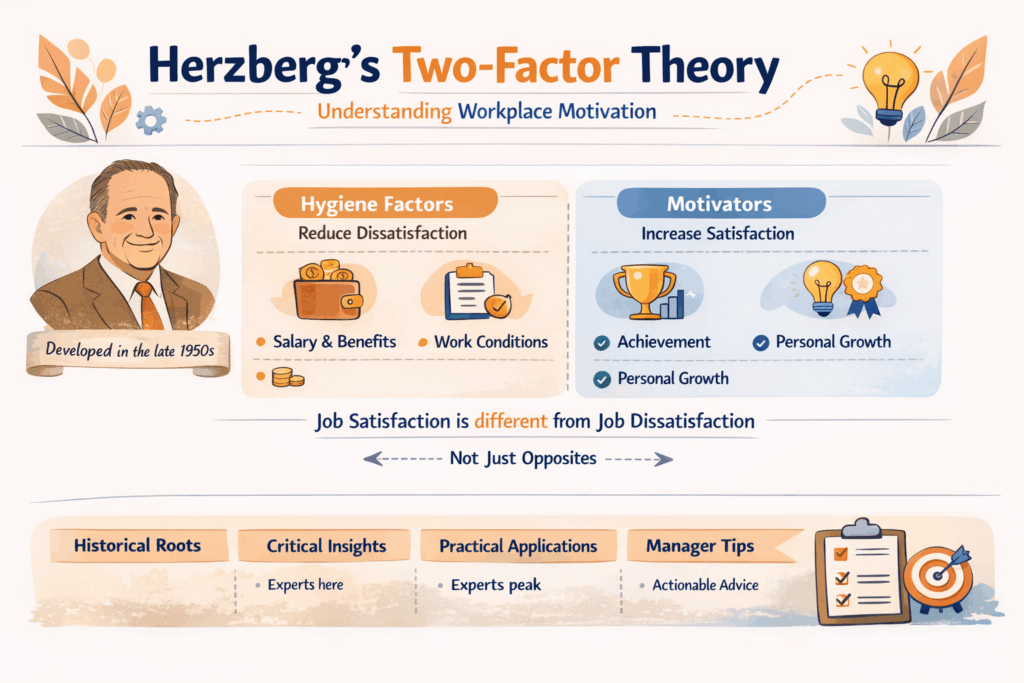
More than six decades ago, Frederick Herzberg’s two-factor theory revolutionised how we understand workplace motivation.
Herzberg proposed that the factors that cause job satisfaction are distinct from those that cause job dissatisfaction, challenging the traditional view of satisfaction and dissatisfaction as two ends of one spectrum.
This essay provides an advanced analysis of Herzberg’s theory. Examining its historical context, core components, practical applications, critical limitations, and contemporary relevance. Herzberg’s work is considered in relation to other motivation theories, and recent research in psychology and neuroscience is discussed to evaluate how well his mid-20th-century ideas hold up today.
Throughout, we maintain a focus on how managers can utilise these insights in modern organisational settings.
Historical context and theoretical background
Herzberg developed his two-factor theory in the 1950s, a period when understanding employee motivation was increasingly important in industrial psychology.
Prior to Herzberg’s work, Abraham Maslow’s hierarchy of needs (1943) had been highly influential in explaining human motivation. Maslow’s model suggested that people have ascending levels of needs (from basic physiological needs up to safety, social, esteem, and self-actualisation needs), and that unmet needs motivate behaviour.
By the 1950s, researchers and practitioners were seeking to apply these human needs concepts to the workplace. Herzberg, a psychologist, built on this foundation but focused specifically on job-related factors. He aimed to identify what factors make people feel satisfied or dissatisfied in their jobs, beyond the general needs that Maslow described.
In 1959, Herzberg and his colleagues published The Motivation to Work. Detailing a study of accountants and engineers (Herzberg et al., 1959). They used the critical incident technique, asking participants to recall occasions when they felt exceptionally good or bad about their jobs and to describe the reasons.
This approach was novel because, at the time, many assumed that job satisfaction was simply the opposite of job dissatisfaction. However, Herzberg’s findings challenged that assumption. He observed that the reasons people gave for feeling happy and motivated at work were often different from the reasons they gave for feeling unhappy or demotivated.
This insight laid the groundwork for the two-factor theory, also known as the motivation–hygiene theory. Which Herzberg formally presented in the late 1950s and further articulated in a famous Harvard Business Review article (Herzberg, 1968).
Motivators and hygiene factors: two distinct influences
Herzberg’s two-factor theory divides workplace factors into motivators and hygiene factors.
Motivator factors
Motivators (also called satisfiers) are aspects of the job that relate to the nature of the work itself and the opportunities it provides for personal growth, achievement, and recognition. These include factors such as challenging work, responsibility, advancement, personal growth, recognition, and achievement (Herzberg et al., 1959). When present, motivators can create positive job satisfaction because they fulfill deep psychological needs for growth and self-actualisation.
For example, being given a chance to lead a project team or design a new product can instill a sense of achievement and purpose. According to Herzberg, these motivator factors actively drive higher motivation and performance. They are the conditions that truly motivate employees to excel, because they make work inherently more engaging and meaningful.
Hygiene factors
On the other hand, hygiene factors (also called dissatisfiers or maintenance factors) encompass the extrinsic aspects of the job environment. These include company policies, supervision quality, salary, job security, working conditions, and interpersonal relations (Herzberg et al., 1959). Herzberg chose the term “hygiene” by analogy to medical hygiene. These factors do not directly make you healthier (more satisfied), but their absence can cause health problems (dissatisfaction).
In the workplace context, hygiene factors do not create high satisfaction or motivation when improved beyond a basic level However if they are inadequate or missing, employees will quickly become unhappy or demotivated.
For instance, a reasonable salary and safe, comfortable working conditions will not make an employee passionately love their job. However insufficient pay or a toxic work environment will cause dissatisfaction and may lead them to disengage or quit.
Herzberg often quipped that you “cannot love an employee into creativity” with better pay or nicer offices; those things only prevent dissatisfaction, they don’t spark true motivation (Herzberg, 1966).
In short, good hygiene factors are necessary to avoid unhappiness, but not sufficient to create genuine enthusiasm.
Herzberg’s key insight was that improving hygiene factors (such as raising salary or fixing policies) could remove sources of dissatisfaction. however this alone would not make workers fundamentally satisfied or more motivated – they would likely feel “okay” rather than truly happy.
Lasting motivation, according to the theory, comes from enriching the content of the work (via motivators). Rather than from continually increasing rewards or reducing irritants.
How motivators and hygiene factors work together
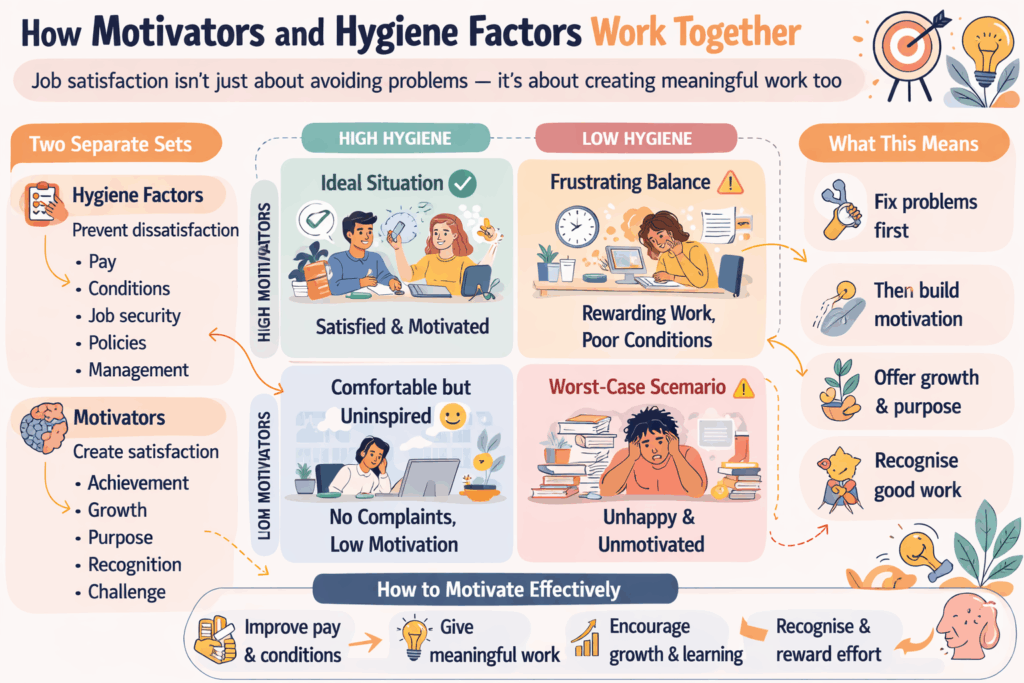
An important aspect of Herzberg’s theory is that job satisfaction and dissatisfaction are not simply opposites. Because motivators and hygiene factors are separate sets, an employee can be satisfied in one sense and dissatisfied in another at the same time.
Herzberg explained that it is possible for someone to love the work they do (finding it meaningful and engaging). Yet simultaneously be unhappy with their pay or work conditions. Conversely, an employee might have no complaints about salary or supervision (all hygiene factors are adequate, so no dissatisfaction). Yet feel bored and unfulfilled because the work lacks challenge (motivators are absent, so no satisfaction).
This interplay can be illustrated by four scenarios combining high or low levels of each set of factors:
High hygiene + High motivators
Ideal situation. The employee enjoys the work itself and has no significant complaints about the context. They are highly motivated and only minimally dissatisfied. For example, a scientist given exciting research projects (rich in motivators) in a well-paid, well-resourced lab (good hygiene) will likely be both satisfied and productive.
High hygiene + Low motivators
The employee is not dissatisfied (the basics like pay, security, conditions are fine) but is not particularly motivated or satisfied either. The job is viewed mainly as a paycheck. For instance, an office worker might have a comfortable salary and decent manager. Yet if their role is monotonous and offers no growth, they will do what’s required but exhibit little passion or extra effort.
Low hygiene + High motivators
The employee finds the work itself rewarding or exciting but has many complaints because basic conditions are poor. This is a frustrating mix – they may want to perform well due to intrinsic interest. However things like low pay, unsafe or chaotic working conditions, or poor management undermine their morale.
A teacher who loves teaching (high motivator) but struggles with overcrowded classrooms and inadequate salary (low hygiene) might feel torn. Passionate about the craft yet tempted to leave for a better-paying job.
Low hygiene + Low motivators
Worst-case scenario. The employee is unmotivated by the work and dissatisfied with the environment. They have little reason to perform well and plenty of complaints. In such a situation – for example, a tedious job that also has low pay and an unpleasant boss. Both motivation and morale will be very low, likely leading to poor performance or turnover.
According to Herzberg, simply eliminating dissatisfaction (e.g. raising hygiene factors from low to high) does not automatically create satisfaction. It may only move someone into the neutral state of scenario 2 (few complaints but not motivated). To reach scenario 1, where employees are truly motivated, motivator factors must also be present and cultivated.
This understanding encourages managers to pursue a dual strategy. Fix the environmental issues that cause grievances, and actively enrich jobs to foster engagement.
Herzberg’s famous admonition captures this balance: if you want people to do a good job, give them a good job to do. In practice, this means that effective motivation involves both “cleaning up” hygiene problems and providing meaningful work and growth opportunities.
Applying Herzberg’s theory in practice
Herzberg’s theory has had a profound influence on management practices, particularly in the design of jobs and motivational strategies.
One direct application is the concept of job enrichment. Since motivators arise from the content of the work, Herzberg advocated for enriching jobs to make them more satisfying. This involves adding more responsibility, variety, autonomy, and opportunities for achievement to roles (Herzberg, 1968).
For example, instead of a worker performing a single repetitive task on an assembly line all day. Job enrichment might involve reorganising work so that the person handles a whole process or a larger unit of work, gets to solve problems, or leads a small team. Such changes can transform a mundane role into a more challenging one, thus tapping into motivator factors like achievement, recognition, and personal growth.
Indeed, Herzberg’s ideas were a catalyst for the job design movement. Influencing later frameworks like the Job Characteristics Model of Hackman and Oldham (1976), which specifies core job features (such as skill variety and autonomy) that lead to intrinsic motivation. Their model built quantitatively on Herzberg’s notion that the design of work itself can motivate. It showed that enriched jobs produce higher job satisfaction and performance, aligning with Herzberg’s thesis (Hackman & Oldham, 1976).
Employee retention and engagement programmes
Managers have also applied the two-factor theory when developing employee retention and engagement programmes. Understanding that salary and benefits alone will not produce passionate, high-performing employees, progressive organisations focus on providing recognition, career advancement, meaningful work, and employee development.
For instance, many companies establish recognition schemes (acknowledging achievements and contributions), mentorship and training programmes (supporting growth), and participative management practices (giving employees more voice and responsibility). These initiatives target Herzberg’s motivators.
At the same time, effective managers know they must maintain competitive pay, fair policies, and safe working conditions – not to motivate outstanding performance, but to ensure people are not demoralised or distracted by grievances.
In practice, Herzberg’s theory helps prioritise management actions: fix the negatives to get people to a baseline of contentment, and then build the positives to truly energise them.
Real world application
It is worth noting that real-world situations can be complex, and managers sometimes face trade-offs between motivators and hygiene factors. Herzberg’s framework can guide decision-making in these scenarios.
For example, consider a highly skilled engineer who is passionate about innovative work (motivator) but is dissatisfied with their relatively low salary (hygiene factor). A manager might use Herzberg’s insight to avoid assuming that a big pay raise alone will secure the engineer’s long-term commitment. Instead, they might offer a moderate salary increase combined with richer job assignments, such as leading an R&D project or greater creative autonomy. The pay rise helps remove dissatisfaction, and the enhanced responsibilities provide genuine motivation.
In another scenario, a firm might realise that employees are comfortable but not inspired – a classic “high hygiene, low motivation” condition. Using Herzberg’s approach, the firm could introduce more challenging projects, team problem-solving sessions, or innovation days to infuse motivators, rather than mistakenly assuming that perks or bonuses will ignite enthusiasm.
In summary, Herzberg’s theory remains a practical tool for diagnosing motivation problems and crafting more holistic solutions: it reminds leaders to both mend the holes in the bucket (hygiene) and fill it with water (motivators).
Criticisms and limitations of the theory
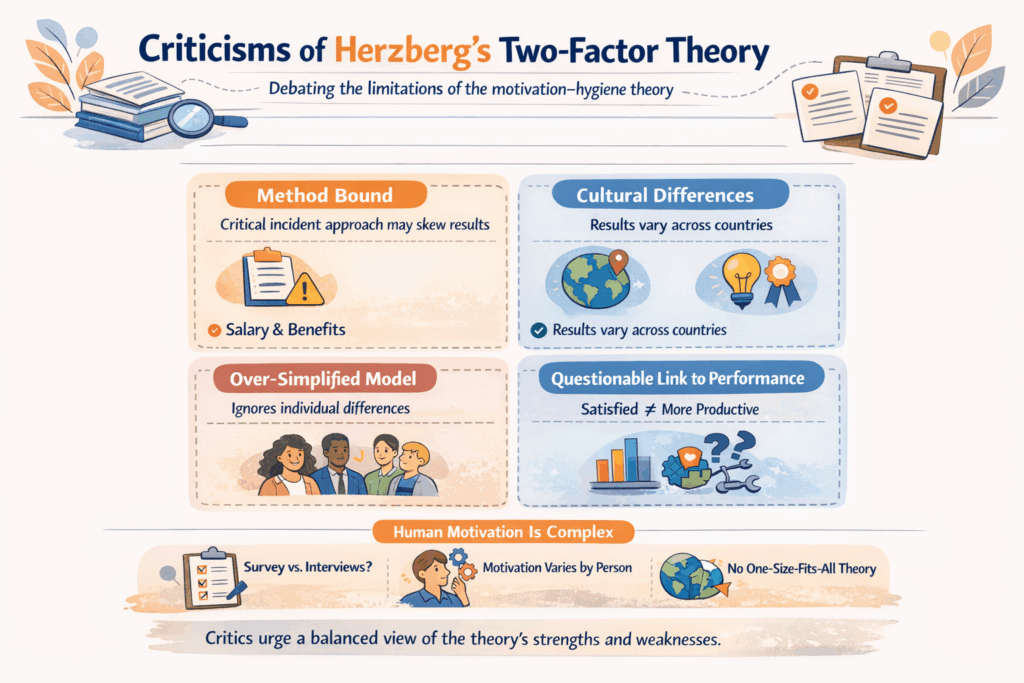
Herzberg’s two-factor theory has attracted considerable critique over the years. One major criticism is that the theory may be “method bound” – meaning its findings could be an artefact of Herzberg’s research method rather than a universal principle. The original study relied on the critical incident interview technique, which might have introduced response bias. As noted by Vroom (1964) and later highlighted by House and Wigdor (1967), people tend to attribute good experiences to their own actions and bad experiences to external factors.
In Herzberg’s interviews, when recalling times of satisfaction, employees often cited their achievements and positive aspects of the work itself (which flatters their self-image). When recalling dissatisfying episodes, they more readily blamed external circumstances like company policy or pay. This self-serving bias could exaggerate the separation between motivators and hygiene factors.
In other words, it’s possible that the respondents’ psychology – taking personal credit for success and blaming others for failure – contributed to the apparent two-factor result (House & Wigdor, 1967). Critics argue that if different research methods (such as surveys or experiments) are used, the distinction between motivators and hygiene factors becomes less clear.
Mixed evidence raises concerns
Empirical evidence on the two-factor theory has been mixed, which raises further concerns. Some studies attempting to replicate Herzberg’s findings did not always get neat two-factor results.
For instance, George Hines (1973) tested Herzberg’s theory in a different context – among middle managers and salaried employees in New Zealand – using survey ratings of various job facets. His results did not fully support a strict division between satisfiers and dissatisfiers.
Notably, factors that Herzberg classified as hygiene (like supervision and interpersonal relations) were also cited by highly satisfied employees as important contributors to their satisfaction (Hines, 1973). This suggests that in that cultural and organisational context, good relationships with one’s boss or colleagues could act as motivators too. The New Zealand findings imply that cultural or situational differences may affect which factors drive satisfaction.
Similarly, another review by King (1970) pointed out ambiguities in how factors are classified and noted that some so-called motivators can sometimes cause dissatisfaction if absent.
These studies illustrate that human motivation is complex and may not always split neatly into two independent categories.
Individual differences and theoretical limitations
Another limitation of Herzberg’s theory is its relative neglect of individual differences. The model presents a general rule that motivators satisfy and hygiene factors prevent dissatisfaction, treating workers somewhat uniformly. In reality, individuals can value factors differently.
For example, one person might find a high salary truly motivating (perhaps because of their financial pressures or values), while another might view salary as merely a baseline expectation. Herzberg’s framework does not fully account for such variations.
Subsequent theories have tried to incorporate individual differences; notably, Victor Vroom’s expectancy theory (Vroom, 1964) offers a more personalised perspective. Expectancy theory posits that motivation is determined by an individual’s expectation that effort will lead to performance and that performance will lead to valued outcomes.
This approach allows that each employee may weigh rewards differently – something Herzberg’s theory, with its broad brush categories, does not explicitly address.
Likewise, later research highlighted that a satisfied worker is not necessarily a more productive worker – a criticism directed at both Maslow’s and Herzberg’s implication that boosting satisfaction improves performance (House & Wigdor, 1967). In some cases, an employee might be content but complacent, or motivated by personal goals outside work.
These nuances remind us that Herzberg’s model, while insightful, is a simplified representation of motivation.
Summary from critics
In summary, the two-factor theory has been criticised for methodological issues, inconsistent empirical support, and overgeneralisation. Its dichotomy of factors, while conceptually appealing, does not always hold up across different populations and contexts.
Researchers have called for caution in treating motivators and hygiene factors as strictly separate. However, as we will discuss, these criticisms do not render Herzberg’s contributions obsolete; instead, they invite a more nuanced application of the theory in conjunction with other insights.
Contemporary perspectives and relevance
Despite the criticisms, Herzberg’s core idea – that simply removing the causes of dissatisfaction is not enough to motivate people – has endured and is echoed in modern motivation research. In fact, many contemporary theories and findings reinforce aspects of the two-factor theory, albeit with refinements.
Support from contemporary research
One prominent example is Self-Determination Theory (SDT) developed by Edward Deci and Richard Ryan. SDT distinguishes between intrinsic motivation (engaging in work for its own inherent satisfaction) and extrinsic motivation (working for external rewards or to avoid punishment) (Deci & Ryan, 2000).
This maps closely to Herzberg’s motivators (which foster intrinsic interest in the work) versus hygiene factors (which are analogous to external rewards or conditions). Deci and Ryan identify basic human needs – autonomy, competence, and relatedness – that must be fulfilled to sustain intrinsic motivation. We can see clear parallels: the need for autonomy and competence relates to having responsibility, growth, and achievement opportunities (Herzberg’s motivators), whereas the need for relatedness resonates with interpersonal factors.
However, SDT also expands on Herzberg by describing how extrinsic incentives can sometimes undermine intrinsic motivation (if they make people feel controlled rather than autonomous).
This insight offers a more detailed explanation of something Herzberg intuited: why giving more money (an extrinsic reward) beyond a point does not produce more drive, and might even backfire.
In essence, modern motivation science has validated Herzberg’s emphasis on intrinsic factors, while also highlighting that the line between intrinsic and extrinsic is not rigid – they can interact, and individuals need the right balance.
Behavioural economics and neuroscience
Recent research in behavioural economics and neuroscience also provides support for parts of Herzberg’s theory.
Behavioural economists have shown that people are not purely driven by monetary rewards; factors like meaning, purpose, and fairness strongly influence motivation.
For instance, Ariely et al. (2009) found that extremely large bonuses could impair performance on complex tasks – a phenomenon consistent with the idea that beyond a threshold, extrinsic motivators (money, a hygiene factor) do not yield additional effort and may create pressure that diminishes intrinsic interest.
In another study, Ariely and colleagues demonstrated that when the meaningfulness of a task was stripped away, people’s motivation plummeted, even if they were being paid – highlighting that a sense of purpose (intrinsic reward) is crucial for sustained effort. Neuroscience research complements these findings: studies using brain imaging have observed that intrinsic rewards and extrinsic rewards activate different neural pathways.
For example, Murayama et al. (2010) showed that when people received monetary rewards for an activity they initially enjoyed, their brain’s reward response associated with intrinsic motivation decreased – evidence of the “undermining effect” of external rewards on internal motivation.
These insights from behavioural science and neuroscience lend biological and psychological credence to Herzberg’s separation of motivators from hygiene factors. They suggest that the human brain is wired to respond to intrinsic fulfilment (such as mastering a skill or contributing to a meaningful goal) in a way that is not simply interchangeable with extrinsic payoffs.
Continuing relevance in management practice
In the field of management practice, Herzberg’s legacy is visible in how modern organisations approach employee engagement.
The Gallup Organisation, through extensive research in the 1990s, identified key elements that drive high performance at work. The result was the well-known “Q12” survey – twelve questions Gallup uses to measure employee engagement. These questions include items like “Do I have the opportunity to do what I do best every day?” or “Does my supervisor, or someone at work, seem to care about me as a person?” (Buckingham & Coffman, 1999).
Strikingly, the factors singled out by Gallup as critical for engagement align closely with Herzberg’s motivators: opportunities to use talents, recognition, personal growth, feeling valued. In contrast, traditional hygiene factors (like pay and benefits) are notably absent from the Q12 – they turned out to be less predictive of outstanding performance.
This does not mean salary and perks are unimportant, but it reinforces Herzberg’s argument that beyond a reasonable level, improving extrinsic conditions yields diminishing returns in motivation. Employees need a foundation of fair treatment and resources (hygiene) and the presence of motivating factors to truly thrive.
Contemporary employee engagement models often implicitly follow this template: ensure the basics are right, then focus on career development, empowerment, and purpose to drive engagement.
Resilience of Herzberg’s theory
Herzberg’s theory has also shown resilience in academic studies over time.
In a survey of over 3,200 employees on what motivates them to contribute ideas at work, Bassett-Jones and Lloyd (2005) found that intrinsic factors trumped monetary incentives, aligning with Herzberg’s original predictions. Even recognition – typically considered a motivator – was not as powerful as the intrinsic satisfaction employees got from contributing ideas and seeing them implemented.
The authors concluded that, nearly 50 years on, Herzberg’s two-factor framework still had explanatory power for understanding employee motivation in modern workplaces (Bassett-Jones & Lloyd, 2005).
To be sure, no single theory can capture all aspects of something as complex as human motivation. However, Herzberg’s contribution remains at the forefront of the field in the sense that it established a guiding principle widely accepted by scholars and practitioners: the key to motivating employees lies in the work itself.
Today’s cutting-edge discussions on improving the employee experience – involving concepts like meaningful work, psychological empowerment, and employee well-being – can all be seen as direct descendants of Herzberg’s insight that true motivation is built on fulfilling higher-level psychological needs, not just providing material comforts.
A more flexible modern interpretation
Importantly, modern perspectives tend to adopt a more integrative view, acknowledging some overlap between motivators and hygiene factors.
For example, good relationships at work might be viewed as both a hygiene factor (part of a pleasant environment) and a motivator (sense of camaraderie and belonging). Rather than seeing this as a fatal flaw, one can argue that Herzberg’s dichotomy is still useful as a thinking tool – it reminds managers to both cover the basics and truly engage people – but it should be applied flexibly.
The criticisms that Herzberg’s factors are not pure categories can actually enhance the theory’s application: they encourage us to consider how intrinsic and extrinsic factors interact.
In a modern, holistic approach to employee engagement, one might use Herzberg’s principles alongside other frameworks.
For instance, combining Herzberg’s focus on job content with elements of goal-setting theory or feedback systems can address some gaps (like ensuring that performance and satisfaction link to results).
In sum, Herzberg’s two-factor theory, tempered by its critiques, remains a cornerstone that informs and is enriched by contemporary motivational science.
Conclusion
Frederick Herzberg’s two-factor theory of motivation has stood the test of time as a seminal concept in organisational behaviour.
This advanced evaluation has shown that Herzberg’s distinction between motivators and hygiene factors was a breakthrough that changed how managers approach job design and employee satisfaction. The theory is well-grounded in the context of earlier need-based models and continues to be relevant, especially when interpreted in light of modern research.
We have seen that Herzberg’s ideas are supported by, and in dialogue with, contemporary theories like Self-Determination Theory and empirical findings from behavioural economics and neuroscience.
The criticisms of Herzberg’s theory – regarding its methodology, generalisability, and simplicity – are valid and caution us against a one-size-fits-all view. Yet, rather than invalidating the theory, these critiques help refine it.
By recognising that motivators and hygiene factors can interplay and that individual differences matter, we can apply Herzberg’s insights more effectively in today’s diverse workplaces.
Practical implications for modern management
Ultimately, Herzberg’s core message endures: true motivation comes not merely from what an organisation does for employees (pay, comfort, security) but from what it allows employees to do in their work (achieve, learn, create, and take pride). Managers aiming to foster a high-performing, satisfied workforce must address both sides of this coin.
They should strive to eliminate unnecessary dissatisfiers because a fair, supportive environment is the foundation on which motivation can flourish. But they must also go beyond that and enrich work itself – crafting roles that are interesting, challenging, and meaningful – so that employees can find personal fulfilment through their jobs.
Herzberg’s two-factor theory, after more than sixty years, thus remains a valuable guide. It reminds us that people work for more than a paycheck, and that tapping into the human need for growth and recognition is key to unlocking their full potential.
In an era where talent and engagement are critical for organisational success, Herzberg’s insight that “you have to give them a bicycle if you want them to learn to ride” rings as true as ever, highlighting a legacy that continues to shape motivational strategies at the forefront of the field.
Still struggling with Herzberg’s theory? We can help! Check out our expert writing service on the management assignment help page.
For those who prefer to hear it explained in person, Mike Clayton gives an excellent presentation in the video below.
References
- Ariely, D., Gneezy, U., Loewenstein, G. & Mazar, N. (2009) Large stakes and big mistakes. Review of Economic Studies, 76(2), 451–469. DOI: 10.1111/j.1467-937X.2009.00534.x
- Bassett-Jones, N. & Lloyd, G. C. (2005) Does Herzberg’s motivation theory have staying power? Journal of Management Development, 24(10), 929–943. DOI: 10.1108/02621710510627064
- Buckingham, M. & Coffman, C. (1999) First, Break All the Rules: What the World’s Greatest Managers Do Differently. New York, NY: Simon & Schuster.
- Deci, E. L. & Ryan, R. M. (2000) Self-determination theory and the facilitation of intrinsic motivation, social development, and well-being. American Psychologist, 55(1), 68–78. DOI: 10.1037/0003-066X.55.1.68
- Hackman, J. R. & Oldham, G. R. (1976) Motivation through the design of work: Test of a theory. Organizational Behavior and Human Performance, 16(2), 250–279. DOI: 10.1016/0030-5073(76)90016-7
- Herzberg, F., Mausner, B. & Snyderman, B. B. (1959) The Motivation to Work (2nd ed.). New York, NY: John Wiley & Sons.
- Herzberg, F. (1966) Work and the Nature of Man. Cleveland, OH: World Publishing Company.
- Herzberg, F. (1968) One more time: How do you motivate employees? Harvard Business Review, 46(1), 53–62.
- Hines, G. H. (1973) Cross-cultural differences in two-factor motivation theory. Journal of Applied Psychology, 58(3), 375–377. DOI: 10.1037/h0036299
- House, R. J. & Wigdor, L. A. (1967) Herzberg’s dual-factor theory of job satisfaction and motivation: A review of the evidence and a criticism. Personnel Psychology, 20(4), 369–389. DOI: 10.1111/j.1744-6570.1967.tb02440.x
- King, N. (1970) Clarification and evaluation of the two-factor theory of job satisfaction. Psychological Bulletin, 74(1), 18–31. DOI: 10.1037/h0029444
- Murayama, K., Matsumoto, M., Izuma, K. & Matsumoto, K. (2010) Neural basis of the undermining effect of monetary reward on intrinsic motivation. Proceedings of the National Academy of Sciences, 107(49), 20911–20916. DOI: 10.1073/pnas.1013305107
- Vroom, V. H. (1964) Work and Motivation. New York, NY: John Wiley & Sons.

Cite This Work
To export a reference to this article please select a referencing stye below: