Guide to writing a nursing medication management assignment
Info: 3057 words (12 pages) Study Guides
Published: 19 Mar 2026
Still struggling with your nursing research? We can assist! Check out our writing service for nursing assignment help.
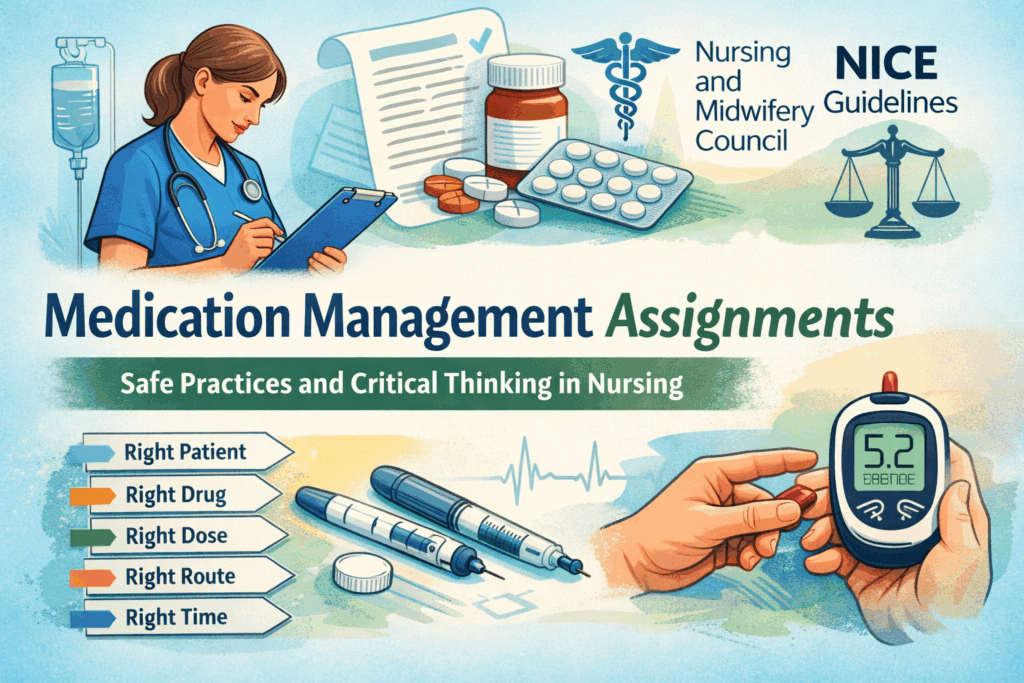
Medication management is a fundamental nursing responsibility, deeply linked to patient safety and quality of care. Indeed, nursing assignments on this topic test your ability to critically assess medication protocols, safe administration practices, and pharmacology knowledge in clinical scenarios.
However, these assignments require more than just describing how to give a drug. You must demonstrate an understanding of why each step is important, and support your discussion with evidence-based references. In the UK, the Nursing and Midwifery Council (NMC) holds nurses accountable for safe medicines management (NMC, 2018).
This guide outlines how to approach a medication management assignment, using the example of insulin administration for patients with diabetes. It will cover interpreting the assignment question, researching best practices, and structuring your answer. Furthermore, the guide discusses nursing responsibilities and considerations when administering insulin.
Understanding medication management assignments
Medication-related tasks make up a substantial part of nursing practice (Athanasakis, 2021), and errors can seriously jeopardise patient safety. Assignments in this area typically require you to examine how nurses manage medications safely. They also expect you to demonstrate insight into the policies and principles that underpin safe practice.
For example, an assignment might prompt you to analyse a scenario or protocol, explaining the nursing responsibilities involved and evaluating their importance.
Medication management constitutes a core nursing competency. It encompasses multiple steps – from verifying the prescription and preparing the drug to administering it correctly, monitoring the patient, and documenting the outcome (Athanasakis, 2021).
These assignments assess not only your factual knowledge of pharmacology and guidelines, but also your critical thinking. They evaluate how well you can justify each nursing action and consider its implications for patient care.
In a UK context, high-quality answers will reference national standards and guidelines (such as the NMC Code or NICE recommendations) to support the discussion and demonstrate evidence-based practice.
Analysing the assignment question
Before writing, take time to break down exactly what the assignment is asking.
In our example question, “Discuss the nursing responsibilities and considerations when administering insulin to diabetic patients”, the key directive is “discuss”. This means you should explore the issue in depth and consider different aspects, supporting your points with evidence.
The topic focuses on administering insulin to patients with diabetes. This means your answer must cover what nurses are responsible for doing during insulin administration, as well as what factors they must consider to ensure safety and effectiveness.
Start by identifying the core components of the topic:
Nursing responsibilities
These are the specific duties or actions the nurse must perform when giving insulin. Think in terms of the medication administration process. For example, the nurse must verify the correct insulin and dose, use the right administration technique, time doses appropriately with meals, and monitor blood glucose.
Considerations
These include all the special precautions, patient-specific factors, and clinical reasoning points that a nurse must keep in mind. For insulin, considerations might include the type of insulin (and its pharmacokinetics) and signs of hypoglycaemia or hyperglycaemia to watch for. They also include patient education needs and adherence to safety protocols (such as double-checking doses).
By parsing the question this way, you create a roadmap of what your essay should address. You might even sketch an outline – for example, plan to discuss preparation and checks before administration, safe injection technique, post-administration monitoring, and patient teaching. Make sure you understand each term in the question. For instance, “diabetic patients” implies that both type 1 and type 2 diabetes contexts are relevant.
Meanwhile, “administering insulin” encompasses everything from handling the insulin supply to evaluating the patient’s response. Clarifying the scope early will help you stay on track and ensure you cover all relevant points in your assignment.
Researching evidence and guidelines
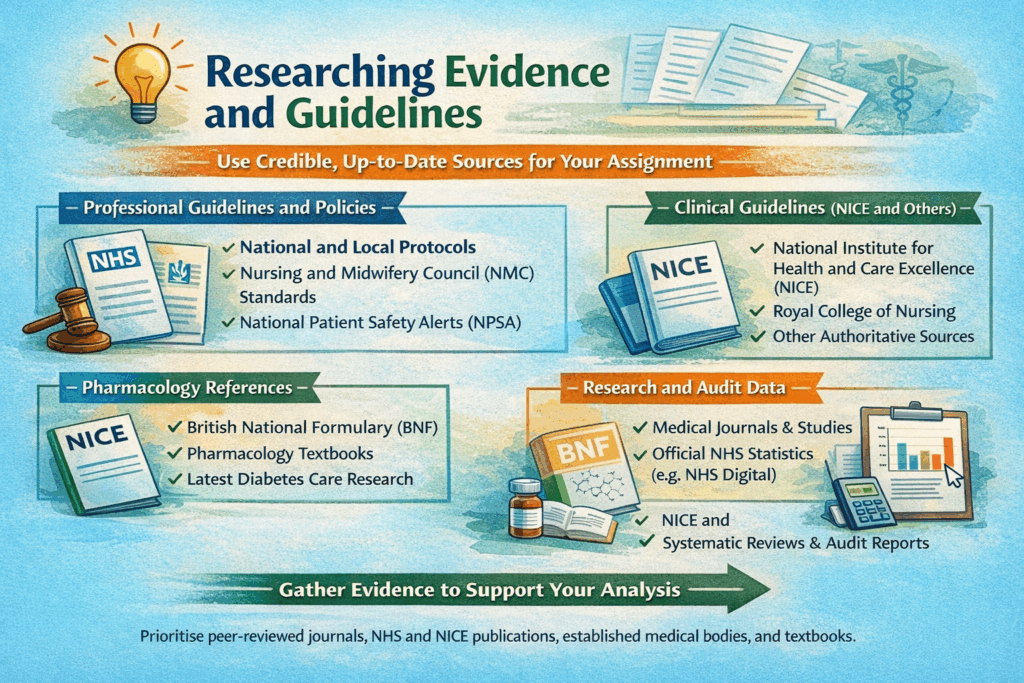
Once you have outlined what needs to be covered, the next step is to research each aspect using credible, up-to-date sources. High-quality evidence strengthens your assignment and shows the marker that your recommendations are grounded in best practice.
In a UK nursing assignment, you should prioritise official guidelines, standards, and reputable clinical literature. This means using up-to-date national policies, professional standards, and high-quality research sources:
Professional guidelines and policies
Check if there are national or local guidelines on the topic. For insulin administration, important sources include NHS or hospital protocols (e.g. insulin administration policies) and safety alerts. The Nursing and Midwifery Council’s Code (NMC, 2018) emphasises that nurses must administer medicines safely and effectively, so referencing the NMC standards can underline professional accountability.
Likewise, national safety guidance has highlighted the risks of insulin errors. For instance, the National Patient Safety Agency issued alerts after fatal insulin incidents, mandating measures like double-checking doses and avoiding abbreviation of “units” (NPSA, 2010). Being aware of such guidance helps you critique existing protocols and suggest improvements.
Clinical guidelines (NICE and others):
See if the National Institute for Health and Care Excellence (NICE) or professional bodies like the Royal College of Nursing have published relevant guidance. NICE diabetes guidelines may not give step-by-step instructions on insulin administration. However, they do stress safe and patient-centred care, which you can relate to insulin management.
Citing authoritative recommendations supports your proposed practices. For example, NICE advises giving insulin at appropriate times relative to meals (NICE, 2015), and including this evidence shows that your plan aligns with established standards.
Pharmacology references:
Use reliable sources to refresh your understanding of how insulin works and its pharmacokinetics. For instance, the British National Formulary (BNF) or pharmacology textbooks can provide details on different types of insulin (rapid-acting, long-acting), their onset and peak times, and common side effects.
This information is crucial for explaining why certain nursing interventions are needed. If you note that a rapid-acting insulin peaks within roughly an hour, the patient must eat promptly to avoid hypoglycaemia.
Be sure to back up this statement with a citation from a trusted source. For example, when discussing timing, you might cite that rapid insulin starts to work within minutes and lasts only a few hours (Diabetes UK, 2022). By linking the drug’s action profile to nursing actions (such as meal timing and blood sugar checks), you demonstrate pharmacology knowledge in practice.
Research and audit data:
To critically assess medication management, include any relevant statistics or studies. Quantify the problem if possible – for example, nearly 40% of hospital patients on insulin have experienced an insulin-related error during their admission (NHS Digital, 2020).
Presenting such data (from audits or studies) demonstrates why meticulous insulin management is necessary and provides a platform to discuss how nursing practices can reduce errors.
Academic journals, systematic reviews, and case studies on medication safety or diabetes care can also offer insights into best practices and common pitfalls. You can weave these examples into your analysis.
While researching, take careful notes and record the full details of each source for your references. Aim to use current (last 5–10 years) sources for clinical guidelines and research, as practices evolve.
Avoid unverified online content – stick to peer-reviewed journals, official NHS or government publications, established medical organisations, and respected textbooks. By gathering strong evidence, you equip yourself to write a well-informed and authoritative assignment.
Structuring your assignment
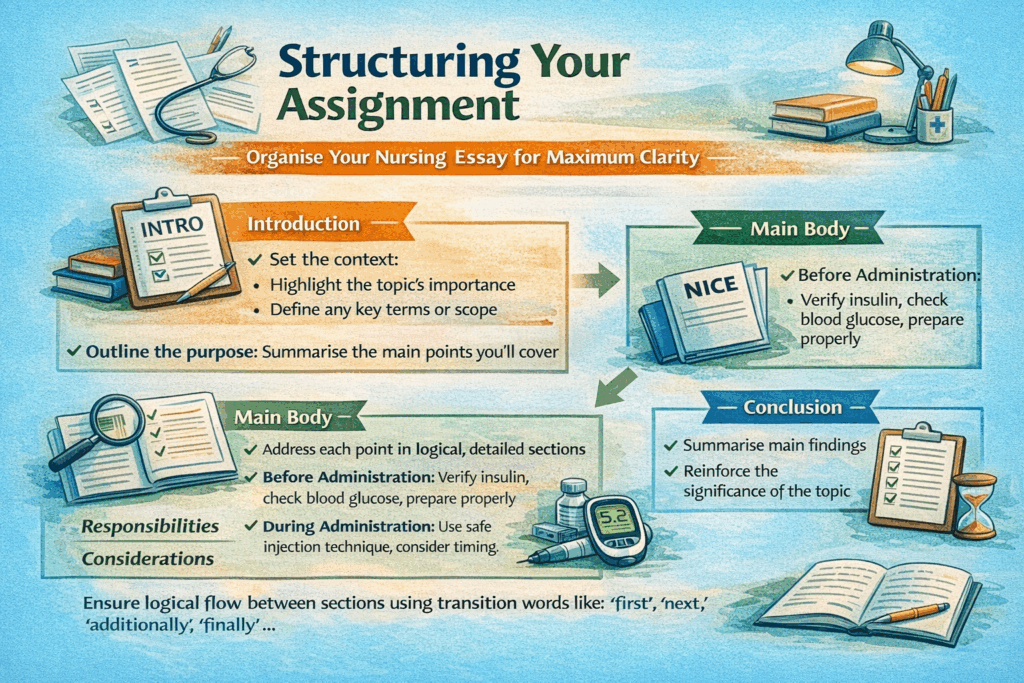
A clear structure will make your assignment logical and easy to follow. Organise your essay into an introduction, a well-sequenced body, and a conclusion. Here is a suggested approach:
Introduction
Start by engaging the reader with the significance of the topic. For instance, you might note that insulin is a life-saving medication. However, it is also prone to errors, underscoring why proper management is critical.
State what your discussion will cover. In this example, the introduction could briefly mention that you will be examining how nurses safely administer insulin, from preparation and dose verification to post-administration monitoring. It should also highlight key considerations such as patient safety and education.
Keep the introduction concise. However, ensure you define any central terms (for example, briefly explain what insulin is and its role in diabetes to set the context) and outline the scope of your answer.
Main body
Divide the body into coherent paragraphs or sections, each covering a major point. A logical way to tackle the insulin question is to follow the process of medication administration:
Before administration:
Discuss nursing responsibilities in the preparation stage. This includes checking the medication order (prescription) for the correct insulin name and dose, confirming the patient’s identity, and reviewing the patient’s blood glucose and clinical status before injection. The nurse then prepares the insulin (drawing up the dose in an insulin syringe or pen) while maintaining sterile technique.
Explain why each step matters. For example, emphasise that verifying the insulin type and dose prevents potentially dangerous mix-ups (Cousins et al., 2011). Checking the blood glucose level beforehand ensures it is safe to give insulin at that moment.
During administration:
Describe the safe injection technique and real-time considerations. Nurses must choose an appropriate subcutaneous injection site (such as the abdomen, thigh or upper arm), rotating sites to prevent tissue damage. They should administer the insulin using the correct angle and method.
Timing is also crucial – for example, a rapid-acting insulin should only be given when the patient’s meal is ready, to avoid hypoglycaemia. Here you would highlight practices like double-checking the dose with a second nurse (a common policy for insulin due to its high risk) and ensuring the patient is informed and comfortable.
Cite guidelines or literature to support these practices. For instance, a hospital guideline may recommend always having a second RN verify insulin doses (NHS Lanarkshire, 2024). Research shows that such double-checks can catch errors in high-risk medications (Athanasakis, 2021).
After administration:
Explain the follow-up responsibilities and considerations post-injection. This includes safely disposing of sharps and documenting the administration in the patient’s medication record (time, dose, site, and any reactions).
Ongoing monitoring is also crucial after the injection. Monitoring is crucial because insulin can cause blood glucose to drop. You should discuss how nurses observe for signs of hypoglycaemia (such as sweating or confusion) and how they respond if it occurs (for example, administering glucose per protocol).
Also, mention that nurses should later evaluate whether the insulin had the desired effect (for example, by checking blood glucose again). They should communicate any issues to the healthcare team.
Patient education is another important post-administration task: nurses might reinforce teaching on how the patient can manage their insulin, diet, and symptoms once they’re home. Bringing in pharmacology knowledge, you could note that long-acting insulins have no pronounced peak.
Rapid-acting insulins, in contrast, peak quickly – hence the different monitoring needs (Diabetes UK, 2022).
Ensure that you cover both “responsibilities” (the tasks nurses perform) and “considerations” (the reasons, cautions, and patient factors influencing how those tasks are done). You might blend these together – for instance, when writing about administering the injection, you would inherently discuss considerations like technique and timing alongside the actions. The key is that the assignment’s body should systematically address all facets of the question.
Use transition words to lead the reader through your points (for example, “first, the nurse should…”, “additionally, it is important to…”, “however, one must consider…”). This practice makes your argument flow logically and shows a clear progression of ideas.
Conclusion:
Finish with a strong conclusion that summarises the key points and reflects on the broader implications.
In our insulin example, the conclusion could reaffirm the critical role of the nurse in managing insulin safely. It would note that vigilant adherence to protocols and informed monitoring protects patients from harm.
You might also mention the importance of ongoing training or improvements in practice (for example, regular competency assessments or insulin safety devices to reduce errors). However, avoid introducing entirely new points in the conclusion. It should only synthesise what you have already discussed.
Ensure the question posed has been answered directly. A well-written conclusion leaves the reader with a clear understanding of your position. In this case, it would emphasise that safe insulin administration requires a combination of technical skill, pharmacological knowledge, and diligent nursing care. It would also highlight why this matters for patient outcomes.
Structuring your assignment in this way (introduction – main points organised logically – conclusion) will help you present a cohesive argument. Each section should connect to the next, and all parts of the question should be addressed with appropriate weight. It often helps to revisit the assignment prompt after drafting. Double-check that you haven’t overlooked any aspect (for example, confirm that you discussed both responsibilities and considerations).
Demonstrating critical analysis
Throughout your assignment, aim to go beyond just stating facts – analyse and evaluate the why and how. Critical analysis in a medication management context involves several elements. For example:
Connecting actions to outcomes
Don’t simply say “the nurse should monitor for hypoglycaemia.” Instead, explain that insulin can drive blood sugar too low and use evidence to show how frequent hypoglycaemic episodes can harm patients. Providing such rationales shows a deeper understanding.
Weighing guidelines and evidence
If there are recommended protocols (like double-checking insulin doses or using insulin-specific syringes), discuss their impact. You might reference studies or audits demonstrating reduced error rates after a safety policy was implemented, or note practical challenges.
For example, you could note that while double-checking is widely endorsed to improve safety, it can be limited by staff availability on a busy ward. Making a point like this shows that you can consider real-world constraints (while still reaffirming the importance of the safety measure).
Comparing alternatives
Where relevant, mention if there are different approaches and why one is preferred. For instance, if a newer insulin delivery device (such as an insulin pump or a safety syringe) is being introduced to reduce errors, you could briefly mention it. Citing evidence of its effectiveness (if relevant) can demonstrate a broader understanding.
Using a scholarly tone
Present your analysis objectively, backed by references. Use tentative language where appropriate (for example, “This suggests that…”, “It could be argued that…”). This shows that you are evaluating evidence rather than asserting personal opinion. Avoid overly absolute statements unless you have definitive evidence – academic writing often acknowledges uncertainty or varying perspectives.
By critically appraising the practices and backing up every key point with authoritative sources, you will fulfil the “critical assessment” requirement of the assignment. Remember to analyse any case scenario or example provided as well.
For instance, if the assignment includes a specific patient situation, tie your general points to that case. Discuss any unique considerations (such as the patient’s age, comorbidities, or understanding of insulin) as well.
Overall, demonstrate a questioning mindset: show that you have asked “why is this done? is there evidence it works? what could go wrong if it’s not done correctly?” and provided answers in your essay. This level of critical thinking is what elevates an assignment from a simple descriptive piece to a high-quality analytical discussion.
Proofreading and finalising
Once you have written a draft, leave time to revise and refine it. Review the content to ensure you have answered the question directly and thoroughly. Check that the discussion stays on topic.
For example, you don’t need to delve into general diabetes pathology beyond what’s relevant to insulin administration. Ensure that your arguments flow well – adding transition words and clear topic sentences can help guide the reader.
Pay attention to academic writing conventions. Write in a formal, clear style (in British English), and try to use active voice and precise terminology. Edit out any colloquialisms or overly casual phrasing.
Also verify that you have defined any technical terms and acronyms. For instance, if you mention “DKA”, clarify that it stands for diabetic ketoacidosis.
Importantly, check your referencing. Every claim that is not common knowledge should have a citation. In the text, use Harvard referencing format (e.g. Smith (2020) states… or (Smith, 2020)). Then prepare a reference list at the end, listing all sources you cited.
Make sure the reference list is formatted correctly. In Harvard style, this usually means listing sources alphabetically by author surname. Ensure it contains all the details needed for each source (author, year, title, publication, and URL or DOI if applicable).
Finally, proofread your assignment carefully. Look for any spelling or grammar errors. Ensure that your paragraphs and sentences meet any length requirements (as a rule of thumb, paragraphs under ~150 words and a mix of short and longer sentences will improve readability). It can help to read your work aloud or ask a peer to critique it.
Next steps
A polished, error-free presentation enhances the credibility of your content. By the end of this process, you should have a well-structured, critically insightful assignment that convincingly addresses the topic of medication management – in our example, demonstrating exactly how and why nurses safely manage insulin therapy for patients with diabetes.
For further reading closely associated to this guide, check out the following two articles on ‘James Reason’s Swiss Cheese Model to Assess Medical Errors and Patient Safety‘ and this ‘Guide To a Nursing Care Plan’.
Still struggling with your nursing research? We can assist! Check out our writing service for nursing assignment help.
References
- Athanasakis, E. (2021) ‘Medication Safety Practices in Clinical Nursing: Nurses’ Characteristics, Skills, Competencies, Clinical Processes, and Environment’, International Journal of Caring Sciences, 14(3), pp. 2019–2028.
- Cousins, D. H., Rosario, C. and Scarpello, J. (2011) ‘Insulin, hospitals and harm: a review of patient safety incidents reported to the National Patient Safety Agency’, Clinical Medicine, 11(1), pp. 28–30.
- Diabetes UK (2022) ‘Types of insulin’. Available at: https://www.diabetes.org.uk/about-diabetes/looking-after-diabetes/treatments/insulin/types (Accessed 24 July 2025).
- National Institute for Health and Care Excellence (NICE) (2015) Type 1 Diabetes in Adults: Diagnosis and Management (NICE Guideline NG17). London: NICE. Available at: https://www.nice.org.uk/guidance/ng17 (Accessed 24 July 2025).
- National Patient Safety Agency (2010) Rapid Response Report NPSA/2010/RRR013: Safer Administration of Insulin. London: NPSA. Available at: https://www.cas.mhra.gov.uk/ViewandAcknowledgment/ViewAttachment.aspx?Attachment_id=101195 (Accessed 24 July 2025).
- NHS Digital (2020) National Diabetes Inpatient Audit (NaDIA) 2019, Full Report. Leeds: NHS Digital. Available at: https://files.digital.nhs.uk/65/504167/NaDIA%202019%20-%20Full%20Report%20v1.0.pdf (Accessed 24 July 2025).
- NHS Lanarkshire (2024) Guideline for the Administration of Insulin by Nursing Staff. [Online]. (Updated May 2024). Available at: https://rightdecisions.scot.nhs.uk/media/ayxl2ykb/guideline-for-the-administration-of-insulin-by-nursing-staff-final-update-may-24.pdf (Accessed 24 July 2025).
- Nursing & Midwifery Council (2018) The Code: Professional Standards of Practice and Behaviour for Nurses, Midwives and Nursing Associates. London: NMC. Available at: https://www.nmc.org.uk/globalassets/sitedocuments/nmc-publications/nmc-code.pdf (Accessed 24 July 2025).

Cite This Work
To export a reference to this article please select a referencing stye below: