Guide to the McKinsey 7S framework
Info: 5651 words (23 pages) Study Guides
Published: 11 Mar 2026
Whether you’re looking for help with the McKinsey 7S framework or wider strategy and management assignments, our experienced writers can help you produce clear, high-quality academic work. Find out more on our assignment help page.
The McKinsey 7S framework is a strategic organisational tool that highlights the importance of alignment among seven key internal elements to achieve business success.
It was originally developed at McKinsey & Company in the late 1970s. The framework is most closely associated with consultants Robert Waterman, Tom Peters and Julien Phillips, with input from Richard Pascale and Anthony Athos (Waterman et al., 1980; Pascale and Athos, 1981).
In their influential article “Structure Is Not Organisation”, Waterman et al. (1980) argued that “an organisational structure is not an organisation”. They emphasised that formal structure is only one aspect of effective management.
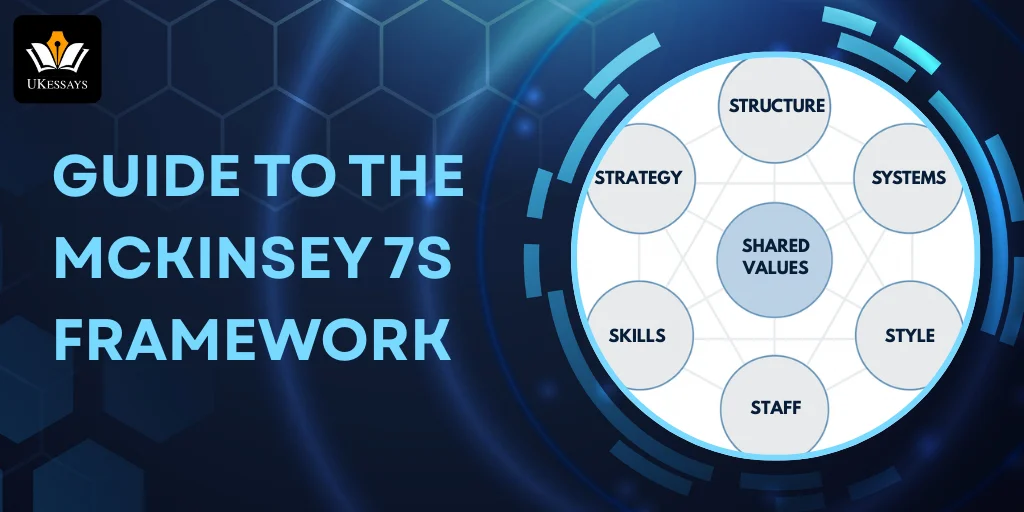
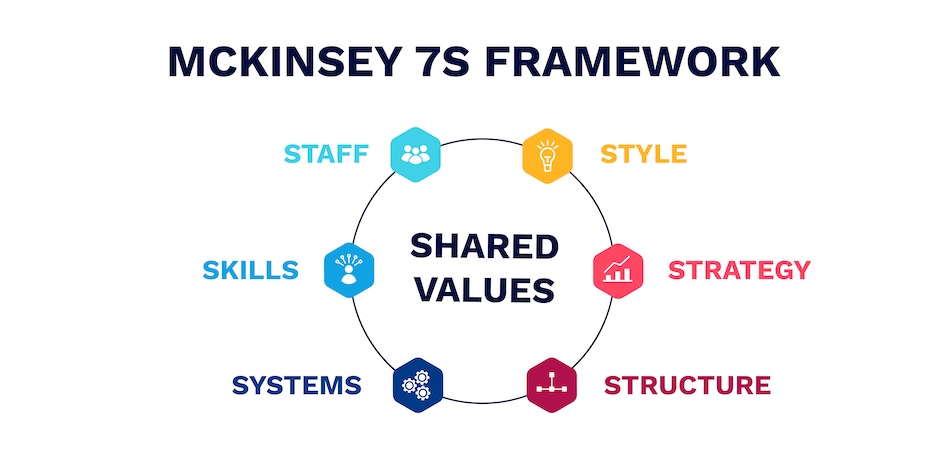
Instead, they introduced a holistic model encompassing strategy, structure, systems, skills, staff, style and shared values – the seven “S” factors. Together, these provide a comprehensive view of an organisation’s capabilities and its readiness to implement strategy (Waterman et al., 1980).
The framework was later popularised in the best-selling book In Search of Excellence (Peters and Waterman, 1982), and it remains closely associated with McKinsey’s approach to organisational analysis.
Importance of the McKinsey 7S Framework
The enduring appeal of the 7S model lies in its focus on organisational alignment. It posits that all seven elements must be mutually reinforcing so that the organisation can execute its strategy effectively and adapt to change.
In practice, this means that if one element changes or is weak, it will affect the others. For example, even a brilliant strategy will likely falter if the company’s structure and systems are not suited to execute it, or if the staff’s skills and the corporate culture do not support the strategic direction. The 7S framework therefore encourages managers to look beyond narrow silos and consider the organisation as an interconnected system.
Indeed, since its introduction the model has been widely used by academics and practitioners and is considered “one of the most popular strategic planning tools” for diagnosing organisational issues and guiding change (Ravanfar, 2015). It has been applied in diverse industries and contexts because it provides a practical checklist for ensuring that all parts of an organisation are working in harmony towards its objectives (Ravanfar, 2015).
Elements of the McKinsey 7S framework
The 7S framework identifies seven interdependent elements of an organisation. These are divided into “hard” and “soft” areas, reflecting how tangible or intangible they are.
The hard elements – strategy, structure, and systems – are relatively concrete and easily identified in organisational charts, plans and processes.
In contrast, the soft elements – skills, staff, style, and shared values – are more intangible, rooted in culture and people, and therefore harder to observe directly but just as crucial to success.
Crucially, the model asserts that there is no hierarchy among these factors; each interacts with and influences the others. Effective organisations achieve a fit between all seven elements, aligning them to reinforce one another (Peters and Waterman, 1982). Below, we examine each of the seven S’s in turn, explaining what they entail and why they matter in practice.
Strategy
Strategy is the organisation’s plan of action to achieve competitive advantage and meet its goals. It defines how the company will deploy resources and respond to environmental changes in order to accomplish its long-term objectives. A well-formulated strategy should clearly articulate the company’s chosen direction, target market positioning and value proposition.
However, simply formulating a strategy is not enough. The 7S framework stresses that strategy must remain consistent with the other six elements. For instance, a firm may prioritise innovation and rapid growth. In that case, it needs appropriate structures, such as a flexible or decentralised hierarchy. It also requires supportive systems, including fast decision-making processes, and a culture that encourages risk-taking.
In practice, misalignment can derail execution. A brilliant strategy on paper may still fail if staff lack key skills. It may also struggle if outdated systems prevent an agile response. Managers therefore use the 7S model to ensure they do not design strategy in isolation. Instead, they ground it in what the organisation can realistically support and implement (Peters and Waterman, 1982).
A sound strategy in the 7S framework does more than chart a clear course. It must also align with the company’s capabilities, culture and structure so that the organisation can carry it out effectively.
Structure
Structure refers to the organisational architecture – how people and activities are organised, the chain of command, and the reporting relationships. It encompasses the company’s formal organisational chart, including divisions or business units, hierarchical levels, and coordination mechanisms. Structure is considered a “hard” element because it is tangible and can be represented visually.
According to the 7S framework, the structure must support the strategy and fit with the other elements. A company’s structure determines how information flows and how agile or bureaucratic decision-making will be.
For example, a highly centralised and tall hierarchy may provide tight control. This can suit a cost-leadership strategy in a stable environment. However, it may also restrict creativity and slow decision-making. This would conflict with a strategy that requires innovation or responsiveness.
When using the 7S model, leaders examine whether their current structure enables or hinders their strategic aims. They also consider whether the structure aligns with the organisation’s people and culture.
Changes in strategy often require structural adjustments. For example, entering a new market may require the creation of a new division. A shift to a product-centric strategy may also require reorganisation. In this case, a company might move from a geographical structure to a product-line structure. The framework reminds us that these structural changes can have knock-on effects. Altering reporting relationships may influence communication and organisational culture. Therefore, leaders must design structure alongside the other S elements (Waterman et al., 1980).
In short, structure is the skeleton of the organisation, and it needs to be designed in harmony with strategy, systems and skills to avoid organisational misfits.
Systems
Systems are the processes and procedures that support daily operations and decision-making. This includes both formal systems (such as IT systems, accounting and budgeting processes, performance measurement and reward schemes) and informal routines (the established workflows and ways things are done). Systems determine how business is conducted on a day-to-day basis. They are considered a hard element because they can be documented and are often technology- or process-driven.
In the 7S framework, systems must align with strategy and structure. For example, if a company’s strategy focuses on customer service excellence, it may require systems that track customer satisfaction. It may also need rapid feedback loops for service issues. In addition, training processes may be necessary to improve staff skills in customer relations.
In practice, misaligned systems can undermine strategic intent. For example, a company may aim to promote innovation and speed. However, its internal systems may remain slow and cumbersome. Lengthy approval processes or outdated IT systems can create delays. These inconsistencies often lead to frustration and weak execution.
Managers applying the 7S model therefore ask whether their systems reinforce the intended strategy and values. They examine systems across HR, finance, IT and other functions. If misalignment exists, managers often prioritise systems during organisational change. Updating processes or tools can help enable wider improvements.
Systems changes can also require adjustments in other areas. For example, implementing new enterprise software or quality control processes may demand new skills from employees. It may also require changes in staff behaviour and working practices. This illustrates the interdependence of the 7S elements.
Ultimately, systems, structure and strategy must operate in alignment. Robust systems help ensure that everyday activities move the organisation towards its strategic objectives (Ravanfar, 2015).
Skills
Skills encompass the distinctive capabilities and competences of the organisation’s employees. This element addresses what the company does best – its core competencies and collective abilities. Skills can include technical know-how, managerial competencies, or specific expertise that give the firm an edge.
When analysing skills in the 7S model, one considers both the current skills present (what the workforce already excels at) and any gaps between current skills and those needed to execute the strategy. For instance, a technology company may recognise that data analytics is a core skill it must have; if currently the staff lack strength in advanced analytics, this misalignment would need to be addressed (through training, hiring, or partnerships) to support the strategy.
The 7S framework makes managers ask whether the organisation’s skills base fits its strategic ambitions. Old or obsolete skills may hinder new strategic directions, so organisations often need to develop new competencies as they evolve (Ravanfar, 2015).
This element is tightly linked with the staff and systems elements: the skills present will inform what kind of training systems or knowledge management processes are required, and vice versa. Moreover, an honest skills assessment can influence strategy – a strategy might be unrealistic if the necessary skills are absent or costly to acquire.
In practice, companies use the 7S model to perform a skills gap analysis during strategic planning: they identify key skills needed for future success and then ensure plans are in place to build or acquire those capabilities. This proactive alignment of skills with strategy and structure (e.g. placing the right talent in the right positions) is essential so that the organisation has the expertise required to carry out its plans (Hayes, 2014).
Staff
Staff refers to the organisation’s people – not just the raw number of employees, but also aspects of talent management including recruitment, development, and motivation. This element covers the human resources practices and the general profile of the organisation’s workforce.
Questions under staff include: What types of people do we hire and retain? What is the demographic and skill composition of our teams? How do we train, mentor, and reward employees?
In the 7S framework, the staff element must be consistent with the other S’s, especially strategy, style and shared values. For example, if a company’s strategy relies on exceptional customer service, it should be hiring people with strong customer orientation and training them in customer care; its incentive systems (a part of “staff” practices) should reward excellent service. Similarly, if the corporate culture (shared values) emphasises teamwork, the HR practices should select and reward people who collaborate well.
Misalignment in the staff element can severely impact performance – consider a firm that talks about innovation (shared value) but recruits and promotes only those who conform to traditional methods, thereby stifling creativity.
Using the 7S model, organisations examine whether their people strategies (hiring, placement, promotion, and development activities) reinforce the broader strategy and culture. In practice, this might mean identifying a need to restructure teams, adjust incentive schemes, or invest in employee development programs to cultivate needed competencies.
Ultimately, the staff element highlights that organisations are as strong as their people, and achieving strategic goals requires the right people in the right roles, supported by appropriate HR policies (Pascale and Athos, 1981).
Style
Style in the 7S framework denotes the leadership and management style of the organisation, as well as the general behavioural culture. It often reflects “how things get done around here” in terms of management approach. This includes the tone set by leaders. It also includes interaction norms, such as formal versus informal or authoritarian versus participative styles. In addition, it reflects the example provided by management. Style is considered a soft element because it is intangible. It develops over time through the behaviour of key individuals and groups.
The 7S model pays special attention to style because leadership behaviour often permeates organisational culture. For instance, the way top managers communicate and make decisions can strongly influence the organisation’s working climate. Managers may act in collaborative, secretive, or risk-averse ways. These behaviours shape how the wider organisation operates.
Alignment in this area means the management style should suit the organisation’s strategy and values. For example, a company may claim to value innovation and flexibility. However, its leadership style might be highly controlling or punitive of mistakes. Employees will likely notice this inconsistency. As a result, the innovative strategy may suffer.
On the other hand, a coherent style can drive success. For example, a start-up pursuing disruptive innovation may adopt an informal and empowering management style. Such an approach encourages experimentation. It also reinforces the organisation’s strategic goals.
Style and Organisational Change
When applying the framework, leaders should assess whether the prevailing leadership approach and organisational culture support the desired goals. Organisations undergoing transformation often recognise the need to adjust their management style. Cultural attributes may also require change to support a new strategy. For example, firms may shift from a top-down leadership style to a more inclusive approach. This can help empower employees during a digital transformation.
Style and shared values are closely linked. Because of this, shifts in leadership style often require efforts to influence organisational culture (Peters and Waterman, 1982). The 7S framework highlights these subtle but powerful aspects of leadership. It reminds managers that leadership behaviour and culture can ultimately determine whether a strategy succeeds or fails.
Shared Values
Shared values, also called “superordinate goals” in early versions of the model, are the core values, fundamental principles and cultural norms that are at the heart of the organisation. This element is placed at the centre of the 7S model diagram, signifying that these values are pivotal: they influence all the other elements.
Shared values include the mission and vision of the company and the general work ethic or ethos that managers and employees share. They answer questions like: What does the organisation fundamentally stand for? What values guide our actions and decisions?
For example, a company might have shared values such as a commitment to quality, customer satisfaction, innovation, integrity, or teamwork. These core values should ideally drive employee behaviour and company decisions at all levels.
In the 7S framework, the shared values must be aligned with strategy, style, staff, and so on. If there is a disconnect – say the formal strategy prioritises short-term profits in a way that clashes with a long-standing value of putting customers first – the organisation will experience internal tension and likely performance issues.
Shared Values and Organisational Change
Strong, clear shared values can be a unifying force in times of change: they help employees understand why certain changes are necessary and can motivate collective effort. Conversely, ambiguous or conflicting values can undermine change initiatives (for instance, if employees suspect leadership no longer adheres to the company’s stated principles).
Practically, when using the 7S model, leaders revisit the organisation’s shared values to ensure they remain relevant and supportive of the strategy. Often, successful transformations involve explicitly reaffirming or sometimes reframing the organisation’s core values to better support new strategic directions (Hayes, 2014).
This element underscores that beyond structures and systems, it is the culture of the organisation – its shared values and beliefs – that ultimately holds everything together. When values are strong and aligned with the company’s mission, they act as an internal compass for decision-making and behaviour, greatly easing the implementation of strategy.
When to use the 7S framework
The McKinsey 7S framework is a versatile tool that can be applied in a variety of situations where organisational alignment is in question. Business leaders and consultants often use the 7S model in the following scenarios:
Strategic change implementation:
When introducing a new strategy or major initiative, the 7S model helps ensure that internal elements (structure, systems, etc.) are realigned to support the change. For example, a company executing a digital transformation would review all seven elements to identify what needs to change internally for the strategy to succeed (Hayes, 2014).
Organisational restructuring or mergers and acquisitions:
During mergers or significant reorganisations, the framework is used to align departments, processes and cultures of the merging entities. It can highlight differences in staffing, style or values that need reconciliation. This comprehensive check can prevent the common pitfall of focusing only on structure and neglecting cultural integration, which is often crucial for merger success.
Performance diagnosis and improvement:
If a company is underperforming or encountering specific problems (e.g. slow product development, high employee turnover, poor customer service), the 7S model provides a diagnostic lens to pinpoint misalignments. It may reveal, for instance, that the strategy is sound but the systems and skills are lacking, or that the structure is siloed and stifling collaboration. By systematically reviewing each S, managers can identify root causes of performance gaps and address them holistically (Ravanfar, 2015).
Aligning strategy during rapid growth or change in environment:
When an organisation experiences rapid growth, enters a new market, or faces a changing external environment, its internal alignment can slip. The 7S framework is useful for a periodic health-check of organisational fit. It ensures that as the company scales or adapts, its internal elements remain in sync and supportive of its strategic direction. This prevents scenarios where, for example, a company’s market strategy evolves but its internal culture or skills lag behind the new demands (Prosci, 2024).
In summary, the model is applied whenever leaders need to ensure that “everything lines up” internally before executing strategy or during change. It prompts a thorough examination that goes beyond the usual suspects (strategy and structure) to include culture, people and systems. Because of this comprehensive scope, John Hayes (2014) notes that the 7S framework has become a staple in change management, helping organisations assess their readiness for change and identify areas requiring adjustment. By using the model in these key moments, organisations can increase the likelihood that changes are implemented smoothly and objectives are met.
How to apply the 7S model step by step
Applying the McKinsey 7S framework involves a structured analysis and action planning process. Below is a step-by-step approach to using the 7S model in practice to drive organisational change or alignment:
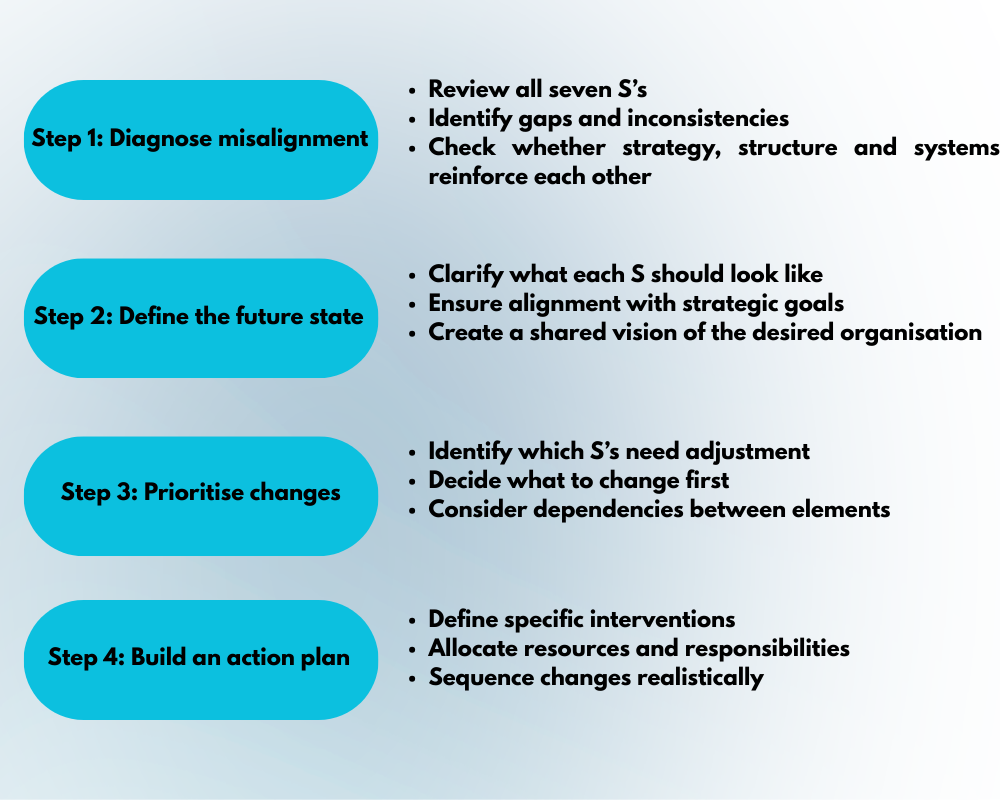
1. Identify misalignments and gaps:
First, examine each of the seven elements in the current state of your organisation and ask how well they align with each other. This often involves qualitative assessment (interviews, surveys, workshops) and reviewing documentation.
Look for inconsistencies – for example, is the strategy clearly understood by staff? Does the structure facilitate the strategy, or are there bottlenecks? Are systems reinforcing the desired culture? By the end of this diagnostic step, you should pinpoint which factors are out of sync.
It may help to map out each S (documenting key points like current strategy, structure chart, stated values, etc.) and draw connections or tensions between them. Common findings might be things like “our incentive system (systems) does not motivate the collaborative behaviour our strategy needs” or “we have a skill gap in digital marketing given our new growth plan.” This candid assessment sets the foundation for action.
2. Design the optimal alignment (future state):
Next, determine what each element should look like to support the strategic goals. It is useful to define a clear vision of the target state for each of the seven S’s.
For instance: a new strategy might require a more agile structure (maybe moving from a functional to a matrix organisation), different systems (like a new project management tool or CRM software), a workforce with certain new skills, and possibly a shift in management style or company values (such as embracing innovation or customer-centricity more deeply).
This step often requires input from top leadership to ensure the envisioned alignment is realistic and in line with the organisation’s mission. It may also involve benchmarking or consulting best practices (though every organisation’s optimal design will be unique).
The key outcome of this phase is a blueprint of how the organisation’s elements should be configured in harmony – effectively a picture of a well-aligned organisation ready to implement the strategy. Having this blueprint allows you to clearly see the gaps between where you are (from step 1) and where you want to be.
3. Determine priority changes and interventions:
Then, identify which elements need to change and how to change them in order to move from the current misaligned state to the desired aligned state. This step involves formulating specific change initiatives for each misaligned S.
For example, if “skills” are lacking in a certain area, the change might be to institute a training program or hire specialists. If “structure” is misaligned, perhaps a reorganisation or new team structure is required.
It is crucial to set priorities – you might not tackle everything at once, so figure out which changes will drive the most alignment. Often, changes in one area will necessitate changes in others (as the model predicts), so a coordinated plan is needed. For instance, a structural change will likely imply changes in systems and staff allocations too.
At this stage, it is wise to consider sequencing (what should be done first) and resourcing (what budget or personnel are needed for each change). The 7S model doesn’t prescribe an order – in fact, all elements are interdependent – but practically, you may decide to start with strategy and shared values (the broadest guiding aspects) and then proceed to align structure, systems, and so on.
The outcome here is a comprehensive action plan listing what will be adjusted in each of the seven areas.
4. Implement changes and monitor alignment:
Finally, execute the changes according to the plan and monitor their impact on organisational alignment. This is where change management principles come into play – communication to stakeholders, training for new skills, adjustments to systems, and so forth.
It’s important to ensure that as each change is rolled out, the organisation remains in balance. The 7S framework can be used as a continuous checklist during implementation: after making a change in one element, revisit the other six to see if further tweaks are needed.
For example, if you restructure the organisation (structure change), you should observe whether any cultural issues arise (shared values or style needing attention) or if people need support adapting (staff and skills considerations). Monitoring might involve using metrics (like performance indicators related to each S) or regular feedback sessions with teams.
Maintaining long-term alignment
The goal is to gradually achieve the target alignment identified in step 2. Keep in mind that complete alignment is an ongoing journey rather than a one-time task. As the business environment evolves, you may cycle back through these steps to adjust the elements again.
Over time, an organisation that consistently uses the 7S model in this iterative way will be more agile and cohesive, because it consciously maintains tight alignment between strategy, structure, processes, and culture.
Using the 7S framework to support effective change
By following these steps, managers can systematically leverage the 7S framework to plan and execute changes. This approach ensures that improvements are not ad hoc but rather consider the organisation as an integrated whole.
It is often noted that organisations which neglect one or more of the seven elements during change efforts run into trouble – for instance, implementing new technology (systems) without addressing staff training and culture can lead to failure. The step-by-step 7S analysis helps avoid such pitfalls by providing a balanced roadmap, thereby increasing the likelihood of successful implementation (Prosci, 2024).
Advantages of the 7S framework
The McKinsey 7S model has endured for decades because of several notable strengths that make it valuable for both analysis and planning:
Holistic perspective:
The framework forces a comprehensive view of the organisation. Instead of focusing on strategy and structure alone (as earlier models often did), 7S ensures that soft factors like culture, leadership style, and staff capabilities are also examined.
This holistic approach reduces the risk of overlooking critical issues that could derail a strategy. It encourages cross-functional thinking, as changes in any one domain are evaluated in terms of impact on all others.
Alignment-driven discipline:
A core advantage of the model is its emphasis on alignment. By examining the consistency among all seven elements, organisations can achieve a state where “everything pulls in the same direction.”
This alignment tends to produce more coherent execution and better performance, because all parts of the organisation are synchronised around shared objectives. The 7S framework provides a structured way to diagnose misalignments – for example, revealing if “our incentives (systems) are discouraging the collaboration we say we value” – so that leaders can proactively realign internal elements with strategy.
Bridging strategy and implementation:
The 7S model is praised for linking strategic planning with operational execution. It effectively bridges the gap between strategy design and day-to-day implementation by addressing the question: “What needs to be in place internally for this strategy to work?”
This makes it a practical tool for managers. In fact, it embeds structured implementation considerations into the strategic plan – every initiative can be checked against the seven dimensions, creating a thorough roadmap rather than a piecemeal plan.
This reduces the likelihood of failure in execution, a common problem when firms focus too much on strategy formulation and too little on the capabilities and coordination needed to carry it out (Bryan, 2008).
Widely tested and accepted:
Another advantage is the framework’s proven track record and familiarity. Since its introduction, the 7S model has been applied by countless organisations worldwide (Ravanfar, 2015).
It has therefore accumulated a credibility that can be reassuring to stakeholders. Because many executives and consultants are already familiar with the 7S terminology, using it can create a common language for discussing organisational change. This can speed up buy-in and understanding when communicating strategic plans.
Moreover, its longevity attests to its adaptability – companies in technology, healthcare, government and beyond have all found it relevant, showing that the mix of hard and soft factors resonates across sectors.
The McKinsey 7S framework’s strengths lie in its balanced, all-encompassing view of organisational factors and its focus on making sure those factors reinforce each other. It serves as a powerful checklist for strategic alignment, ensuring that leaders address the “people and culture” side of change as rigorously as the structural and strategic side (Prosci, 2024).
By doing so, it helps organisations plan changes that are realistic, implementable, and supported throughout the enterprise.
Limitations and considerations
No framework is without its limitations, and it is important to understand where the McKinsey 7S model may present challenges or require supplementation. Critics and experts have pointed out several potential drawbacks:
Internal focus (ignoring external environment):
The 7S framework looks exclusively at internal organisational factors. External forces – such as market dynamics, competition, regulatory changes, or technological disruptions – are not explicitly included in the model.
This means that using 7S alone might lead a company to become too inward-looking. In fast-changing industries, a firm could align its internal elements perfectly yet still fail if it misses shifts in the external environment.
Managers should therefore use the 7S analysis in conjunction with external analysis tools (like SWOT, PESTEL, or industry analysis) to ensure the strategy itself is sound in context. The model’s internal emphasis is a deliberate focus, but it can be a limitation if one mistakenly treats 7S as a complete strategy tool rather than an internal alignment tool (Prosci, 2024).
No prioritisation of elements:
The 7S model deliberately avoids ranking the elements in importance – all are considered interdependent. However, this can translate into practical difficulty in knowing where to start or which issues to tackle first.
In a situation with multiple misalignments, the model doesn’t inherently tell management which S to focus on. Everything being linked to everything else can also be intellectually overwhelming; less experienced teams might fall into “analysis paralysis” trying to analyse all seven dimensions deeply at once.
In reality, not all factors are equally urgent at all times. Some critics argue that the model’s strength (comprehensiveness) can become a weakness if it leads to overly complex change programs.
Effective use of 7S thus relies on sound judgement to identify leverage points and sequence initiatives – the framework won’t do that prioritisation for you (Orr Consulting, 2023).
Static snapshot and rigidity:
The model tends to encourage analysis at a given point in time (a snapshot of alignment). Implementing a full 7S alignment can be time-consuming, which may not suit very dynamic environments.
If an industry is in rapid flux, by the time an organisation realigns all seven elements, conditions might have changed again. In other words, the 7S approach can seem too slow or too rigid for agile adaptation, especially if taken as a one-off exercise.
Today’s organisations may need to change continuously, and the criticism is that 7S, developed in a more stable era, assumes you can methodically realign and then enjoy a period of stability.
To mitigate this, many organisations now treat the 7S framework as an iterative or continuous improvement tool, revisiting the elements frequently. Still, the lack of an explicit mechanism for handling rapid external change is a shortcoming. It’s best suited for guiding planned, deliberate change rather than crisis management or very fast pivots (Orr Consulting, 2023).
Subjectivity in assessment:
Some of the soft elements – such as shared values and style – are qualitative and can be difficult to assess objectively. Different evaluators might reach different conclusions about whether an element is “aligned” or not.
The model doesn’t provide quantitative measures or a clear-cut scoring system. This means the quality of a 7S analysis heavily depends on the insights of those conducting it. If managers are not candid or thorough, they might gloss over cultural issues or misjudge skill levels.
There is also the risk of bias – seeing what one wants to see to justify a preferred strategy. To address this, organisations often use surveys, cultural diagnostics, or external facilitators to get a clearer read on the soft areas.
Nonetheless, the inherently qualitative nature of parts of the model is a limitation; it requires careful handling to ensure a rigorous analysis.
It is worth noting that despite these limitations, the 7S framework remains a valuable tool. Many of its drawbacks can be managed by using it in combination with other frameworks and by applying managerial judgement.
For example, to avoid an internal-only focus, one would ensure that insights from external analysis feed into the “Strategy” element of 7S. To handle urgency, one might implement a leaner, priority-focused version of the analysis under tight timeframes.
Essentially, the 7S model should not be seen as a magical formula, but rather as a guide – it prompts the right questions, but leaders must find the answers using both data and experience.
When used wisely, the framework’s comprehensive lens far outweighs its challenges, and it provides structure and clarity to the often messy process of organisational change (Prosci, 2024). The key is to remain aware of what 7S does and does not cover, and to be flexible in its application.
Conclusion
The McKinsey 7S framework endures as a seminal model in management thinking because it addresses a timeless concern: how to align an organisation’s many moving parts so that strategy translates into action and results.
This guide has provided a detailed look at each of the seven elements – strategy, structure, systems, skills, staff, style, and shared values – and illustrated how they interrelate. In practice, the true power of the 7S model lies in its reminder that organisations are complex, adaptive systems: success is rarely about excelling in one area, but rather about achieving coherence across all areas.
By using the 7S framework, business leaders and change practitioners can diagnose misalignments that might otherwise be overlooked and design more comprehensive solutions. It encourages a balance between the “hard” technical factors and the “soft” human factors, reflecting the reality that both must work together for organisations to thrive.
Applying the 7S framework in a changing business environment
In a business environment that is continually evolving, the 7S framework remains highly relevant. It is sufficiently flexible to apply to everything from restructuring a multinational corporation to improving a small nonprofit’s effectiveness.
Moreover, it instills a disciplined thought process: before leaping into action, ensure that your strategy, structure, systems, and culture are all pulling in the same direction. This integrative approach can make the difference between a well-intentioned plan that stalls and one that succeeds brilliantly.
Alignment as a foundation for effective execution
Whether you are a manager looking to implement a new strategy, a consultant tasked with diagnosing a struggling organisation, or an executive guiding a merger, the McKinsey 7S model offers a robust framework to guide your analysis and actions.
Its longevity in the field of strategic management is a testament to its usefulness – indeed, the principle that “alignment is the engine of execution” is as important now as when the 7S framework was first conceived (Bryan, 2008).
By diligently applying the insights from this model, organisations can enhance their internal harmony and be better prepared to meet their goals in an effective, sustainable way.
For support with strategy and management assignments, our experienced writers can help you produce clear, high-quality academic work. Find out more on our assignment help page.
References
Bryan, L. (2008) ‘Enduring Ideas: The 7-S Framework’, McKinsey Quarterly, (March 2008). Available at: https://www.mckinsey.com/ (Accessed: 10 November 2025).
Hayes, J. (2014) The Theory and Practice of Change Management. 4th edn. London: Palgrave Macmillan.
Orr Consulting (2023) ‘McKinsey’s Strategic Planning Framework: Strengths, Limitations and Implementation Warnings’. Available at: https://www.orr-consulting.com/ (Accessed: 5 November 2025).
Pascale, R.T. and Athos, A.G. (1981) The Art of Japanese Management: Applications for American Business. London: Penguin Books.
Peters, T.J. and Waterman, R.H. (1982) In Search of Excellence: Lessons from America’s Best-Run Companies. New York: Harper & Row.
Prosci (2024) ‘The McKinsey 7-S Model: Definition, Pros and Cons’. Published 1 October 2024. Available at: https://www.prosci.com/blog/ (Accessed: 5 November 2025).
Ravanfar, M.M. (2015) ‘Analyzing organizational structure based on 7s model of McKinsey’, Global Journal of Management and Business Research: A, 15(10), pp. 7–15.
Waterman, R.H. Jr., Peters, T.J. and Phillips, J.R. (1980) ‘Structure is not organisation’, Business Horizons, 23(3), pp. 14–26.

Cite This Work
To export a reference to this article please select a referencing stye below: