Guide to opinion writing and legal opinions
Info: 3819 words (15 pages) Study Guides
Published: 14 Apr 2026

Our UK legally qualified experts can help with opinion writing or any other law assignment. Check out our law assignment help page for more info.
Legal opinion writing is a core professional skill for lawyers, requiring the ability to provide structured, formal advice documents for clients or instructing solicitors. It involves explaining the relevant legal issues, assessing risks and options, and ultimately recommending a preferred course of action.
A legal opinion (sometimes called a letter of advice or counsel’s opinion) is essentially written legal advice on a specific scenario, addressing the client’s questions and guiding their decisions. Such documents are common in legal practice and remain an important skill in legal education.
This guide helps students preparing for professional assessments and qualifications, including the LPC, SQE2, CILEX, STEP and CLC pathways.
For barristers, formal opinion writing is a central feature of training and practice, as counsel frequently provides written opinions to instructing solicitors. For solicitors, the closest parallel is the client advice letter, which sets out the legal position and recommended next steps for the client in clear, practical terms. Under the Solicitors Qualifying Examination (SQE), SQE2 assesses this type of written advice through legal writing tasks, in which candidates must draft plain-English advice tailored to a client’s situation.
The goal is to translate complex law into practical guidance for the client’s situation, so the client understands their position and knows how to proceed.
Purpose and context of legal opinions
Legal opinions serve to inform and advise. They are formal communications that give the recipient an expert evaluation of their legal position, answer specific queries, and recommend what to do next. Typically, the lawyer will review all relevant facts and law before writing, ensuring the advice is accurate and comprehensive.
The resulting opinion document should be clear, unambiguous, and concise, conveying the advice without unnecessary jargon. These letters or memoranda can address a wide range of matters: for example, advising a private client on a potential claim, guiding a business on contractual obligations, or giving an opinion on whether evidence is sufficient for litigation.
In all cases, the purpose is not just to state the law, but to apply the law to the client’s facts and answer the client’s underlying concerns. Importantly, a legal opinion also often outlines the client’s rights, obligations, and available remedies in the situation and offers practical guidance on any steps they should take or avoid.
In professional training contexts like the LPC/SQE2 and Bar courses, students learn opinion writing to bridge the gap between academic law and real-world advice. They practice analysing realistic case files and then writing up advice as if to a client or instructing solicitor.
This training underscores that legal advice is not a one-size-fits-all exercise. Indeed, each fact pattern is different and the advice required changes with each case.
Novice writers sometimes attempt to follow a template answer, but effective opinion writing demands a flexible, fact-driven approach rather than slavishly copying examples (Koroma, 2012). The focus should always be on addressing the client’s specific questions and concerns with a logical, structured analysis.
Structure of a legal opinion
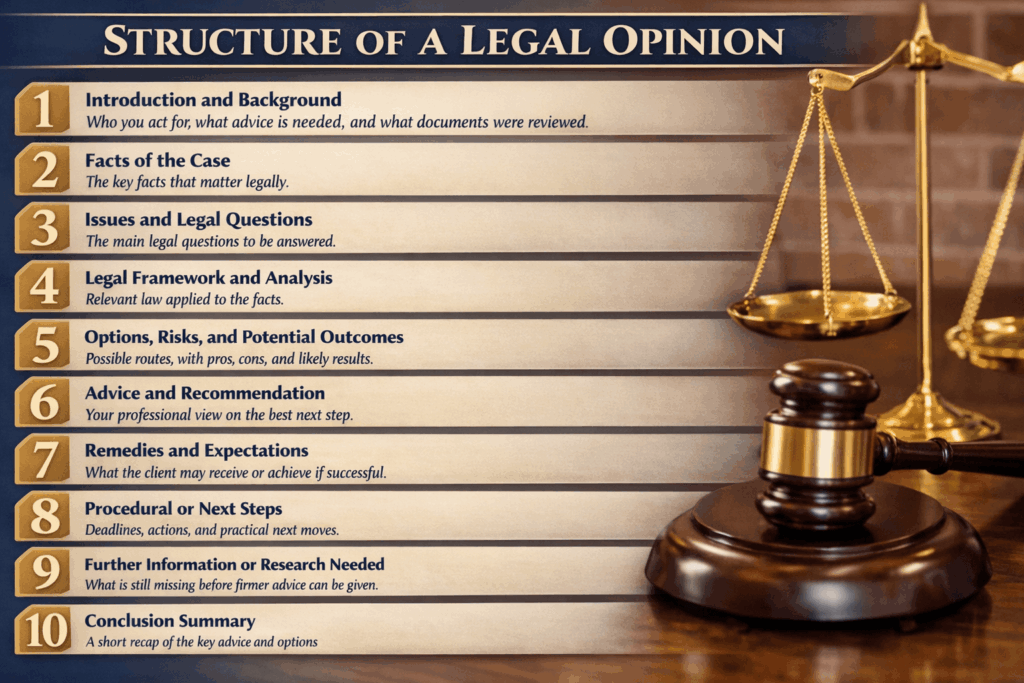
Although every legal opinion must be tailored to the particular issue, most follow a broadly similar structure to ensure all key elements are covered. A clear structure helps both the writer and the reader, so the advice is easy to follow. A typical structured legal opinion document includes the following components:
Introduction and background
Begin by stating who you are acting for and what you have been asked to advise on. For example, a barrister’s opening might say, “I am instructed on behalf of [Client] to advise on [the issue].” A solicitor might write:“You have asked me to advise on [specific question] and the options available. This letter sets out my initial advice and next steps.”
This section may also list the documents and information reviewed (such as contracts, witness statements, or other evidence provided). Listing the materials considered is good practice because it documents the basis of your advice and protects you if something was not provided. The introduction should also clarify the stage of any legal proceedings and the client’s objectives, as these context factors frame the advice.
Facts of the case
Summarise the relevant facts clearly and succinctly. The opinion should recount only material facts – those that affect the legal outcome – and omit unnecessary background. Keeping this section focused helps the reader understand the scenario without distraction.
If some facts remain disputed or unclear, note that briefly. In most opinion-writing tasks on the Bar course, examiners provide students with an extensive narrative containing extraneous details; part of the skill lies in identifying what is relevant and leaving out the rest.
If the client or the papers present certain points as important which you believe are not legally relevant, you might mention them only to explain why they do not affect your advice. This reassures the client that you have not overlooked anything and helps them understand why those points are not central.
Issues and legal questions
Clearly identify the legal issues or questions to be addressed. Sometimes this is implicit from the facts, but it is often helpful to state the issues explicitly (for example: “The issues in this case are (1) whether X Ltd owed a duty of care to the client, and (2) if so, whether that duty was breached.”).
Framing the questions focuses the opinion and ensures you cover all of them. In more complex matters, you might bullet-point the key issues at the start of the analysis section. But note my points on writing style and tone below.
Legal framework and analysis
This is the core of the opinion – a reasoned application of law to the facts for each issue. A common approach is to use the IRAC method (Issue, Rule, Application, Conclusion) or a similar logical flow for each point.
For a barrister’s opinion, you would set out the relevant law (statutes, case law, regulations) that governs each issue, then analyse how the facts fit that law.
It is crucial to weigh the evidence for and against the client’s position on each issue. For example, if advising on a negligence claim, the opinion would examine each element (duty, breach, causation, damage), discuss evidence supporting or undermining each element, and consider any defences or counterarguments. This balanced analysis shows the client the strengths and weaknesses of their case.
Where information is missing and prevents a definitive view, the opinion should flag this. In fact, acknowledging gaps in evidence or uncertainties (and possibly suggesting what further evidence is needed) is expected in good opinion writing.
The tone of this section should remain objective and factual, presenting the likely interpretation of the law. However, it must be client-oriented: the analysis should directly address the client’s questions and use their situation as the focus of examples.
Options, risks, and potential outcomes
After analysing the issues, the opinion should discuss the options available to the client and the pros and cons, or risks, of each. In other words, it is not enough to say “you have a good claim” or “you will likely lose.” The client needs to understand what they can actually do with that information.
For instance, if a claim is likely to succeed, one option might be to proceed with litigation. Another option could be to negotiate a settlement. The opinion should outline the advantages and risks of each route, such as the cost and time involved in litigation compared with the certainty and speed of a settlement.
Likewise, if a client is facing legal risk, such as potential liability or criminal charges, the opinion might set out options like contesting the matter in court, seeking a plea deal, or taking other action. It should also explain the implications of each. This part of the advice demonstrates that you have considered the situation holistically.
It is also important to address any specific concerns raised by the client, or by the instructing solicitor. Ensure the opinion responds to all the questions they asked.
Finally, and this is a point many students do not appreciate when working from textbooks, remember that many cases do not go to court. Mediation and settlement are usually much cheaper options and should be mentioned where appropriate. They will not always be appropriate, however, for example in domestic violence cases.
Advice and recommendation
Here, the opinion should set out your professional advice – indicating the most appropriate course of action, supported by reasons. After analysing the issues, the client will expect a steer, but it should be framed in realistic and balanced terms. For example:
“On balance, it appears the claim has reasonable prospects of success, and pursuing it may be commercially worthwhile given the potential recovery. A sensible first step would be to send a letter before action, while keeping open the option of settlement.”
The advice should be clear and practical, but avoid over-promising. Even where the prospects are poor, the wording should focus on risks and available options (e.g. emphasising the likelihood of costs being incurred if proceedings are defended, and advising that early settlement may reduce those risks).
Professional rules in England and Wales emphasise that clients must be given enough information to make informed decisions, but lawyers should not ever express absolute guarantees of outcome.
Additionally, if any conditions apply (for example, if your advice would change if new evidence emerges), you should explicitly note that qualification in the opinion.
Remedies and expectations
If the client is pursuing a claim or some legal action, the opinion should describe what outcome the client can expect if successful. After advising on liability or legal questions, include what the client could get if they win their case (or otherwise resolve the matter in their favor).
For instance, clarify the likely remedies or damages available, or other results such as an injunction or specific performance. Being specific here manages the client’s expectations. Instead of simply saying “you will win,” the opinion might say, “If you succeed in court, the likely measure of damages, based on the invoices you have provided and comparable awards in the Judicial College Guidelines, would be in the region of £45,000–£55,000.” Covering remedies ties the legal analysis to practical consequences for the client.
Procedural or next steps
Most formal opinions include a section on procedural matters – what should happen next in terms of legal procedure or case management. This might mention any critical dates or deadlines (for example, a time limit for bringing a claim, or an upcoming hearing date) as well as recommended next actions.
In an academic context, this section often follows a checklist provided in the course (and can account for easy marks in an exam setting).
In practice, it ensures the client knows how to implement the advice. For example, the opinion might advise, “The next step is to file a defence by 1 September” or “I suggest we draft a letter to the opponent outlining our position.” Including concrete next steps makes the advice immediately useful.
Further information or research needed
Good opinions often conclude the substantive discussion by noting if any further information is required from the client or elsewhere.
For example, you might state that your advice is subject to reviewing a full contract, or that you need medical reports to firm up the damages estimate. This signals that your advice is thorough and also highlights any contingencies.
In training exercises, including a short “further information required” section can demonstrate reflection (and earn extra credit). In real life, it shows the client exactly what information is missing or what assumptions you have made.
Conclusion summary
Finally, end with a concise conclusion that encapsulates the overall advice. This typically reiterates the key outcome and recommendation in a few lines.
The conclusion of an opinion or advice letter should draw together the key points and explain the client’s options in plain terms. The aim is not to make the decision for the client, but to ensure they have enough information to make an informed choice about how to proceed.
A well-written conclusion will:
- Summarise the key issues and risks that affect the matter;
- Outline the practical options available (for example, issuing proceedings, seeking settlement, or taking no further action);
- Highlight the potential consequences of each option, including costs, time, uncertainty, and any wider implications; and
- Explain any further information required before firmer advice can be given.
Writing style and tone
Effective legal opinions are not just about the substance of the advice, but also about how the advice is communicated. The style should be professional and clear, bridging the gap between technical legal analysis and client-friendly explanation. Here are some principles of style and tone in opinion writing:
Clarity and plain language:
Use straightforward language as much as possible, especially if the opinion will be read by a lay client. Lawyers are often tempted to use archaic or overly formal phrases to sound “legal,” but this can obscure meaning. Instead, strive for plain English and define any legal terms that are unavoidable. A good legal opinion is clear and concise, avoiding unnecessary legalese or jargon.
Example 1:
- technical: “The agreement is void for want of consideration.”
- plain: “The promise is not enforceable because nothing was given in return.”
Example 2:
- technical: “The defendant owed no duty of care to the claimant in these circumstances.”
- plain: “The law does not require the defendant to take responsibility for the claimant’s loss in this situation.”
Tone and formality:
Maintain a tone that is formal but approachable. You are providing professional advice, so the document should not be chatty or overly familiar. At the same time, it should not be stilted or pompous.
Write in a polite and respectful manner, as you would in a business letter. Avoid humour, sarcasm, or anything that could be misconstrued. It is also wise to avoid emotive or exaggerated language – do not say you are “appalled” by the opponent’s conduct or that the client is “extremely upset,” as this can come across as unprofessional.
Maintain a measured tone: even if describing a fact that is in the client’s favour, you might say it is “strong evidence” but not “absolutely conclusive” (LawTeacher, 2013). The goal is to sound objective and trustworthy.
Perspective and audience awareness:
Always remember who the intended reader is. If you are a barrister writing an opinion for the instructing solicitor (and indirectly for the lay client), you can assume that the solicitor has some legal knowledge. However, the lay client will very likely also read the advice they have paid for. Therefore, explain matters in a way the client can follow.
If you are writing directly to a client, take even greater care to avoid unexplained legal references. Tailor the depth of explanation to the client’s background. For instance, when advising a business executive, you might use a slightly more technical discussion of a contract clause, since the client may have commercial experience, that is, be a ‘sophisticated client’, but you would still avoid heavy legal jargon. The key is to put yourself in the client’s shoes and ensure that they can understand the tone and content.
Active voice and direct sentences:
Write in an active voice for clarity and impact. Active constructions make it clear who is doing what (e.g. “The court will likely find that the contract is binding” instead of “It is likely that the court will find the contract binding”). This not only reduces ambiguity but also generally makes sentences more concise.
Keep sentences relatively short and focused, as this aids readability. You can use occasional longer sentences for complex ideas, but break up any overly long or convoluted lines so the reader does not get lost. Use transition words (such as however, therefore, additionally, and consequently) to link ideas; this improves flow and makes the reasoning easy to follow.
Precision and completeness:
Every statement in a legal opinion must be accurate and supportable. How you handle case law and legislation in a written opinion depends on the audience.
- Barristers’ opinions are usually addressed to instructing solicitors (and often shown to the lay client). It is standard for counsel to refer to statutes and leading cases to demonstrate the legal foundation for their advice. These references are typically concise and woven into the text (e.g. “In Smith v Jones [1995] the Court of Appeal held…”), or included in footnotes. The solicitor receiving the opinion will expect to see the authorities relied upon.
- Solicitors’ advice letters, by contrast, are written directly to clients. Here, the focus is on explaining the effect of the law in clear, practical language. Specific citations to cases or legislation are normally avoided, as they risk confusing the reader. Instead, the solicitor will summarise the principle (“the law gives employees three months from dismissal to bring a claim”) and then apply it to the client’s situation. If necessary, the underlying authority may be provided separately (for example, as part of internal research notes or an annex).
- Training contexts reflect this distinction. On the Bar course, opinion-writing assessments often require citation of authorities because the task simulates writing to an instructing solicitor. On the LPC, and now under the SQE, written advice tasks take a more client-facing approach, so assessors focus on clarity, structure, and client care rather than on references to case law. If a task expects citations, they usually belong in a research memorandum or internal note rather than in a letter of advice.
In practice, accuracy remains essential – names of cases, statutory provisions, and key principles must be correct if included. But the professional skill lies in pitching the detail at the right level for the intended audience.
Positive and solution-oriented approach:
While an opinion may convey bad news, it should still be constructive. The client is looking for guidance, so even if the case is weak, frame the advice around what can be done (e.g. alternative options or steps to mitigate loss).
For instance, instead of just writing “You have no defence,” you might add “Therefore, the advisable course is to seek an early settlement to minimise costs.” Always aim to present the client with clear options, highlighting the risks and benefits of each, and indicate which course may be most advantageous in light of their objectives. The decision, however, must remain with the client. The opinion should therefore be practical and solution-focused, but framed in a way that empowers the client to make their own informed choice.
Additionally, adhere to any formal formatting conventions expected in practice. In the UK, a counsel’s opinion might be a typed document with headings and numbered paragraphs; a solicitor’s advice letter will be on firm letterhead with the appropriate salutation and sign-off. Use a consistent voice and perspective. Minor details such as correct dates, references, and including any enclosures with the letter also contribute to a professional impression. And of course, always proofread carefully for grammar and spelling errors before sending out the opinion.
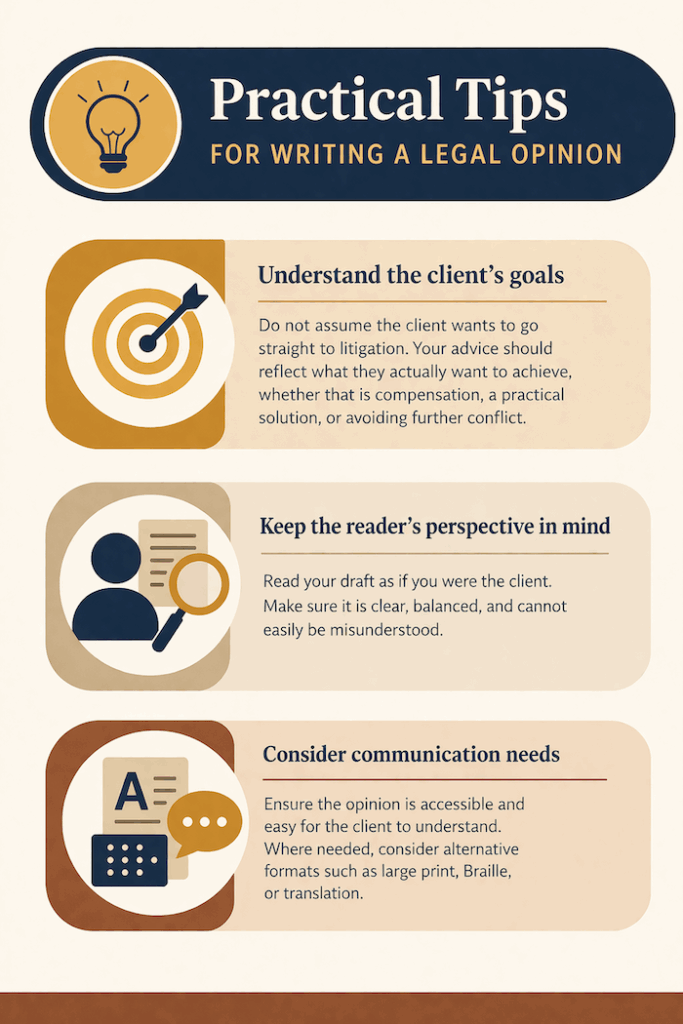
Practical tips to keep in mind
Beyond structure and style, here are some practical tips to ensure your legal opinion is comprehensive and professional:
Understand the client’s goals:
A lot of students jump straight into the litigation scenario, enthusiastically discussing insurance, offers, compensation, costs and so on. In practice, this could be quite a shock to a client who hasn’t thought so far ahead. Sometime clients just want to be heard, and may seek a practical solution, rather than monetary compensation.
You need to understand what the client ultimately wants to achieve (e.g. monetary compensation, enforcement of a right, minimising liability, etc.). The tone and focus of the opinion should reflect those goals.
If the client mainly wants to avoid litigation, your advice might emphasise mediation, practical solutions, settlement options and risk avoidance strategies. On the other hand, if the client is determined to have their “day in court,” you may spend more time discussing litigation strategy and likelihood of success.
Experienced lawyers will also suggest practical solutions rather than just legal ones. For example, if the dispute involved a fallout within a partnership, you could mention buying the other partner out as an option.
Keep the reader’s perspective in mind:
As you write, periodically step back and read your draft as if you were the client or an outsider. Consider how the reader will interpret what you have written. Something that seems clear to you could be misunderstood by someone else.
Ensure that nothing in the document can be misconstrued or taken out of context. If possible, have a friend review the letter – a fresh pair of eyes can spot ambiguities or mistakes you may have missed.
Consider special communication needs:
Make sure you deliver the opinion in a way the client can access and understand. If the client has any known communication issues (for example, if they are visually impaired or if their first language is not English), consider providing the letter in an alternative format.
This might mean using large print or Braille, or arranging a translation. This level of consideration forms part of professional client care, and in training scenarios, students will be expected to identify such measures where the facts call for them.
Wrapping up:
Legal opinion writing is an art that combines legal expertise with clear communication. A well-crafted opinion or advice letter enables clients to understand complex legal issues and make informed choices. By structuring the document in a logical way, writing in a clear and active style, and addressing the client’s specific needs (including outlining risks and offering concrete recommendations), a lawyer builds trust and demonstrates professionalism.
Whether it is a brief email to a solicitor or a lengthy counsel’s opinion on a complex case, the principles remain the same: know your facts and law, focus on the client’s questions, explain your reasoning step by step, and give practical advice. Mastering this skill is essential for successful legal practice, and it ensures that clients receive not just knowledge of the law, but guidance on what to do with that knowledge.
Our UK legally qualified experts can help with opinion writing or any other law assignment. Check out our law assignment help page for more info.
References and further reading:
- Koroma, A. (2012). “Surviving the BPTC – Opinion Writing.” The Student Lawyer, 5 November 2012. Available at: https://thestudentlawyer.com/2012/11/05/surviving-the-bptc-opinion-writing/
- LawTeacher (2013). LPC Legal Drafting – LPC Letter Drafting Practicalities. LawTeacher.net, November 2013. Available at: https://www.lawteacher.net/law-help/lpc/lpc-letter-drafting-practicalities.php
- Pearl Lemon Team (2022). “How To Write A Legal Letter of Advice.” Pearl Lemon Legal Blog, 25 October 2022. Available at: https://pearllemonlegal.com/write-legal-letter/

Cite This Work
To export a reference to this article please select a referencing stye below: