Guide to McGregor’s Theory X and Theory Y
Info: 2826 words (11 pages) Study Guides
Published: 21 Mar 2026
Need some extra assistance understanding McGregor’s theories? We can help! Check out our Management Assignment Help page for more information about our custom writing services.
Douglas McGregor’s Theory X and Theory Y are two contrasting sets of assumptions about human motivation and management. He introduced these theories in the late 1950s, first in a classic Harvard Business Review article and then in his influential book The Human Side of Enterprise (McGregor, 1960).
Theory X and Theory Y describe opposing views of employees: one is pessimistic about workers’ attitudes and the other optimistic. Understanding these theories is essential because they shed light on how managers’ beliefs can shape their leadership style, organisational culture, and ultimately workplace performance.
This guide provides a comprehensive overview of McGregor’s Theory X and Theory Y, explaining their origins, key assumptions, management implications, and ongoing relevance. It is written in formal British English and aims to be useful to both academic and practitioner audiences.
Origins of Theory X and Theory Y
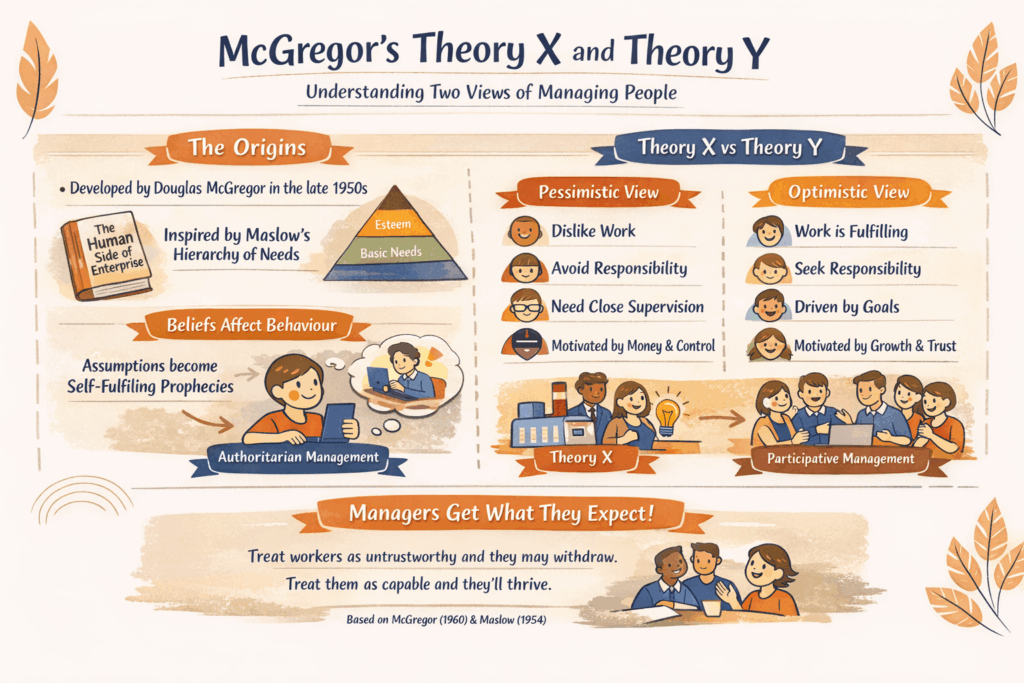
McGregor developed Theory X and Theory Y amid a mid-20th century shift in management thinking from authoritarian models towards more humanistic approaches. He drew on earlier research into human motivation, especially Abraham Maslow’s hierarchy of needs.
McGregor noted that classical management practices treated workers as if they were only motivated by basic needs like pay and security – consistent with Theory X assumptions – whereas emerging approaches recognised higher-level needs for achievement and self-actualisation, aligning with Theory Y (Maslow, 1954; McGregor, 1960).
In The Human Side of Enterprise, McGregor argued that managers’ assumptions about employees become self-fulfilling prophecies. If a manager believes workers are lazy and need coercion (as in Theory X), they will manage accordingly, and employees are likely to respond with minimal effort or compliance.
Conversely, a manager who assumes people want to contribute and take ownership (Theory Y) will delegate responsibility and encourage participation, and employees often rise to those expectations.
McGregor’s aim was to challenge the prevailing Theory X mindset of the time by offering Theory Y as a more enlightened alternative (McGregor, 1960).
Key assumptions of Theory X
Theory X represents the “authoritarian” view of employees. McGregor summarised Theory X with three primary assumptions about human nature in the workplace (McGregor, 1960):
Dislike of work
The average person inherently dislikes work and will avoid it if possible.
Need for control
Because people naturally resist work, most employees must be coerced, controlled, directed, or threatened with punishment to make them put forth adequate effort toward organisational objectives.
Avoidance of responsibility
The average person prefers to be directed, avoids responsibility, has little ambition, and above all seeks security.
Under these assumptions, the role of management is to impose strict supervision and control. A Theory X manager believes that without close oversight and external incentives or penalties, employees would not perform adequately. This mindset leads to a “carrot-and-stick” approach to motivation – offering monetary rewards or applying disciplinary measures as necessary.
Such a style can achieve short-term results and is sometimes necessary (for example, in crisis situations or with untrained workers), but it often breeds resentment, low morale, and a lack of trust between workers and management (McGregor, 1960).
Theory X essentially focuses on lower-order needs: it assumes workers are mainly motivated by money and job security, not by the work itself.
Key assumptions of Theory Y
Theory Y presents a fundamentally “optimistic” or humanistic view of employees. McGregor outlined six key assumptions for Theory Y, reflecting a much more positive view of human motivation (McGregor, 1960):
Work as natural
Expending effort at work is as natural as play or rest. People do not inherently dislike work. Depending on conditions, work can be a source of satisfaction.
Self-direction
If people are committed to goals, they will exercise self-direction and self-control in achieving them. External control and the threat of punishment are not the only means to ensure effort.
Intrinsic rewards
Commitment to objectives is a function of the rewards associated with achievement. Under proper conditions, individuals will seek and enjoy responsibility. The most meaningful rewards – such as the satisfaction of ego and self-actualisation needs – can be achieved through one’s work.
Capacity for responsibility
The average person, when given the chance, not only accepts but seeks responsibility. Avoidance of responsibility is not an inherent trait but often a consequence of experience under restrictive conditions.
Creativity and ingenuity
Imagination, creativity, and ingenuity are widely distributed in the population. Employees’ intellectual potential is only partially utilised in most organisations; people are capable of contributing much more.
Underused potential
In modern industrial life, most workers’ abilities are only partly tapped. Organisations habitually underestimate their people.
These assumptions imply that people want to do a good job and will do so if they find meaning and satisfaction in their work. A Theory Y manager thus perceives their role not as a strict overseer, but rather as a facilitator who aligns organisational goals with employees’ personal goals.
This approach emphasises empowering employees, providing opportunities for growth, and creating conditions for them to exercise initiative. Theory Y aligns with higher-order needs in Maslow’s framework – such as esteem and self-actualisation – suggesting that work can be fulfilling and that employees can be trusted to drive themselves when motivated by meaningful goals (Maslow, 1954; McGregor, 1960).
Implications for management practice
The two theories lead to very different management styles and organisational atmospheres. McGregor (1960) argued that the style a manager adopts will largely flow from their underlying assumptions about people.
Theory X management style
A manager operating with Theory X assumptions tends to use an authoritarian or autocratic leadership style. They set tight controls, detailed procedures, and close supervision to ensure tasks are completed. They centralise decision-making, and communication is mostly top-down.
Such managers rely on external motivation: they believe that employees require incentives like pay rises to work harder, and that threats of disciplinary action are necessary to prevent shirking. This approach can sometimes be efficient for routine tasks or in hierarchical, high-risk environments (for example, military units or certain production lines) where compliance to instructions is critical.
However, a strict Theory X approach often results in low morale and engagement. Employees treated as if they are lazy or untrustworthy may withdraw, become resistant, or only do the bare minimum. In the long run, over-reliance on control can stifle creativity and initiative. It can also create a culture of dependency, where staff wait for orders rather than proactively solving problems.
In summary, Theory X management might achieve order and consistency, but it risks creating an unmotivated workplace climate with little innovation.
Theory Y management style
In contrast, a manager who embraces Theory Y assumptions typically adopts a participative or democratic style. They trust employees to take ownership of their work and thus delegate authority and decision-making where possible.
Such managers encourage two-way communication and feedback, involve team members in setting goals, and support their development.
Motivation under Theory Y is largely intrinsic: managers focus on creating conditions where people find personal satisfaction in meeting organisational objectives. This might include enriching jobs to make them more interesting, offering opportunities for learning and advancement, recognising achievements, and fostering a sense of purpose in work.
The workplace environment in a Theory Y culture is generally more open and collaborative. Managers give employees the autonomy to figure out the best ways to accomplish their tasks, and they encourage employees to contribute ideas.
Many modern organisations known for innovation and high employee engagement – for example, certain technology companies – illustrate Theory Y principles in practice. Managers in these settings act more as coaches or partners than as taskmasters. They assume that if management treats people as responsible and capable, then most will respond with initiative, creativity, and commitment.
This style can yield high motivation, innovation, and loyalty, although it also requires management to invest time in mentoring and to tolerate occasional risks or mistakes as employees learn and grow. Employees tend to feel more valued and empowered, which often translates into better performance and problem-solving.
Overall, Theory Y management cultivates a more dynamic and resilient organisation, one that can adapt and innovate by tapping into its people’s ideas and enthusiasm.
Empirical evidence and impact
Since McGregor’s time, researchers have examined how Theory X and Theory Y assumptions influence workplace outcomes. Many studies support the idea that a Theory Y orientation correlates with better employee attitudes and sometimes improved performance.
For example, early research found that employees working under supervisors perceived as Theory Y-oriented reported higher job satisfaction (Fiman, 1973, as cited in Lawter et al., 2015).
More recent multi-source analyses have shown that managers who personally endorse Theory Y beliefs tend to foster greater employee engagement and organisational citizenship behaviours, whereas a strong Theory X mindset in leaders is often linked to lower morale (Lawter et al., 2015; Arslan & Staub, 2013).
There is also evidence that Theory Y management can indirectly boost performance by creating more supportive work environments. A study in healthcare organisations found that when employees perceive their managers hold Theory Y assumptions, they exhibit more positive attitudes and discretionary effort (Prottas & Nummelin, 2018).
On the other hand, managers with pronounced Theory X beliefs may inadvertently cause higher turnover or absenteeism due to the lack of trust and empowerment inherent in that style (Davison & Smothers, 2015).
It is important to note, however, that empirical research on direct performance effects has yielded mixed results. Not all studies find a straightforward productivity gain from Theory Y – other factors such as the nature of the task, employee personality, and organisational context also play significant roles.
Nevertheless, the consensus in organisational psychology is that engaged and respected employees (as nurtured by Theory Y approaches) are more likely to contribute above and beyond minimal requirements, which in turn benefits organisational effectiveness.
Criticisms and need for balance
McGregor presented Theory Y as a more progressive vision of management, yet he acknowledged it was not a cure-all. Even in the 1960s, he cautioned that Theory Y would not automatically solve every organisational problem (McGregor, 1960).
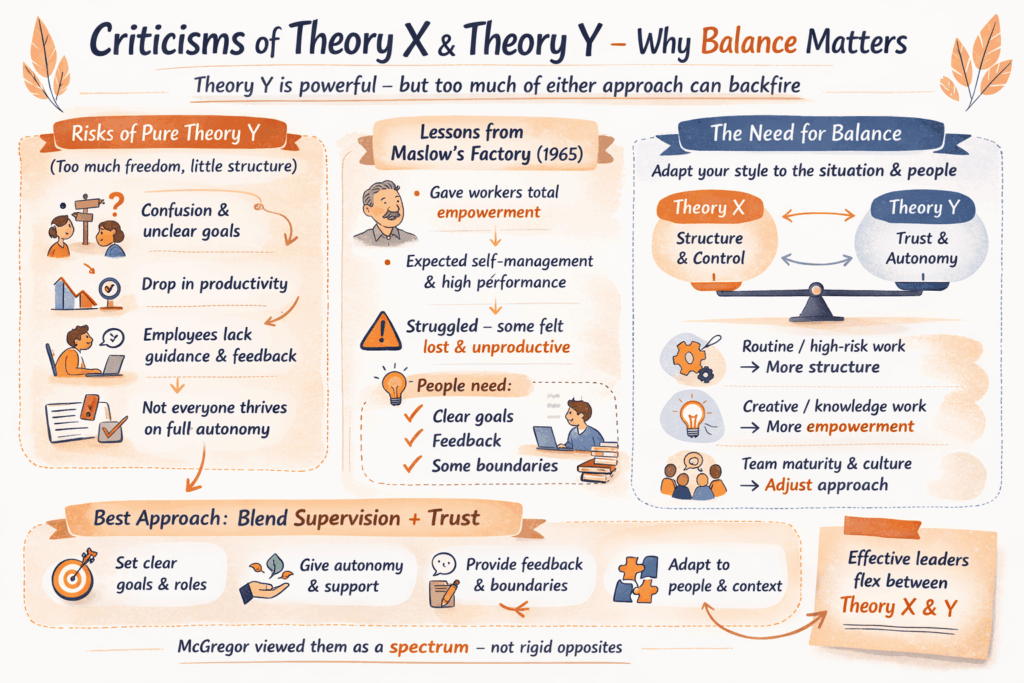
One critique is that Theory Y might be too idealistic if applied without regard to situational realities. Some employees – due to skill gaps or prior conditioning under authoritarian regimes – may not initially thrive under complete freedom or self-direction. In practice, an exclusively Theory Y approach can falter if it lacks sufficient structure.
The psychologist Abraham Maslow, a mentor to McGregor, experienced this first-hand. Maslow (1965) attempted to implement pure Theory Y principles in a California electronics factory, expecting that workers would self-manage and excel when given total empowerment.
However, he found that without any traditional controls or guidance, the organisation struggled: some employees became confused or unproductive when left entirely to their own devices.
Maslow concluded that even independent and mature people require some clear goals, feedback, and boundaries to perform their best (Maslow, 1965).
A bit of Theory X-style structure (such as defined roles or rules) can complement Theory Y freedom. This does not mean reverting to a pessimistic view of workers, but rather providing supportive leadership alongside autonomy.
Another criticism of McGregor’s dichotomy is that it oversimplifies a complex reality. Real workplaces are not one-size-fits-all. What motivates people can vary widely with context and individual differences.
A rigidly Theory Y approach might overlook employees who actually value extrinsic motivators or who need more hands-on guidance. Conversely, a strict Theory X stance might demoralise those who crave involvement and creativity.
A modern take on management theory
Modern management theorists generally advocate a contingency approach – effective leaders adjust their style to the situation. Routine or safety-critical tasks may require a firmer hand at times, whereas creative and knowledge-driven work calls for empowerment.
Indeed, studies suggest there is no single “best” approach: the optimal management style depends on factors like the nature of the work, team maturity, and organisational culture (Lawter et al., 2015; Davison & Smothers, 2015).
McGregor’s Theory X and Theory Y can be seen as two ends of a spectrum. Most successful managers likely operate somewhere between these extremes, blending elements of supervision and trust as appropriate.
Legacy and influence
Despite critiques, McGregor’s Theory X and Theory Y have had a profound and lasting influence on management thought. They helped usher in an era of greater attention to human motivation at work, paving the way for concepts such as employee engagement, participative leadership, and job enrichment.
The notion of empowering employees and meeting higher-level psychological needs is reflected in later developments like participative decision-making models and self-managed teams.
McGregor himself demonstrated the power of Theory Y during his career. He reportedly introduced Theory Y practices in a Procter & Gamble manufacturing plant – including forming self-directed teams – which led to a dramatic increase in productivity and profitability at that facility (Kleiner, 1996).
Such early success stories inspired other organisations to experiment with more democratic management styles. Over time, terms like “Theory X manager” and “Theory Y manager” have entered the lexicon as convenient labels for authoritarian vs. empowering leaders.
Modern application and adoption of the theories
Theory Y’s influence is visible in some of today’s most admired companies. Many high-performing firms consciously foster cultures of trust, innovation, and employee development – principles fundamentally aligned with Theory Y. For example, organisations known for their employee-friendly practices and flat structures often empower staff to make decisions, valuing their initiative and creativity.
These approaches have been linked to outcomes like higher innovation rates, better employee well-being, and lower turnover, reinforcing McGregor’s original argument that treating employees as responsible adults pays off.
Theory X, on the other hand, still has cautionary relevance: it surfaces in workplaces where micromanagement prevails and can serve as a reminder of the potential costs of overly negative assumptions about people.
McGregor’s ideas also stimulated further theoretical work. He had begun formulating a “Theory Z” before his untimely death, aiming to integrate the best of X and Y, but he passed away in 1964 before he could fully develop or publish this work.
Two decades later, in a separate initiative, William Ouchi (1981) introduced his own Theory Z – a concept drawing from Japanese management practices – which emphasised long-term employment, collective decision-making, and high commitment. Ouchi’s Theory Z can be seen as complementary to McGregor’s legacy: it shares the spirit of trusting and investing in employees, while also acknowledging the value of stability and structure.
In broader terms, the continued exploration of how to manage and motivate people effectively – from situational leadership models to modern self-determination theory – owes a debt to the foundational X–Y dichotomy that provoked managers to rethink their assumptions.
Conclusion
Douglas McGregor’s Theory X and Theory Y remain landmark contributions in organisational psychology and management. They distil a critical insight: managers’ beliefs about their people tend to be self-confirming. Theory X and Theory Y challenge leaders to reflect on whether their management practices stem from cynical or humanistic assumptions. Although framed in the language of the 1960s, the underlying message is timeless.
Organisations today still grapple with finding the right balance between control and autonomy, between discipline and trust. McGregor’s work does not provide a simple recipe for success – indeed, blind adoption of either extreme can be problematic – but it offers a framework that has helped countless managers become more mindful of how their approach can unlock or stifle human potential.
In modern workplaces that demand both efficiency and creativity, a Theory Y mindset arguably holds more promise. Yet effective leadership often requires judiciously blending the structured discipline of Theory X with the empowerment advocated by Theory Y. Ultimately, the value of Theory X and Theory Y lies in prompting organisations to question prevailing assumptions and to create management systems that not only meet performance goals but also respect and harness the capabilities of their people.
Need some extra assistance understanding McGregor’s theories? We can help! Check out our Management Assignment Help page for more information about our custom writing services.
For those that find it easier to have someone talk through these theories, the video below is a great explanation.
References
- Arslan, A. & Staub, S. (2013). Theory X and Theory Y type leadership behavior and its impact on organizational performance: Small business owners in the Şishane Lighting and Chandelier District. Procedia – Social and Behavioral Sciences, 75, 102–111.
- Davison, H. K. & Smothers, J. (2015). How Theory X style of management arose from a fundamental attribution error. Journal of Management History, 21(2), 210–231.
- Kleiner, A. (1996). The Age of Heretics: Heroes, Outlaws and the Forerunners of Corporate Change. New York: Doubleday.
- Lawter, L., Kopelman, R. E. & Prottas, D. J. (2015). McGregor’s Theory X/Y and job performance: A multilevel, multi-source analysis. Journal of Managerial Issues, 27(1–4), 84–101.
- Maslow, A. H. (1954). Motivation and Personality. New York: Harper & Row.
- Maslow, A. H. (1965). Eupsychian Management: A Journal. Homewood, IL: Richard D. Irwin.
- McGregor, D. (1960). The Human Side of Enterprise. New York: McGraw-Hill.
- Ouchi, W. G. (1981). Theory Z: How American Business Can Meet the Japanese Challenge. Reading, MA: Addison-Wesley.
- Prottas, D. J. & Nummelin, M. R. (2018). Theory X/Y in the health care setting: E

Cite This Work
To export a reference to this article please select a referencing stye below: