A practical guide to writing an economics research proposal
Info: 3123 words (12 pages) Study Guides
Published: 14 Apr 2026

Whether you are putting together a research proposal or refining your approach, our economics specialists can help you produce clear, well-structured work. See our dissertation proposal service for more information.
Understanding the purpose of a research proposal
A research proposal in economics is a formal plan for a prospective study. It serves to demonstrate why your project is worthwhile. It does so by explaining the context of your topic, outlining your precise objectives, and describing the methods you will use (Scribbr, 2023). In academic settings, proposals show that you grasp the relevant economic literature. They also demonstrate that you have a clear, critical approach to your research problem. Additionally, they allow supervisors or admissions committees to assess your ability to conduct rigorous research. They help evaluators determine whether your research interests fit within the department’s expertise (McClung, 2025; University of Manchester, n.d.). Therefore, it is crucial to treat the proposal as more than a formality. It lays the groundwork for your research and establishes your credibility as an economics scholar.
Think of the proposal as a miniature version of an academic paper that outlines what you intend to do. It stops short of presenting results, since the research is still pending. Typically, an economics research proposal will contain several key sections. First is an introduction that states your research question. Next is a literature review of relevant studies. Then, a methodology section describes your approach (including data sources and analytical techniques). Finally, you outline the expected outcomes or contributions of the work (McClung, 2025). Each component needs to be coherent and convincing. In the following sections, we break down these elements and offer practical advice specific to economics.
Defining clear research aims and objectives
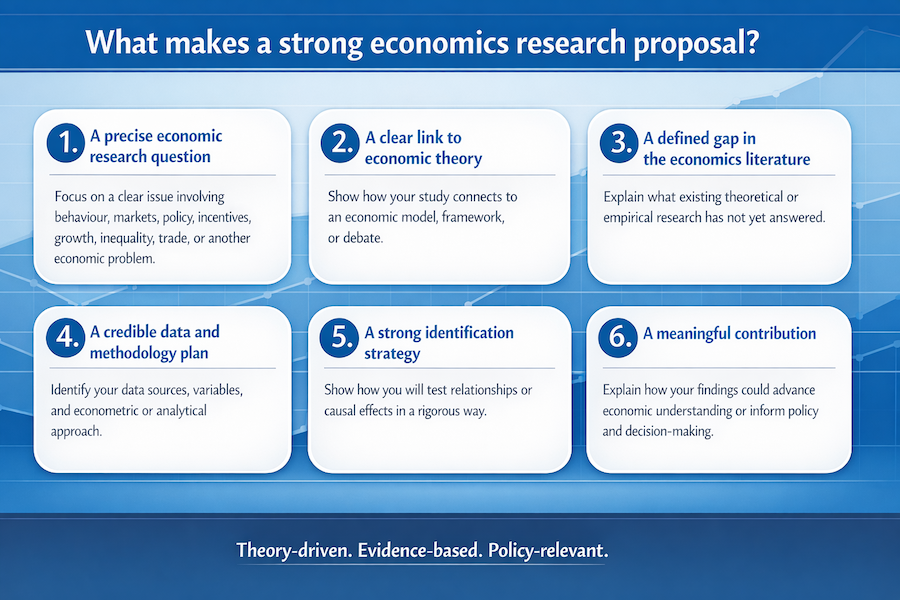
Every strong economics research proposal begins with a well-defined research question. It also requires a set of clear, specific objectives. Identify a focused question that addresses a gap or problem in the economic literature. The research question should be specific enough to be answerable within the scope of your project. Yet it must remain significant enough to contribute new insight. For example, instead of a broad question like “What affects economic growth?”, you might pose a more focused question. You could ask, “How do banking regulations impact small business lending and local economic growth in the UK?” This refined question signals exactly what you will explore.
Turning your research question into aims and objectives
Once the main question is established, articulate the aims and objectives of your study. Your aim is the broad goal of the study – essentially, what you hope to find out (University of Sydney, n.d.). Your objectives break this aim into a series of smaller, manageable steps or sub-questions. For instance, one objective might be to conduct a theoretical analysis of banking regulation effects. Another could be to perform an empirical analysis using UK regional data. Finally, you may plan to compare your results with findings from existing studies. Be logical in how you order these objectives so that each step builds on the previous one (University of Sydney, n.d.). This shows a clear plan of action.
Writing specific and actionable objectives
When formulating objectives, use active language and make them as concrete as possible. Avoid vague phrases like “study aspects of X.” Instead, clearly state what specific relationship or effect you will examine and by what means. For example, one objective might be: “Estimate the causal effect of Policy A on outcome B using a difference-in-differences econometric approach.” Writing such a concrete objective clarifies your intent. It also signals that you understand the tools needed to reach your aim. Moreover, well-defined objectives will guide your methodology and keep your project on track.
Conducting a thorough literature review
A rigorous literature review is the foundation of a compelling economics research proposal. This section demonstrates that you understand the current state of knowledge on your topic. It also shows that you can situate your research within the existing body of economic literature. Start by surveying key academic papers, reputable working papers, and relevant economic reports related to your question. In doing so, you should identify major findings, theoretical frameworks, and methodological approaches that others have employed. It is important to show not only what has been studied, but also where the gaps or unresolved issues lie (McClung, 2025).
Identifying gaps and positioning your study
Contextualise your study by highlighting how your research question grows out of this literature. Discuss the consensus or debates in the field, and then pinpoint the gap your study will address. For instance, you might find that many studies examine how banking regulations affect large banks, but few focus on small local banks. This gap is precisely what your research will fill. By explicitly stating what is missing or what remains to be examined, you establish the need for your project. Remember to keep the discussion focused on economics research. If your question relates to a theory (for example, Keynesian vs. monetarist views) or an empirical trend (such as a particular market anomaly), explain how scholars have approached it so far.
Synthesising and evaluating previous research
Throughout the literature review, synthesise and critique your sources rather than just describing them. Show that you can evaluate the strengths and limitations of previous studies. Perhaps one paper uses an innovative model but only a limited dataset. Meanwhile, another study has comprehensive data but leaves some theoretical questions open. By comparing such studies, you can illustrate how your approach will build upon and improve on past work. Moreover, use proper citations for all statistics, theories, or findings you mention. In economics writing, key papers or theoretical models should be acknowledged. Demonstrating familiarity with notable works and citing them correctly (using Harvard style in this case) adds to your credibility.
Linking the literature review to your own research
The last part of the literature review should transition to your own research idea. After surveying existing work, make it clear what hypothesis or model you propose to test. Also clarify how this will fill the identified gap. In other words, the literature review sets up the justification for the research methodology you will outline next. In fact, writing a thorough review shows the reader how your study connects to what has been done. It also highlights what new insight your work will bring (Scribbr, 2023). Do not underestimate the importance of this section. It convinces evaluators that you have a command of economic scholarship and a solid basis for your project.
Designing a robust methodology
In the methodology section of your proposal, you explain how you plan to answer your research question. This part must be as concrete and specific as possible because it demonstrates the feasibility and rigour of your approach. Begin by restating your central hypothesis or research question in methodological terms. For example, consider a hypothesis: Policy A increases small business lending. You might propose to test this by conducting an empirical analysis using regional banking data. Next, describe in detail the methods and data you will use to carry out this analysis (McClung, 2025). If your study is theoretical, outline the model or framework you will develop. If it is empirical, identify the data sources and econometric techniques you will use.
Specifying data sources and research tools
In empirical economics proposals, it is crucial to specify your data sources. Will you use panel data from the World Bank or a dataset from a national statistical agency? Mention the exact databases or surveys (e.g. Bank of England quarterly lending survey 2010–2020 or World Bank World Development Indicators) and explain why these are appropriate. By listing concrete data sources, you show that the project is practical and grounded in available information. This assures readers that it is not just a hypothetical idea (McClung, 2025). Additionally, outline how you will obtain and handle the data. For instance, specify any data cleaning steps or transformations required. Mention software tools you plan to use for analysis (e.g. Stata, R, or Python).
Explaining your analytical strategy
Next, explain your analytical strategy and tools. In an economics context, this might involve specifying an econometric model or an experimental design. For example, you might state: “The analysis will employ a difference-in-differences regression model comparing regions affected by the policy to control regions over time.” Make sure to be explicit about key methodological choices. This includes defining the variables, specifying the model, and explaining the identification strategy. These elements are especially important if your research design aims to establish causality. If your work is theoretical, describe the model setup (agents, assumptions, equilibrium concept, etc.) and how you will solve or simulate it. Also consider any relevant economic theory that underpins your approach. Mention if you will use established models – for example, an IS-LM framework for macroeconomic analysis or a game-theoretic model for strategic behaviour.
Justifying your methodological choices
It is equally important to address why your chosen methodology is suitable. Briefly note why alternative approaches might be less effective, to show you have thought critically. For example, you might explain that a randomised controlled trial is not feasible for your policy question. Hence, you rely on observational data with a quasi-experimental method. Acknowledge potential limitations such as data constraints, possible biases, or other challenges, and suggest how you will cope with them. This proactive approach indicates methodological maturity and honesty.
Maintaining clarity and ethical awareness
Throughout the methodology section, maintain clarity and objectivity. Write in the active voice and be direct. For instance, say “I will analyse” or “The model will include X” rather than using vague or passive phrasing. Economics writing values precision, so define any technical terms or abbreviations you use. If ethical considerations arise (for example, when using confidential data or conducting surveys), briefly note how you will address them. Ensure that your plan aligns with relevant ethical guidelines (University of Manchester, n.d.). By presenting a detailed and coherent plan, you convince readers that you know how to execute the research. This section should instil confidence that, once given the go-ahead, you can obtain meaningful results using sound economic methods.
Articulating expected contributions and significance
An excellent economics research proposal not only explains how the research will be done. It also clearly communicates why the research matters. Essentially, you are asking: “What will we learn from this research, and why is it valuable?” Make sure to connect this question to your earlier literature review. Explain how your findings would fill the gap you identified or help resolve a debate. For instance, perhaps your results will provide the first empirical evidence on a policy’s impact in a particular context. Alternatively, your theoretical model might extend an existing framework to include new factors. Emphasise the novelty: what new insights will emerge?
Explaining why the research matters
To make the case convincing, relate your expected outcomes to the bigger picture. Why is your research question worth asking? You might note its importance for economic theory (e.g. it tests a prediction of a model in a new setting) or for policy and practice (e.g. it provides evidence to guide regulators on an issue). Make it explicit how the current literature is lacking or inconclusive on this point. Then clarify how your work will address that deficiency (University of Sydney, n.d.). Perhaps the literature review revealed mixed results in previous studies; your more refined methodology or newer data could reconcile those findings. Or maybe all prior studies were in other countries, and your research will show whether those findings hold in the UK context.
Presenting contributions in a realistic way
In discussing contributions, avoid grandiose claims. Be realistic about what your research can achieve, especially since this is a proposal. You have not done the work yet, so avoid over-claiming. It is better to promise a modest, solid contribution, such as “providing evidence on X in the context of Y, which has not been studied before.” By contrast, do not claim you will “solve” a broad issue. However, do assert the significance of your expected findings. For example, explain how your study on banking regulation could help inform better credit policies for small businesses. This makes it clear that your work has relevance beyond academia. In summary, this section should convince readers that your project will advance understanding in economics and provide valuable insights. It might do so by filling a scholarly gap or by influencing economic decision-making.
Practical tips and tools for success
Working on a research proposal can be challenging. However, using the right tools and strategies will make the process more manageable. First, approach the task with good time management. Start early and break down the work into stages. For example, allocate separate time blocks for topic selection, literature review, drafting, and revisions. Consider creating a timeline or Gantt chart for your project, even if it is not required in the proposal. This can help demonstrate that your research plan is feasible within the given timeframe.
Using technology to organise your research
Second, take advantage of technology to organise your research. Bibliographic management software such as Zotero, Mendeley or EndNote is extremely helpful for handling your references. These tools allow you to store citations from journal articles, books, and datasets. They can also automatically format your in-text citations and reference list in Harvard style. This is particularly useful in economics, where your proposal may cite a mix of sources (from technical papers to government reports). Keeping your references organised will save you time and ensure you give proper credit to existing work.
Finding and managing relevant literature
For the literature search itself, use academic databases and search engines specific to economics. Google Scholar and EconLit (the American Economic Association’s literature index) are essential for finding relevant economics papers. Resources like JSTOR or university library databases will give you access to full-text articles. Additionally, the repository RePEc (Research Papers in Economics) is useful for locating working papers or publications by economists. It even categorises research by JEL codes (Journal of Economic Literature classification), which helps you identify papers in your subfield. Use keywords and JEL codes related to your topic to ensure you’re covering the major contributions in your area.
Choosing appropriate tools for your methodology
When it comes to the methodology, consider software tools appropriate for your analysis. Most empirical economic research relies on statistical packages: for instance, Stata or R for econometric analysis, or Python for data processing and more complex modelling. You do not need to include exhaustive code in the proposal. However, you might mention that you will use Stata to perform regression analysis or MATLAB to solve a theoretical model. This signals that you have the technical capability to implement your methods.
Maintaining a clear and formal writing style
Another important tip is to follow a clear and formal writing style. Economics proposals should be written in concise, professional language. Use active voice to make statements direct and vigorous. For example, write “The model predicts X” rather than “It is predicted by the model that X” (Nikolov, 2022). Active voice tends to make your writing clearer and more engaging, which is valued in academic writing and will help the reader follow your plan (Nikolov, 2022). Furthermore, employ transition words like “however”, “therefore”, and “for example” to guide the reader through your arguments smoothly. Good flow is important: each paragraph should logically lead to the next, reflecting the progression of your thought.
Revising and proofreading your proposal
Before finalising your proposal, revise and proofread it carefully. Ensure that each section of the proposal is internally consistent and aligns with the others. For instance, check that the objectives you listed match the methods you propose and the contributions you claim. Check for any jargon or acronyms, and define them if needed. Not every reader may be familiar with highly niche terms. Also verify that your tone remains formal and objective throughout. Avoid colloquial language, and present your plan confidently without sounding speculative. If possible, ask a peer or mentor to review your draft. They might catch unclear explanations or logical gaps that you can then address.
Upholding academic integrity
Lastly, uphold academic integrity in your proposal. Plagiarism is strictly forbidden, so make sure all ideas, data, or quotes from others are properly cited. Use Harvard referencing in-text for any literature or data source you mention. List all such references in a bibliography at the end of your proposal. This not only gives credit but also shows that you have done your homework thoroughly. By combining meticulous research, structured writing, and the effective use of tools, you will produce a proposal that is professional and persuasive. It will be well-tailored to the field of economics.
Conclusion
Writing an economics research proposal is a demanding but rewarding process. It compels you to clarify your thinking and map out a feasible path for answering an economic question. Set clear objectives, ground your study in relevant literature, detail a solid methodology, and explain the value of your expected findings. These steps will create a strong blueprint for your project. Throughout this guide, we highlighted the importance of precision, clarity, and relevance – qualities that are essential in economics. Remember that the proposal is not just an assignment; it is often the first step towards conducting meaningful research. Therefore, take the time to craft each section with care. A well-prepared proposal will impress your assessors or potential supervisors. It will also serve as a useful roadmap as you embark on your research journey.
Whether it’s an economics essay, report, or assignment, our subject specialists can help you deliver work that stands out. See our economics assignment help page for more information.
References
- McClung, S. (2025) ‘How to Write a Research Proposal’. INOMICS, 13 March. Available at: https://inomics.com/advice/how-to-write-a-research-proposal-1548238
- Nikolov, P. (2022) ‘Writing Tips for Economics Research Papers – 2021-2022 Edition’. IZA Discussion Paper No. 15057. Available at: https://docs.iza.org/dp15057.pdf
- Scribbr (2023) ‘How to write a research proposal’. Scribbr Academic Writing Guide. Available at: https://www.scribbr.com/
- University of Manchester (n.d.) ‘Writing your economics research proposal’. School of Social Sciences Guidance. Available at: https://www.socialsciences.manchester.ac.uk/study/postgraduate-research/how-to-apply/writing-your-economics-proposal/
- University of Sydney (n.d.) ‘How to write a research proposal’. University of Sydney – Study Advice. Available at: https://www.sydney.edu.au/study/help/advice/how-to-write-a-research-proposal.html

Cite This Work
To export a reference to this article please select a referencing stye below: