Turning vague supervisor feedback into a clear action plan
Info: 1855 words (7 pages) Blog
Published: 12 Mar 2026
Still can’t decode your supervisor’s feedback and need a helping hand? Our qualified team can assist, so just drop us a line. Read about our essay writing service to learn more.
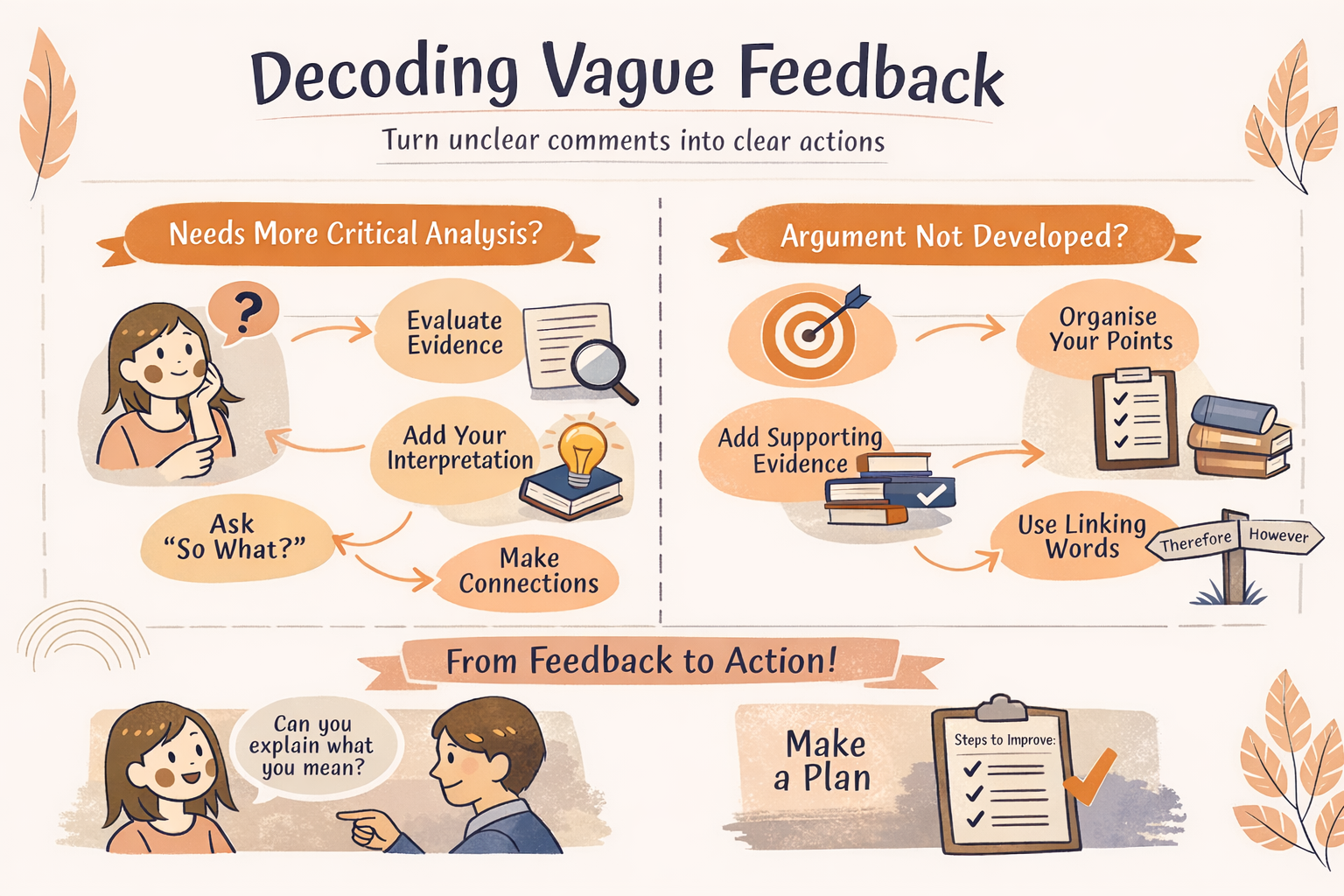
Supervisor feedback aims to help you improve, but it often arrives in cryptic phrases. Many students receive brief comments such as “needs more critical analysis” or “argument not developed”. These phrases provide little guidance on how to fix the issues. Not surprisingly, this leaves students confused about what to do next.
This article tackles that problem directly. We will decode common vague feedback comments and translate them into concrete actions. You need to understand what your supervisor’s feedback really means before you can fix your work. Once you know that, you can respond effectively and make a clear plan for improvement.
In the following sections, we look at two of the most common vague feedback phrases and outline exactly how to address them.
Why supervisor feedback can be vague
It might feel frustrating when a supervisor’s remarks are terse or abstract, but there are reasons behind those short comments. Lecturers and thesis supervisors often expect students to infer the meaning of feedback terms based on academic conventions (Grauman, 2021). In other words, they assume you already know how to “be more critical” or what constitutes a well-developed argument.
However, that is not always the case – especially when you’re still learning academic writing norms. As a result, feedback like “too descriptive” or “lacks critical analysis” can seem puzzling. The truth is that interpreting feedback is a skill in itself (Grauman, 2021). Therefore, if you find comments confusing, remember that you are not alone. It does not mean you are a poor student. It simply means you need to translate those remarks into actionable tasks.
Below, we look at two of the most common vague feedback phrases and outline exactly how to address them.
Feedback says “needs more critical analysis”
One frequent piece of feedback is that an essay or dissertation is “too descriptive” or “needs more critical analysis”. This indicates that while you may have presented relevant information or literature, you have not discussed its significance in depth.
In academic writing, you need to balance descriptive content (explaining what sources say or what happened) with critical analysis – that is, your own evaluation, interpretation, and judgement of that information (University of Leeds, n.d.).
Tutors give this feedback when they want to see your independent thinking. They are looking for you to engage with the material, weigh evidence, and show why it matters for your argument (University of Leeds, n.d.).
In short, if you’re told your work lacks critical analysis, it means you need to comment on the evidence, not just present it.
Action plan: How to add critical analysis to your writing
Identify descriptive sections:
Go through your paper and highlight where you have only described facts or authors’ views, without analysis. These are the places to target.
Ask “So what?” for each point:
For each piece of evidence or factual statement, ask yourself questions like “Why is this important? What does this prove or imply?” (Oladokun, 2023). The goal is to connect the evidence back to your argument or critique its validity.
Add explanation or interpretation:
After a descriptive sentence, add a follow-up sentence that explains its significance or draws a conclusion. For example, if you wrote “Smith (2019) found that 60% of users improved their scores,” don’t stop there. You might add, “This result suggests that the intervention was effective for a majority of users, although it’s important to note the lack of long-term follow-up.” By doing this, you move from mere reporting to analysing the finding.
Evaluate the evidence:
Include comments on the strength and limitations of sources. You could mention if a study’s methodology is strong or flawed, or compare differing viewpoints. This shows that you are engaging critically (University of Leeds, n.d.). For instance, “However, the study relied on self-reported data, which raises reliability concerns.” Such evaluation demonstrates critical thinking.
Synthesize across sources:
If applicable, show how different pieces of information fit together. Do the authors agree or disagree? What patterns or contrasts emerge? Bringing ideas together (instead of treating each source in isolation) is a hallmark of critical analysis.
By systematically applying these steps, you can transform a plain, descriptive passage into an insightful analysis. One expert suggests that when a lecturer says “needs more critical analysis”, they usually mean adding a sentence explaining what your evidence proves for your argument (Oladokun, 2023). In essence, you should answer the question “So what does this mean?” after each point. Adopting this habit will make your writing more analytical and boost the quality of your assignments.
Feedback says “argument not developed”
Another common critique is that the “argument is not developed” or “argument is unclear.” Here, “argument” refers to the central claim or line of reasoning in your essay (UNC Writing Center, n.d.). If a supervisor writes that your argument isn’t well developed, they likely feel that your essay lacks a strong, coherent position. In other words, the main point might not be fully supported throughout the paper.
In practical terms, you might have a decent thesis statement, but the body of your work does not build on it convincingly. Perhaps you listed facts without linking them into a persuasive case. Or maybe you jumped between ideas in a way that obscured your main point.
This feedback is a sign that you need to sharpen the focus and structure of your writing. The “golden thread” – your main argument – should run clearly throughout the paper.
Action plan: How to develop and clarify your argument
Clarify your thesis:
First, ensure you can state your main argument in one clear sentence. Ask yourself: what am I trying to prove or argue overall? If this is not obvious, revise your introduction to explicitly state your position or answer to the question. A concise thesis will anchor the rest of your paper.
Outline your reasoning:
Make a simple outline of your essay’s main points or topic sentences in order. Check if they logically progress and all relate back to the thesis. If you notice gaps or points that stray off-topic, plan to fix those. Every section should contribute to advancing your central argument (UNC Writing Center, n.d.).
Support each claim with evidence:
An under-developed argument often lacks sufficient evidence or explanation. Go through each major claim you make and ensure it’s backed up with relevant data, examples, or citations. After presenting evidence, add an explanation of how it supports your claim – don’t assume the connection is self-evident. This extra step strengthens your argument’s persuasiveness.
Use signposts and transitions:
Guide your reader through your argument. Use transitional phrases (furthermore, however, consequently, etc.) to show how one idea leads to the next. Explicitly referencing back to your thesis at key points can also remind the reader how each point ties into your overall case. For example: “This example illustrates the previous point that social context influences language use, supporting the argument that language cannot be studied in isolation.” Such sentences link the detail back to the bigger argument.
Expand on important points:
If a key part of your argument is mentioned but not explored, take the time to develop it. This could mean adding a paragraph to unpack an idea further or including a counter-argument and rebuttal. For instance, if you assert a theory but don’t discuss why it matters, your argument remains shallow. By elaborating on the “why” and addressing potential objections, you demonstrate a deeper and more developed argument (UNC Writing Center, n.d.).
Revisit your conclusion:
Make sure your conclusion isn’t introducing new ideas or leaving questions. It should concisely show how you have proven your thesis, tying together the strands of your argument. A well-crafted conclusion can highlight the development of your argument by summarising the steps of reasoning you took.
Working through these actions will help turn a vague or weak argument into a compelling one. Essentially, you are building a case for your thesis. You start with a clear claim and then layer it with evidence and analysis. This approach leads the reader to a convincing conclusion.
From feedback to actionable steps: final thoughts
Vague feedback comments don’t have to remain vague. The key is to break them down and extract specific tasks for your next draft.
We’ve seen how a comment like “needs more critical analysis” translates into adding commentary, asking “so what?”, and making your writing more evaluative. Similarly, “argument not developed” translates into clarifying your thesis, structuring your points logically, and providing fuller support for your claims.
In general, always try to interpret what a piece of feedback is asking you to do. If a comment is unclear, it’s acceptable to seek clarification. For example, you can ask your supervisor or a writing tutor to explain what “develop the argument” means in your context (Grauman, 2021).
Finally, remember that acting on feedback is a learned skill and part of becoming an independent scholar (Grauman, 2021). Each time you decode and respond to feedback, you sharpen your ability to critically evaluate your own work.
So, instead of seeing abstract comments as a dead-end, see them as an opportunity. You can turn any vague remark into a clear action plan by systematically applying the strategies outlined above.
Over time – with practice – you will likely anticipate these issues while writing and address them proactively.
For students who need extra help interpreting and applying feedback, support is available. University writing centres, for instance, specialise in explaining feedback and helping you plan revisions. If you’re struggling, don’t hesitate to reach out to such services or academic mentors.
The bottom line
No feedback is truly “unsolvable”. You can continuously refine your work by translating your supervisor’s brief comments into concrete steps. This way, you will reach the standard that both you and your supervisor are aiming for.
If you would like a broader, yet more detailed guide on how to write an essay, look at this guide next.
Still can’t decode your supervisor’s feedback and need a helping hand? Our qualified team can assist, so just drop us a line. Read about our essay writing service to learn more.
Dr Matt Williams of Oxford university explains the wider implications this guide in an easy to digest way.
References
- Grauman, J. (2021) ‘What’s That Supposed to Mean? Using Feedback on Your Writing’, in Writing Spaces: Readings on Writing, Volume 4. Anderson, SC: Parlor Press. pp. 147–162. [Online]. Available at: https://pressbooks.gvsu.edu/writingspaces4/chapter/whats-that-supposed-to-mean-using-feedback-on-your-writing/ (Accessed: 15 December 2025).
- Oladokun, T. (2023) LinkedIn post, “How to write a 2:1 essay: The secret UK lecturers don’t teach you”, 2 October. [Online]. Available at: https://www.linkedin.com/posts/taiwo-oladokun-creative-director_ukuniversity-essaywriting-studentsuccess-activity-7383758534225846272-mvQY (Accessed: 15 December 2025).
- University of Leeds (n.d.) ‘Critical writing’, in Critical thinking (Section 5). [Online]. Available at: https://library.leeds.ac.uk/info/1401/academic-skills/105/critical-thinking/5 (Accessed: 15 December 2025).
- UNC Writing Center (n.d.) Argument. [Online]. Available at: https://writingcenter.unc.edu/tips-and-tools/argument/ (Accessed: 15 December 2025).

Cite This Work
To export a reference to this article please select a referencing stye below: